The library has long been associated with learning & information. Until the 90s this largely meant printed matter – papers, journals & especially books. In linking a KM database to a library the inference is clear: Just a library is a repository of human experience made accessible, so the database contains the experience of that particular organisation made accessible.
One aspect of libraries that is elided in this comparison is the importance of human interfaces. Most libraries have reference desks & front-of-house staff to assist users. These librarians must have a good knowledge of their collection plus the interviewing skills to find out what people want.
The metaphor breaks down when the relationship between users & content is examined. In most libraries, the content is owned by the library and the user borrows it and returns it unaltered. Writers & readers are clearly separate groups. In a KM database, the user may also be a creator. You would hope that users improve & update content to keep it fresh – writing comments in a library book is bad but this ain’t necessarily the case for project methodology. In short the library metaphor stresses a unidirectional flow between content and user.
Sunday, February 19, 2006


KM Databases
If George Lakoff is correct that the primary human tool for understanding the world is the metaphor then knowing the uses and limits of the three metaphors that individuals and organisations use to understand KM databases is important.
I would like to suugest that these are:
- Database as library
- Database as bank
- Database as warehouse
I would like to suugest that these are:
- Database as library
- Database as bank
- Database as warehouse
Thursday, February 02, 2006
Subject Matter Experts (2)
There was one critical area I forgot to discuss in the last post: SME availability.
If your expert is good & their subject is in demand then you can guarantee they will face a million calls on their time - of which yours will be just one. So how do you avoid getting sidelined?
Some suggestions:
Agree with the project sponsor upfront how much SME time you will need & when in the project you will need it. If you are an external provider, get it written into the contract.
Remember that you will need SMEs to check the final outputs as well as for initial information gathering. Do not be stingy in time allocation for this as it will take longer than most expect & will almost certainly be subject to cuts.
The best way to get an SME's attention is to lock them in a room with an instructional designer and their mobile phone turned off. If the SME & the design team a re not co-located then expect to double or triple your allocated development time. If they are not in the same time zone then increase it by 5.
You may have to "sell" the development project to the SME. Take time to understand what motivates them and link this to your training development project. Motivators can include:
1. "I understand that a lot of yout time is taken up with answering simple questions & providing informal training. Invest your time in this project and we can reduce the time you spend on the simple stuff so you can focus on things that are more interesting"
2. "This project will raise your profile within the organisation"
3. "Here's some money" (works with external SMEs)
Know who the SME reports to. If it's your project sponsor - fantastic! If not, you not only have to know what motivates your SME but also what motivates their manager - and have a benefits case for them as well.
Be flexible. If your SME can only spare 3 hours on a Sunday morning then you may have to go with that.
Do not overload your SME with tasks that could be done by someone else - and do not allow them to take on those tasks if they are under pressure. If you can only get an hour of their time then they shouldn't be spending half of that spellchecking.
Often it's all about negotiation (see the reference below for Getting to Yes).
If your expert is good & their subject is in demand then you can guarantee they will face a million calls on their time - of which yours will be just one. So how do you avoid getting sidelined?
Some suggestions:
Agree with the project sponsor upfront how much SME time you will need & when in the project you will need it. If you are an external provider, get it written into the contract.
Remember that you will need SMEs to check the final outputs as well as for initial information gathering. Do not be stingy in time allocation for this as it will take longer than most expect & will almost certainly be subject to cuts.
The best way to get an SME's attention is to lock them in a room with an instructional designer and their mobile phone turned off. If the SME & the design team a re not co-located then expect to double or triple your allocated development time. If they are not in the same time zone then increase it by 5.
You may have to "sell" the development project to the SME. Take time to understand what motivates them and link this to your training development project. Motivators can include:
1. "I understand that a lot of yout time is taken up with answering simple questions & providing informal training. Invest your time in this project and we can reduce the time you spend on the simple stuff so you can focus on things that are more interesting"
2. "This project will raise your profile within the organisation"
3. "Here's some money" (works with external SMEs)
Know who the SME reports to. If it's your project sponsor - fantastic! If not, you not only have to know what motivates your SME but also what motivates their manager - and have a benefits case for them as well.
Be flexible. If your SME can only spare 3 hours on a Sunday morning then you may have to go with that.
Do not overload your SME with tasks that could be done by someone else - and do not allow them to take on those tasks if they are under pressure. If you can only get an hour of their time then they shouldn't be spending half of that spellchecking.
Often it's all about negotiation (see the reference below for Getting to Yes).
Subject Matter Experts (1)
Adam Shapiro from MCQI posted the following question on ElNet about working with subject matter experts for training materials development.
Just addressing the first question, a lot of this depends on the nature of the subject matter.
If it's widely understood, well documented & stable then finding an SME shouldn't be too difficult & neither should getting their work checked.
You will face more challenges if the subject:
- Is a niche area.
- Has a small or non-existent literature.
- Is changing rapidly.
- Has several divergent (& mutually hostile) approaches.
Some comments:
Trust & personal recommendation can play a key role. Is this person respected by their peers & by your colleagues?
Who is the ultimate decision-maker / stakeholder - i.e. who is paying for course development? What are their opinions of the SME or the SME's approach? And what does the SME think of them? Ideally, these two should be aligned.
Most experts have egos. These need handling. Some think their expertise expands beyond their actual domain areas - into things such as instructional design. How much you massage these egos vs. battle with them is a moot point. Establishing your own credentials as an SME in your space is crucial. Getting to Yes & Dealing with People You Can't Stand have some useful things to say here.
Some SMEs are highly articulate. Others seem to spout pure gibberish. Your own interviewing & communication skills will be therefore be crucial.
A final word about scope & audience: Pitching material at the right level of understanding is a fine art. If you are unclear about the needs of your audience then do not expect to get the best out of your SME.
Ideally your expert will be well-respected, modest & a good communicator (and I have been blessed with those). But do not rely on this.
Regarding Piggy-in-the-Middle. The critical thing is to get out of being in the middle. Depending on context you can:
- Lock them in a room until they come up with a single point of view.
- Present both points of view in the final deliverable.
- Get the key stakeholder to make the final call (if it's a major content point).
- Agree an objective criteria for deciding between the two.
Do not let them wage proxy wars through you or slip through changes on the sly. After many painful experiences I have learnt that you can never avoid conflict, only delay it.
Having had some discussion of the role of subject matter experts, I'd be interested in hearing your strategies for ensuring that you get the best value out of your SMEs. I don't mean how do you flog them into a work frenzy, but rather, what are your strategies for ensuring that:
1. You have a good SME who knows their stuff to begin with;
2. You create an environment in which they can contribute to the best of their ability.
Also, what do you do when 2 SME's disagree and you're the piggy in the middle?
Just addressing the first question, a lot of this depends on the nature of the subject matter.
If it's widely understood, well documented & stable then finding an SME shouldn't be too difficult & neither should getting their work checked.
You will face more challenges if the subject:
- Is a niche area.
- Has a small or non-existent literature.
- Is changing rapidly.
- Has several divergent (& mutually hostile) approaches.
Some comments:
Trust & personal recommendation can play a key role. Is this person respected by their peers & by your colleagues?
Who is the ultimate decision-maker / stakeholder - i.e. who is paying for course development? What are their opinions of the SME or the SME's approach? And what does the SME think of them? Ideally, these two should be aligned.
Most experts have egos. These need handling. Some think their expertise expands beyond their actual domain areas - into things such as instructional design. How much you massage these egos vs. battle with them is a moot point. Establishing your own credentials as an SME in your space is crucial. Getting to Yes & Dealing with People You Can't Stand have some useful things to say here.
Some SMEs are highly articulate. Others seem to spout pure gibberish. Your own interviewing & communication skills will be therefore be crucial.
A final word about scope & audience: Pitching material at the right level of understanding is a fine art. If you are unclear about the needs of your audience then do not expect to get the best out of your SME.
Ideally your expert will be well-respected, modest & a good communicator (and I have been blessed with those). But do not rely on this.
Regarding Piggy-in-the-Middle. The critical thing is to get out of being in the middle. Depending on context you can:
- Lock them in a room until they come up with a single point of view.
- Present both points of view in the final deliverable.
- Get the key stakeholder to make the final call (if it's a major content point).
- Agree an objective criteria for deciding between the two.
Do not let them wage proxy wars through you or slip through changes on the sly. After many painful experiences I have learnt that you can never avoid conflict, only delay it.
Wednesday, February 01, 2006
The Maister Plan
Ross has drawn by attention to David Maister's web site. Several of my colleagues hold him in awe as the consultant's consultant so I rushed to check out the site. And it's a delight. DM seems to have taken up blogging & podcasting, he "gets" RSS, there are articles, seminar handouts & videos. The content itself is rock solid - including an article with the title "Marketing is a conversation"...
Tuesday, January 31, 2006
Disappearing email lists
The Yahoo-based ACT-KM list abruptly & mysteriously disappeared about 2 weeks ago along with 2 other KM lists. It has been restarted here. Props to Mark Shenk & Ron Rogers.
Yahoo did not state why the list was terminated.
Until today.
A Yahoo representative contacted the ACT-KM moderator and stated that the group was shut down due to complaint about violated trademarks owned by Hudson Associates. According to an article, their president likes to dress up as Attila the Hun - a role which may have gone to his head.
I would like to know the full list of terms trademarked by Hudson Associates. I pray that it includes "Knowledge Management" - that way we can finally ditch the term & do something more interesting.
Dan Kirsch has yet to provide an answer but I suspect that ACT-KM was caught in a cross-fire between rival US KM professional organisations. Which is akin to being savaged by consumptive sheep.
Yahoo did not state why the list was terminated.
Until today.
A Yahoo representative contacted the ACT-KM moderator and stated that the group was shut down due to complaint about violated trademarks owned by Hudson Associates. According to an article, their president likes to dress up as Attila the Hun - a role which may have gone to his head.
I would like to know the full list of terms trademarked by Hudson Associates. I pray that it includes "Knowledge Management" - that way we can finally ditch the term & do something more interesting.
Dan Kirsch has yet to provide an answer but I suspect that ACT-KM was caught in a cross-fire between rival US KM professional organisations. Which is akin to being savaged by consumptive sheep.
Monday, January 30, 2006
NSW KM Forum: Communities & Serendipity
Good CoP, Bad CoP: Are Communities of Practice a Structural Panacea or Essential Component of the KM Toolkit? Mark Andrews, National Knowledge Manager - Corporate, Freehills
Conversations on Serendipity: Management nightmare or hidden power shaping organisational agility? David Rymer, Thinker-In-Residence, Intuosity
WHAT: The last five years has seen a concerted shift from a technology to people focus in KM, with organisations setting up Communities of Practice (CoPs). However, little consideration is given to the role of alternatives.What can be done with more formal structures? How we can effectively tune an organisation to increase knowledge sharing? Mark Andrews will draw on experience from Capgemini, Sydney Water and Freehills to offer some answers to these questions.
WHO: Mark's KM experience spans Ernst & Young, Capgemini, Sydney Water and Freehills. He also lectures in Knowledge Management as part of the UTS MBA program. His background includes management consulting, HR management and IT project management.
WHAT: Agile organisations centre their knowledge on value creation. Agility (responsiveness, flexibility, and innovation) determines how successfully organisations meet their customers’ needs. David Rymer will draw on real world experience including The Israeli Air Force, venture capital start-ups and The Coca-Cola Company to examine how surfing serendipity shapes knowledge futures, sparks organisational change, fosters innovation and delivers economic outcomes.
WHO: David has enjoyed an eclectic career spanning marketing, technology, innovation, KM and organisational change in Australasia, Asia and the United States. David is the inaugural Thinker-In-Residence with Intuosity, a private Think Tank tasked with exploring the world of ideas, inspiration, intuition, curiosity and innovation. David is also Deputy Chairman of the Standards Australia’s Knowledge Management committee.
WHEN: 3.30 for 4pm until 5.30 pm Wednesday 8th February
WHERE: Standards Australia, 286 Sussex Street, Sydney NSW 2000.
HOW MUCH: Free! If you plan to attend, please RSVP by e-mail to
nswkmforum@gmail.com
Conversations on Serendipity: Management nightmare or hidden power shaping organisational agility? David Rymer, Thinker-In-Residence, Intuosity
WHAT: The last five years has seen a concerted shift from a technology to people focus in KM, with organisations setting up Communities of Practice (CoPs). However, little consideration is given to the role of alternatives.What can be done with more formal structures? How we can effectively tune an organisation to increase knowledge sharing? Mark Andrews will draw on experience from Capgemini, Sydney Water and Freehills to offer some answers to these questions.
WHO: Mark's KM experience spans Ernst & Young, Capgemini, Sydney Water and Freehills. He also lectures in Knowledge Management as part of the UTS MBA program. His background includes management consulting, HR management and IT project management.
WHAT: Agile organisations centre their knowledge on value creation. Agility (responsiveness, flexibility, and innovation) determines how successfully organisations meet their customers’ needs. David Rymer will draw on real world experience including The Israeli Air Force, venture capital start-ups and The Coca-Cola Company to examine how surfing serendipity shapes knowledge futures, sparks organisational change, fosters innovation and delivers economic outcomes.
WHO: David has enjoyed an eclectic career spanning marketing, technology, innovation, KM and organisational change in Australasia, Asia and the United States. David is the inaugural Thinker-In-Residence with Intuosity, a private Think Tank tasked with exploring the world of ideas, inspiration, intuition, curiosity and innovation. David is also Deputy Chairman of the Standards Australia’s Knowledge Management committee.
WHEN: 3.30 for 4pm until 5.30 pm Wednesday 8th February
WHERE: Standards Australia, 286 Sussex Street, Sydney NSW 2000.
HOW MUCH: Free! If you plan to attend, please RSVP by e-mail to
nswkmforum@gmail.com
Innovation - Think Play Do
Read or hear the recent ABC programme by Mark Dodgson on innovation.
Takeaways:
- Innovation as outcome vs process.
- Importance of play within innovation process (and a reference to Michael Schrage).
- A reference to one of the world's least boring economists.
Takeaways:
- Innovation as outcome vs process.
- Importance of play within innovation process (and a reference to Michael Schrage).
- A reference to one of the world's least boring economists.
More Evil
More breaking news of the fight of Good vs. Evil. Danny O'Brien of NTK tells us the epic (and funny) battle going on in the open source software environment.
See No Evil.
Hear No Evil.
Speak No Evil.
Cheers to Boing Boing.
See No Evil.
Hear No Evil.
Speak No Evil.
Cheers to Boing Boing.
Tuesday, January 17, 2006
Prediction Markets
The KM cluster is running an event in NYC on Prediction Markets hot on the heels of a West coast event.
John "KM Cluster" Maloney has recommended Chris Masse's site as a source on Prediction Markets.
I am not aware of much work in prediction markets in Australia - Andrew Leigh has co-written a paper on betting vs. polls and the 2004 Australian election.
Anyone got any ideas?
John "KM Cluster" Maloney has recommended Chris Masse's site as a source on Prediction Markets.
I am not aware of much work in prediction markets in Australia - Andrew Leigh has co-written a paper on betting vs. polls and the 2004 Australian election.
Anyone got any ideas?
Melbourne Lunch redux
Monday's Web 2.0 / any old excuse lunch is blogged about here by Andrew Mitchell.
I got to meet Andrew Rixon which led to an enticing but abortive conversation on representing social networks. Andrew namechecked Space Syntax. The standard node/edge visualisation of an SNA breaks down when you have to handle 100+ nodes. Andrew suggested a "streetmap" visualisation for social networks.
I think he's onto something.
I got to meet Andrew Rixon which led to an enticing but abortive conversation on representing social networks. Andrew namechecked Space Syntax. The standard node/edge visualisation of an SNA breaks down when you have to handle 100+ nodes. Andrew suggested a "streetmap" visualisation for social networks.
I think he's onto something.
Thursday, January 05, 2006
Talking about Pictures Part 2
And that other place entirely is: process
There has been some recent blogospheric discussion driven by Ross Mayfield's declaration of the end of process. In fact, what Ross advocates is:
They are the rules in stone that innovative types must always battle against.
Brushing aside whether the constant recreation of process is always a good idea ("Hey, screw the manual, we're going Open Source on the operation of this nuclear power plant - who wants to start a wiki?"), this position assumes that the processes in question are clearly documented and well understood by those involved in them.
This is not always the case. Rarely are we mindful of the processes we forge or follow.
We need to be able to describe it and/or visualise. If this sounds like I'm getting Buddhist on your ass - well I am.
Now, there is veritable tower of Babel of process description languages - ADF, UML, EPCs, CUL8R (I may have made that last one up). An attempt to forge an Esperanto (altho one that people actual use) of process mapping can be found in the Business Process Modeling Notation project.
What has this got to do with character? Well, process models are all about decisions. Here is one for Sydney cab drivers: "If the traffic light is green keep going. If the traffic light is yellow, then accelerate wildly in attempt to beat it. If the traffic light is red then hit the brakes and swear loudly".
Or as Robert McKee calls them: choices.
(To BE CONTINUED)
There has been some recent blogospheric discussion driven by Ross Mayfield's declaration of the end of process. In fact, what Ross advocates is:
At best, a process should serve as a reference model. Something that others can reference when completing a task. Something that can be leveraged for innovation, a boundary condition for experimentation at the margin.
They are the rules in stone that innovative types must always battle against.
Brushing aside whether the constant recreation of process is always a good idea ("Hey, screw the manual, we're going Open Source on the operation of this nuclear power plant - who wants to start a wiki?"), this position assumes that the processes in question are clearly documented and well understood by those involved in them.
This is not always the case. Rarely are we mindful of the processes we forge or follow.
We need to be able to describe it and/or visualise. If this sounds like I'm getting Buddhist on your ass - well I am.
Now, there is veritable tower of Babel of process description languages - ADF, UML, EPCs, CUL8R (I may have made that last one up). An attempt to forge an Esperanto (altho one that people actual use) of process mapping can be found in the Business Process Modeling Notation project.
What has this got to do with character? Well, process models are all about decisions. Here is one for Sydney cab drivers: "If the traffic light is green keep going. If the traffic light is yellow, then accelerate wildly in attempt to beat it. If the traffic light is red then hit the brakes and swear loudly".
Or as Robert McKee calls them: choices.
(To BE CONTINUED)
Social Software & Web 2.0 Lunch in Melbourne - Monday Jan 16th
Following on from the Sydney Social Software lunch & gossip session, there will be a rematch in Melbourne on Monday 16th. Location as yet undecided. If you are interested then post a comment to register interest and more details will appear anon.
***UPDATE. Location will probably be Regina Pizzeria in the QV precinct.
***UPDATE. Location will probably be Regina Pizzeria in the QV precinct.
Communities, SNA & Personality Types
There has been a recent discussion on the Communities of Practice discussion list about personality typing and activities within communities.
Are specific personality types likely to perform specific roles within a community?
There has been some conjecture from proponents of DISC and Myers-Briggs as to which personality types might gravitate to which specific roles.
Another framework to use are Belbin's team roles. Rather than say: "Your presonality is structured in this way" (which Myers-Briggs definitely does and DISC does to a lesser extent), Belbin says: "These are the roles you find in a team - which ones are you most comfortable with?"
If you have a stable model for the roles in a community, then presumably you could create a set of questions that might identify the suitability of individuals for each of those roles.
As several people have pointed out, such personality profiling systems do not take account of the development of individuals - i.e. they tend to be static rather than dynamic.
In the course of this conversation, Valdis Krebs alluded to an informal study by an academic acquaintance that looked at correlations between Myers-Briggs types for students and SNA metrics (e.g. centrality) for their positions in their study-related networks. Interestingly, no correlation was found...
Are specific personality types likely to perform specific roles within a community?
There has been some conjecture from proponents of DISC and Myers-Briggs as to which personality types might gravitate to which specific roles.
Another framework to use are Belbin's team roles. Rather than say: "Your presonality is structured in this way" (which Myers-Briggs definitely does and DISC does to a lesser extent), Belbin says: "These are the roles you find in a team - which ones are you most comfortable with?"
If you have a stable model for the roles in a community, then presumably you could create a set of questions that might identify the suitability of individuals for each of those roles.
As several people have pointed out, such personality profiling systems do not take account of the development of individuals - i.e. they tend to be static rather than dynamic.
In the course of this conversation, Valdis Krebs alluded to an informal study by an academic acquaintance that looked at correlations between Myers-Briggs types for students and SNA metrics (e.g. centrality) for their positions in their study-related networks. Interestingly, no correlation was found...
Comments
Thanks to a prod from Andrew Mitchell, I have changed the settings on my "Comments" function so now posters do not have to register to post a comment - but I get to moderate them first. I want opinions & insights - not offers for low-cost extensions to various parts of my anatomy.
Tuesday, January 03, 2006
An Ear For The Crowd
Many people I know are scared of public speaking. So they go to Toastmasters or on presentation skills courses.
There are plenty of role-models in the public speaking arena: politicians, preachers & poseurs.
Fewer people are worried about their listening skills. Which is odd - because most of us will do more listening in the course of a day than public speaking. And most of us are pretty bad at it.
So who are our great public listeners? As listening tends to be a private & personal activity, there aren't that many.
There are plenty of entertainers masquerading as interviewers.
However, there are a few that do it well. Denton has his moments. As, in a very different way, does Parkie.
There situation is unnatural in that they are not just listeners but intermediaries on behalf of an audience (some of whom are present in the studio and most of whom aren't). But there are some things that carry over.
One critical issue is attention. With a good listener, you know that this person is listening to what you say. Now some recommend that 100% attention is critical. However, it is possible to "over-attend" to someone. Some people do not actually like eye contact. I am odd in that I find it very difficult to share potentially embarrassing information over the phone (altho it's less difficult in person) - I prefer using instant messaging if possible.
Another is silence. Silence can be scary in conversations. But it can be a good thing. It's s sign to the speaker that the listener is paying attention - and is happy to wait for them to find the words they need to say. I think we need to have silence practice more regularly.
Which reminds me of a Steve Wright joke.
There are plenty of role-models in the public speaking arena: politicians, preachers & poseurs.
Fewer people are worried about their listening skills. Which is odd - because most of us will do more listening in the course of a day than public speaking. And most of us are pretty bad at it.
So who are our great public listeners? As listening tends to be a private & personal activity, there aren't that many.
There are plenty of entertainers masquerading as interviewers.
However, there are a few that do it well. Denton has his moments. As, in a very different way, does Parkie.
There situation is unnatural in that they are not just listeners but intermediaries on behalf of an audience (some of whom are present in the studio and most of whom aren't). But there are some things that carry over.
One critical issue is attention. With a good listener, you know that this person is listening to what you say. Now some recommend that 100% attention is critical. However, it is possible to "over-attend" to someone. Some people do not actually like eye contact. I am odd in that I find it very difficult to share potentially embarrassing information over the phone (altho it's less difficult in person) - I prefer using instant messaging if possible.
Another is silence. Silence can be scary in conversations. But it can be a good thing. It's s sign to the speaker that the listener is paying attention - and is happy to wait for them to find the words they need to say. I think we need to have silence practice more regularly.
Which reminds me of a Steve Wright joke.
Sunday, January 01, 2006
Talking about Pictures Part 1
It's a truism among writers that character & characterisation are two different things.
Over to Robert McKee for a moment:
We'll come back to Robert later but first we need to go to another place entirely... (TO BE CONTINUED)
Over to Robert McKee for a moment:
CHARACTERIZATION is the sum of all observable qualities of a human being, everything knowable through careful scrutiny: age and IQ; sex and sexuality; style of speech and gesture; choices of home, car, and dress; education and occupation; personality and nervosity; values and attitudes – all aspects of humanity we could know by taking notes on someone day in and day out. The totality of these traits makes each person unique because each of us is a one-of-a-kind combination of genetic givens and accumulated experience. This singular assemblage of traits is CHARACTERIZATION. . . but it is not CHARACTER.
True CHARACTER is revealed in the choices a human being makes under pressure - the greater the pressure, the deeper the revelation, the truer the choice to the character's essential nature.

We'll come back to Robert later but first we need to go to another place entirely... (TO BE CONTINUED)
Thursday, December 29, 2005
Systems, Evil & Saving the World
One Monday morning 5 years ago, something struck me in the shower. I was working for one of the big 4 accounting/prof services firms at the time as a KM grunt. I was going thru one of my natural cycles of work-related anomie and couldn't see the point of anything.
What hit me as I was washing off the soap was very simple.
My job was saving the world.
Please note, this did not involve wearing my underpants outside my tight blue lycra trousers (altho that may have made performance appraisals a darn sight more fun).
Instead, the explanation went something like this. Expertise in the world is getting ever more specialised. Back in the eighteenth century one person could realistically expect to know the sum total of one scientific discipline. However, the problems that humanity faces (and various sub-groups thereof - nations, corporations, communities) are increasingly complex & multi-faceted. Environmental, political & economic challenges. Someone was needed to pull link together these diverse groups of experts to meet these challenges. And one of those someones, in a way, was me. Note the qualification: I personally wasn't preventing the destruction of the ozone layer. But I could quiet myself with the thought that I was aiding and abetting intellectual fecundity.
I shared this thought with some of my colleagues. Only some thought I was a lunatic.
Fwd>> So Dave Pollard's blog How To Save The World made me smile. Dave P was something high-up in KM at Ernst & Young. Dave's online musings (altho "musings" doesn't quite capture the intellectual & moral inquisition that the writing sometimes undertakes) have coalesced some thoughts of my own around the nature of evils.
We normally think of Evil as something big and dark - and capitalised. But try shifting perspective to page 24. Think not of The Big Bad. But "little bads" all over the place. Local maxima & minima that sub-optimise their parts of the system. Glitches. Action only makes sense in context. And the ultimate context for all actions is... everything. A system of systems.
We all engage in little evils constantly. My actions make life harder & more unpleasant for others but life easier for me. Evil shifts from something concentrated to something dispersed - like an aerosol. Shifts from something outside to something inside & across. Shifts from "it" to "them" to "us". And back.
Back to the start. If becoming evil is a failure to act in the best interests of the system defined in its broadest terms then fighting evil requires that you see the system as it really is. From as many multiple perspectives as you can. Ensuring that as many people in the system have that opportunity as well.
So there you go. Knowledge Management. Saving the world. Fighting evil. Toodle pip.
What hit me as I was washing off the soap was very simple.
My job was saving the world.
Please note, this did not involve wearing my underpants outside my tight blue lycra trousers (altho that may have made performance appraisals a darn sight more fun).
Instead, the explanation went something like this. Expertise in the world is getting ever more specialised. Back in the eighteenth century one person could realistically expect to know the sum total of one scientific discipline. However, the problems that humanity faces (and various sub-groups thereof - nations, corporations, communities) are increasingly complex & multi-faceted. Environmental, political & economic challenges. Someone was needed to pull link together these diverse groups of experts to meet these challenges. And one of those someones, in a way, was me. Note the qualification: I personally wasn't preventing the destruction of the ozone layer. But I could quiet myself with the thought that I was aiding and abetting intellectual fecundity.
I shared this thought with some of my colleagues. Only some thought I was a lunatic.
Fwd>> So Dave Pollard's blog How To Save The World made me smile. Dave P was something high-up in KM at Ernst & Young. Dave's online musings (altho "musings" doesn't quite capture the intellectual & moral inquisition that the writing sometimes undertakes) have coalesced some thoughts of my own around the nature of evils.
We normally think of Evil as something big and dark - and capitalised. But try shifting perspective to page 24. Think not of The Big Bad. But "little bads" all over the place. Local maxima & minima that sub-optimise their parts of the system. Glitches. Action only makes sense in context. And the ultimate context for all actions is... everything. A system of systems.
We all engage in little evils constantly. My actions make life harder & more unpleasant for others but life easier for me. Evil shifts from something concentrated to something dispersed - like an aerosol. Shifts from something outside to something inside & across. Shifts from "it" to "them" to "us". And back.
Back to the start. If becoming evil is a failure to act in the best interests of the system defined in its broadest terms then fighting evil requires that you see the system as it really is. From as many multiple perspectives as you can. Ensuring that as many people in the system have that opportunity as well.
So there you go. Knowledge Management. Saving the world. Fighting evil. Toodle pip.
Asymmetric Threats: The Bigger They Come...
According to Dave Snowden, a terrorist is the same as a consumer is the same as a citizen is the same as an employee. Now Dave hangs out a lot with the CIA but the basic point runs like this:
In the past, armies fought opponents like themselves - i.e. other armies. However for the likes of the US is no longer the case. The threats to the US state are more likely to be Al Qaeda or Iraqi insurgents than, say, the Soviet Union. You cannot fight such opponents in conventional ways. They can see you but you cannot see them.
These are dubbed "Asymmetric Threats" in military parlance.
Now large corporations find themselves in a similar bind. They have difficulty seeing their customers - because they hide behind systems ironically labelled "customer relationship management" - see the recent news on IVR hacks. However due to a focus on brand marketing, most customers have little difficulty seeing them.
Likewise execs do not always know what their employees think - despite numerous employee satisfaction surveys. And governments face a similar asymmetry with citiziens.
Googling "Asymmetric Threats" does not yield much in terms of non-military results - except for Global Profile set up by ex-journalist Giles Trendle. The site has some interesting articles - esp. around the "Guerilla Matrix".
In the past, armies fought opponents like themselves - i.e. other armies. However for the likes of the US is no longer the case. The threats to the US state are more likely to be Al Qaeda or Iraqi insurgents than, say, the Soviet Union. You cannot fight such opponents in conventional ways. They can see you but you cannot see them.
These are dubbed "Asymmetric Threats" in military parlance.
Now large corporations find themselves in a similar bind. They have difficulty seeing their customers - because they hide behind systems ironically labelled "customer relationship management" - see the recent news on IVR hacks. However due to a focus on brand marketing, most customers have little difficulty seeing them.
Likewise execs do not always know what their employees think - despite numerous employee satisfaction surveys. And governments face a similar asymmetry with citiziens.
Googling "Asymmetric Threats" does not yield much in terms of non-military results - except for Global Profile set up by ex-journalist Giles Trendle. The site has some interesting articles - esp. around the "Guerilla Matrix".
Wednesday, December 28, 2005
A Picture of Communities

The difference between communities and other organisational forms is often stressed. What I am trying to do with this little picture is demonstrate the potential links & overlaps with other organisational forms.
Thursday, December 22, 2005
When Analysts Attack
In the IT analyst game, there are really only two contenders: Gartner & Forrester. IDC produces a lot of numerical market data for IT vendors but if you are a CIO, it's probably either Gartner or Forrester you use. Both recently bought competitors (Gartner swallowed Meta and Forrester chomped on Giga) and both suffered during the post-dotcom blow-out IT slowdown.
Historically, Gartner had the broader coverage but Forrester portrayed itself as funkier & more webby.
Which makes their relative approaches to web tools interesting.
Which of the two is freely using blogging & podcasting?
Well, Gartner offers regular podcasts & has several blogs.
Both are RSS-enabled & the blogs have a comments functionality (altho on the "Predicts" blog, most of the comments seem to be from Gartner staff).
Forrester on the other hand has no blogs and does not seem to offer RSS updates. However it does offer sound & video from a recent forum event.
And don't even mention IDC...
Historically, Gartner had the broader coverage but Forrester portrayed itself as funkier & more webby.
Which makes their relative approaches to web tools interesting.
Which of the two is freely using blogging & podcasting?
Well, Gartner offers regular podcasts & has several blogs.
Both are RSS-enabled & the blogs have a comments functionality (altho on the "Predicts" blog, most of the comments seem to be from Gartner staff).
Forrester on the other hand has no blogs and does not seem to offer RSS updates. However it does offer sound & video from a recent forum event.
And don't even mention IDC...
Tuesday, December 20, 2005
Sounds - The Economist
The Economist's World in 2006 has a podcast section.
More RP/BBC accents. More intelligent analysis - done in an interview format this time (5 - 12 mins long). A couple of heavy hitters such as Amartya Sen & Paul Wolfowitz wade in but mostly Economist editorial staff.
Historically Economist staff have been a shy bunch - articles do not normally appear under bylines - and now we can not only see pictures but hear their voices as well.
Lots of stuff on oil, US, India &... video games.
More RP/BBC accents. More intelligent analysis - done in an interview format this time (5 - 12 mins long). A couple of heavy hitters such as Amartya Sen & Paul Wolfowitz wade in but mostly Economist editorial staff.
Historically Economist staff have been a shy bunch - articles do not normally appear under bylines - and now we can not only see pictures but hear their voices as well.
Lots of stuff on oil, US, India &... video games.
Sounds - FT
Currently suffering from a soundfile/podcast/mp3 fixation.
Financial Times columnist Lucy Kellaway has some "spoken word" versions of her columns on the FT site.
LK's columns are frightfully English & commonsensical - and perfectly matched by her RP/BBC pronounciation. Each verbal column last 5 mins - fantastic! Esp. enjoyed categorization of jargon into A, B & C categories.
All the FT needs to do is set her up with an RSS feed...
Financial Times columnist Lucy Kellaway has some "spoken word" versions of her columns on the FT site.
LK's columns are frightfully English & commonsensical - and perfectly matched by her RP/BBC pronounciation. Each verbal column last 5 mins - fantastic! Esp. enjoyed categorization of jargon into A, B & C categories.
All the FT needs to do is set her up with an RSS feed...
Comment from Andrew
"At Trevor Cook's recent masterclass there were a few women doing / thinking about some interesting uses of social media. From the legal profession, publishing and contruction. I invited one of the women along but she could not make it. Maybe next time."
Tuesday, December 13, 2005
Social Software Lunch
So we had this lunch yesterday. Quick roll call:
Ben Cooper
James Dellow
Trevor Cook
Andrew Mitchell
Ross Dawson
Also Brad Kasell & Robert Perey.
Frank Arrigo had a last minute emergency & couldn't make it.
So thoughts: some headshaking about the state of blogging/podcasting/etc in Australia. Some comments on jargon.
The big question: Lots of people are talking about this but who is actually doing it!!!
And where are the women?
Ben Cooper
James Dellow
Trevor Cook
Andrew Mitchell
Ross Dawson
Also Brad Kasell & Robert Perey.
Frank Arrigo had a last minute emergency & couldn't make it.
So thoughts: some headshaking about the state of blogging/podcasting/etc in Australia. Some comments on jargon.
The big question: Lots of people are talking about this but who is actually doing it!!!
And where are the women?
Thursday, December 08, 2005
Thinking & Stuff
Recently I spent some time in the company of David Rymer & Kim Sbarcea. Kim has some interesting articles on her site. And hopefully David will shortly...
Informal lunch on Social Media inside the Enterprise
Next Tuesday (13th December 2005) some people will be getting together for an informal lunch to discuss the topic of Social Media inside the Enterprise.
Venue for next Tuesday's meet up is the GPO Food Court @ 1 Martin Place - apparently the wood-fired pizza joint is especially good.
Trevor Cook & Andrew Mitchell will be there.
Frank Arrigo will be in the house.
And the recently elusive James Dellow may make an appearance.
Venue for next Tuesday's meet up is the GPO Food Court @ 1 Martin Place - apparently the wood-fired pizza joint is especially good.
Trevor Cook & Andrew Mitchell will be there.
Frank Arrigo will be in the house.
And the recently elusive James Dellow may make an appearance.
Tuesday, December 06, 2005
Dave Snowden tomorrow
Complexity & Sensemaking Breakfast - Dave Snowden, Director, Cynefin Centre
WHAT: Organisational narrative is more than just the art of professional storytelling. And traditional analytical techniques can be limited in this area. Dave Snowden will be discussing his experiences of narrative, sensemaking and complexity in organisations. He will be providing an overview of the activites of the Cynefin Centre in narrative capture & databases; social network analysis & stimulation; and the ABIDE framework.
WHO: Dave Snowden is Director of the Cynefin Centre for Organisational Complexity which focuses on the development of the theory and practice of social complexity. The A native of Wales, he was formerly a Director in the IBM Institute for Knowledge Management where he led programs on complexity and narrative. He pioneered the use of narrative as a means of knowledge disclosure and cross-cultural understanding. He is adjunct Professor of Knowledge Management at the University of Canberra, an honorary fellow in knowledge management at the University of Warwick, Adjunct Professor at the Hong Kong Polytechnic University and MiNE Fellow at Universita Cattolica Del Sacro Cuore in Italy.
WHERE: IBM Tower, Level 12, Darling Park, 201 Sussex Street. Call Matt Moore on 0423 784 504 if you have difficulties locating the venue.
WHEN: 8am start Thursday 8th December
HOW MUCH: Free! If you plan to attend, please RSVP by e-mail to:nswkmforum@gmail.com
WHAT: Organisational narrative is more than just the art of professional storytelling. And traditional analytical techniques can be limited in this area. Dave Snowden will be discussing his experiences of narrative, sensemaking and complexity in organisations. He will be providing an overview of the activites of the Cynefin Centre in narrative capture & databases; social network analysis & stimulation; and the ABIDE framework.
WHO: Dave Snowden is Director of the Cynefin Centre for Organisational Complexity which focuses on the development of the theory and practice of social complexity. The A native of Wales, he was formerly a Director in the IBM Institute for Knowledge Management where he led programs on complexity and narrative. He pioneered the use of narrative as a means of knowledge disclosure and cross-cultural understanding. He is adjunct Professor of Knowledge Management at the University of Canberra, an honorary fellow in knowledge management at the University of Warwick, Adjunct Professor at the Hong Kong Polytechnic University and MiNE Fellow at Universita Cattolica Del Sacro Cuore in Italy.
WHERE: IBM Tower, Level 12, Darling Park, 201 Sussex Street. Call Matt Moore on 0423 784 504 if you have difficulties locating the venue.
WHEN: 8am start Thursday 8th December
HOW MUCH: Free! If you plan to attend, please RSVP by e-mail to:nswkmforum@gmail.com
Mythmakers & Storytellers
I picked up this book second-hand at the weekend. Fascinating read - nicely balancing the functions of organisational storytelling & storylistening - and even hinting at the possibilities of the co-production of stories by different groups.
David Boje namechecks it.
Apparently Kaye died a few years back. Does anyone know anything about his work and whether his wife does indeed still consult in Australia?
David Boje namechecks it.
Apparently Kaye died a few years back. Does anyone know anything about his work and whether his wife does indeed still consult in Australia?
Is KM Dead?
In the last few days several people have stated to me that KM is dead.
I do not want to argue whether or not that is the case.
I would prefer to take it as a proposition and work from there.
Please complete the following statement in 50 words or less and return to me by postcard:
"Now that KM is dead, I can..."
For example: "Now that KM is dead, I can stop running workshops where I ask people to learn from their recent project experiences and they feed me a pack of self-serving lies. Instead, I get the US army to electrocute the truth out them. Workshop participants? Enemy combatants more like."
The winner will be drawn from a hat and given the keynote address at my upcoming Sydney Inner West Knowledge Management Conference 2009.
I do not want to argue whether or not that is the case.
I would prefer to take it as a proposition and work from there.
Please complete the following statement in 50 words or less and return to me by postcard:
"Now that KM is dead, I can..."
For example: "Now that KM is dead, I can stop running workshops where I ask people to learn from their recent project experiences and they feed me a pack of self-serving lies. Instead, I get the US army to electrocute the truth out them. Workshop participants? Enemy combatants more like."
The winner will be drawn from a hat and given the keynote address at my upcoming Sydney Inner West Knowledge Management Conference 2009.
Sunday, December 04, 2005
Smarter Lawyers
Gretta Rusanow gave a good talk on KM in legal & financial services companies @ NSW KM Forum last night.
Key things:
- For most law firms KM = precedents.
- The focus on billing by time rather than by outputs discourages sharing & resuse.
- Partnership structures can discourage sharing between practices.
Key things:
- For most law firms KM = precedents.
- The focus on billing by time rather than by outputs discourages sharing & resuse.
- Partnership structures can discourage sharing between practices.
Thursday, November 24, 2005
Babson College Blog
The Boys from Babson (Tom Davenport, Don Cohen, Larry Prusak)now have their own blog.
Check out the posts on telecommuting & Ideas...
Check out the posts on telecommuting & Ideas...
SNA @ Sydney University
A few weeks ago, I paid a visit to the Knowledge Management Research Group @ Sydney University. They specialise in data mining and social network analysis. In particular Ken Chung is doing interesting work with NSW rural GPs and Ying Zhou with bloggers...
Podcasting - Do It...
Friday, November 11, 2005
No accounting for taste?
We had the NSW KM Forum last night at Minter Ellison.
Rob Stewart from Safetrac gave us a demo of the product and explained its role in monitoring compliance & culture change. One key takeaway for me was: this only works if the organisation in question is willing to look at its employees' behaviours and then (where necessary) seek to change them rather than punish them.
Then we had James Guthrie and Christina Boedker talking about the new Society for Knowledge Economics.
Actually, the two presentations had a great deal in common. They were both concerned with making visible (and hence measureable / manageable) that which had been hidden - i.e. competence / intangible assets.
Rob Stewart from Safetrac gave us a demo of the product and explained its role in monitoring compliance & culture change. One key takeaway for me was: this only works if the organisation in question is willing to look at its employees' behaviours and then (where necessary) seek to change them rather than punish them.
Then we had James Guthrie and Christina Boedker talking about the new Society for Knowledge Economics.
Actually, the two presentations had a great deal in common. They were both concerned with making visible (and hence measureable / manageable) that which had been hidden - i.e. competence / intangible assets.
Acting all clever like
Went to a free workshop put on by Maura Fay. The basic idea is that Mf use actors as trainers for courses on presentation skills.
And it seems to work pretty well. Their presentation skills are top notch and the attendees seem to enjoy themselves.
I may approach them re:hiring a stunt double for some of my trickier meetings next week.
And it seems to work pretty well. Their presentation skills are top notch and the attendees seem to enjoy themselves.
I may approach them re:hiring a stunt double for some of my trickier meetings next week.
Monday, November 07, 2005
Knowledge Tree Launch
Went to the launch of Knowledge Tree which was cool - despite some technical hiccups.
Hear an interview with me here on Dot's blog.
Hear an interview with me here on Dot's blog.
Power
Julie Diamond ran very cool workshop on power this weekend. Yes, POWER!!!
*Ahem*
Julie is practitioner of Process Work. Which I am just starting to get my head around.
Couple of key things from process work:
1. Primary & secondary processes. What is most alien, unpleasant, unthinkable about what others do - and especially about what you do - is very important. And may be the source of something positive so should not merely be ignored / suppressed. Which brings us to...
2. Edges. Where's the limit for you? Where don't you want to go? And why..?
*Ahem*
Julie is practitioner of Process Work. Which I am just starting to get my head around.
Couple of key things from process work:
1. Primary & secondary processes. What is most alien, unpleasant, unthinkable about what others do - and especially about what you do - is very important. And may be the source of something positive so should not merely be ignored / suppressed. Which brings us to...
2. Edges. Where's the limit for you? Where don't you want to go? And why..?
Monday, October 31, 2005
I heart Huckabees (warning: spoilers)
Some people might find this movie very annoying.
But it has a fascinating sub-plot about the use of personal narrative. One character has a story he tells over and over again - that takes them up the corporate ladder. The story is a tool for the character to gain respect and power. At one point in the film however, the story is taken apart. Not shown to be fake or a lie (necessarily). But its purpose is exposed and discussed. And then the story loses its power.
1. It's a truism that explaining a joke kills it. To what extent does explaining a story kill it? And how is this connected to power? Those in charge have the power to dismiss/deconstruct/demolish the stories of those beneath them. Subordinates do not have a reciprocal platform for story dissection.
2. Some stories are not closely associated with the teller - stories with common ownership such as fairy stories and folk parables are examples of these. At the other extreme are biographical stories. These stories are more precious to us. If we hear someone else telling those then we may get angry - something is being stolen. Or if they are attacked/discounted we respond defensively.
But it has a fascinating sub-plot about the use of personal narrative. One character has a story he tells over and over again - that takes them up the corporate ladder. The story is a tool for the character to gain respect and power. At one point in the film however, the story is taken apart. Not shown to be fake or a lie (necessarily). But its purpose is exposed and discussed. And then the story loses its power.
1. It's a truism that explaining a joke kills it. To what extent does explaining a story kill it? And how is this connected to power? Those in charge have the power to dismiss/deconstruct/demolish the stories of those beneath them. Subordinates do not have a reciprocal platform for story dissection.
2. Some stories are not closely associated with the teller - stories with common ownership such as fairy stories and folk parables are examples of these. At the other extreme are biographical stories. These stories are more precious to us. If we hear someone else telling those then we may get angry - something is being stolen. Or if they are attacked/discounted we respond defensively.
Scientific Research Proves Bloggers Evil
The latest from Forbes.
Some of this article deals with justified fears around the limits of both freedom of speech & legal methods for its control in an online environment. And some of it is right. The rest appears to be an example of the unbalanced invective it attacks.
Web logs are the prized platform of an online lynch mob spouting liberty but spewing lies, libel and invective.
Mwahahahahaha!!!!
*Twirls ends of waxed moustache*
Some of this article deals with justified fears around the limits of both freedom of speech & legal methods for its control in an online environment. And some of it is right. The rest appears to be an example of the unbalanced invective it attacks.
Web logs are the prized platform of an online lynch mob spouting liberty but spewing lies, libel and invective.
Mwahahahahaha!!!!
*Twirls ends of waxed moustache*
Sunday, October 23, 2005
Brainstorming Software
Meet Eliza.
Isn't she helpful. And kinda annoying?
Originally built to pass the Turing Test, Eliza is suggestive of an untapped opportunity - one-person brainstorming.
This may sound a bit onanistic - but think about it. You want someone to bounce ideas off but everyone else is off playing Doom. What do you do? Well, you probably want something like Eliza - but with an added randomizer - e.g.
"So what do I do about the limited bandwidth of the application?"
"Do you like pickled mangoes?"
Or something...
Isn't she helpful. And kinda annoying?
Originally built to pass the Turing Test, Eliza is suggestive of an untapped opportunity - one-person brainstorming.
This may sound a bit onanistic - but think about it. You want someone to bounce ideas off but everyone else is off playing Doom. What do you do? Well, you probably want something like Eliza - but with an added randomizer - e.g.
"So what do I do about the limited bandwidth of the application?"
"Do you like pickled mangoes?"
Or something...
What do you do when you meet someone famous?
So I was at the theatre on Saturday night and after the show I visit the bathroom. And the sink is William H Macy. What do I do? Do I say: "Hello. I am a fan of your understated yet acutely observed performances?"
Do I act like a smart ass? "You were great in Fargo but I prefer Reservoir Dogs, Mr Buscemi".
Do I ask him to sign some paper towel with some soap?
Well I do none of these things. It's a Saturday night and he's just seeing a show with some friends. So I just wash and dry my hands.
He coughed a couple of times though.
Do I act like a smart ass? "You were great in Fargo but I prefer Reservoir Dogs, Mr Buscemi".
Do I ask him to sign some paper towel with some soap?
Well I do none of these things. It's a Saturday night and he's just seeing a show with some friends. So I just wash and dry my hands.
He coughed a couple of times though.
Tuesday, October 18, 2005
ISPI
Last night's ISPI session looked at whole brain thinking & the Herrmann model. There's an obvious use for this in starting conversations around diversity & thinking styles for teams.

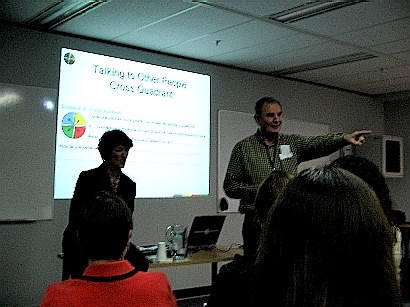
Hello Laziness
Hello Laziness is the French Dilbert - i.e. more erudite, epicurean and cruel. It mercilessly scewers what passes for corporate culture and management wisdom. Some of its examples are particularly French but everyone will recognise something from it in their working lives. The back cover suggests that the author was almost fired for writing it. So there you go - if you want to slag off your employeers, better make it a best seller.
I especially enjoyed the application of Lacan to work archetypes (just as I enjoyed the Team America view of international relations).
I especially enjoyed the application of Lacan to work archetypes (just as I enjoyed the Team America view of international relations).
Great Tippers Make Great Lovers
So by his own definitions, is Malcolm Gladwell a Connector, a Maven or a Salesman?
Connector? Well, he certainly seems to have talked to a few people in writing the Tipping Point. But writing can be a lonely job and it's hard to gauge his connection levels. Is he a Maven? As noted below, MG is not necessarily a great thinker or even an "expert" - his arguments are generally suggestive rather than rigorous and he leaves an impression of playing fast and loose with academic data. But Salesman? Oh yes. He uses everyday examples (e.g. teen smoking, Seasame Street) and simple, jargon-free language. He makes direct emtional appeals for a better world. He plays to the crowd and we love it.
Connector? Well, he certainly seems to have talked to a few people in writing the Tipping Point. But writing can be a lonely job and it's hard to gauge his connection levels. Is he a Maven? As noted below, MG is not necessarily a great thinker or even an "expert" - his arguments are generally suggestive rather than rigorous and he leaves an impression of playing fast and loose with academic data. But Salesman? Oh yes. He uses everyday examples (e.g. teen smoking, Seasame Street) and simple, jargon-free language. He makes direct emtional appeals for a better world. He plays to the crowd and we love it.
Saturday, October 15, 2005
Think with the whole your brain
I'll be at ISPI on Tuesday.
I will try to be thinking with my whole brain but I can't make any guarantees.
I will try to be thinking with my whole brain but I can't make any guarantees.
SOLA Games Workshop
You are cordially invited to an evening of game-playing and discussion. We hope that we will all find out more about: leadership, communication, power and language. But we can’t guarantee that we will – after all, it has yet to happened. Participation is free but we would like you to bring the name of a game we could play at a future event.
SoLA - Games Workshop – Thursday 27th October – 5.30pm to 7pm
Venue UTS – Building 10 Level 5 room 580.
Drop a line to our generous host if you wish to attend.
SoLA - Games Workshop – Thursday 27th October – 5.30pm to 7pm
Venue UTS – Building 10 Level 5 room 580.
Drop a line to our generous host if you wish to attend.
Monday, October 10, 2005
Last Thursday's NSW KM Forum
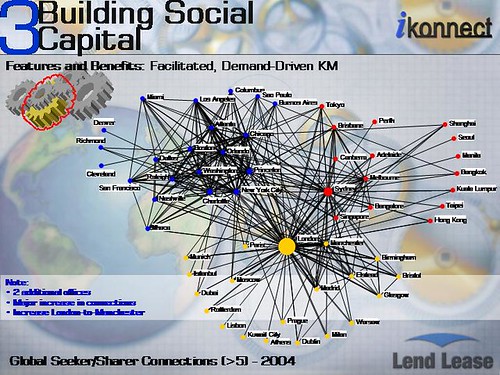
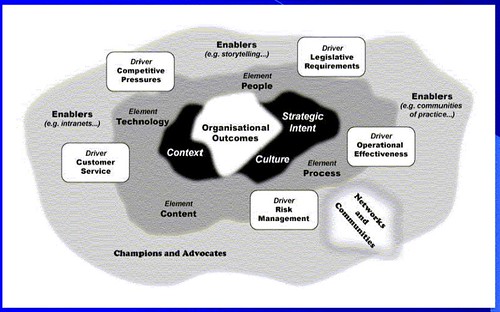
Last Thursday, Marcus Gibson gave a great presentation on the ikonnect programme at Lend Lease. This diagram indicates the interpersonal connectivity that ikonnect has achieved.
Lauren Allen from HLA Envirosciences & the Weblogics crew also came up with the goods on the implementation of Extralogic software to support communities of practice development.


Lauren Allen from HLA Envirosciences & the Weblogics crew also came up with the goods on the implementation of Extralogic software to support communities of practice development.

Smart Mobs
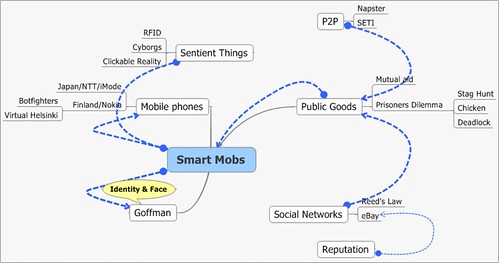
Smart Mobs by Howard Rheingold is an entry-user look at mobile/pervasive/ubiquitous computing. I was tempted to review it but thought I'd just show you my mind map (created using a trial version of MindManager) instead.

Sunday, October 09, 2005
The Map Is Not The Territory
I have seen quite a lot of KM technology maps - of differing levels of detail & complexity.
Why do we need a KM technology map? Well, the obvious answer is that there's a lot of tech out there. Some of which claims to be KM-related and some of which is used in KM initiatives (N.B. these sets overlap but are not identical). So how do we make sense of this morass of software? With a map that tells you - this piece of software is good for this thing. Simple.
Now, there are some risks involved in doing this. Here are some that come to mind:
1. Any map represents a particular construct of KM. And such contructs should be specific to certain organisations and certain contexts. You actually need to map the tech against local models of how KM operates. A generic map may be a trap.
2. The tech itself is changing dynamically so the map is always out of date.
3. The tech in a particular area may not work with a specific group depending on context. E.g. I am doing a project with some telesales people at the moment and these people have been selected for their conversational ability and relationship-building skills - but not necessarily their reading comprehension. So visual eLearning without a verbal, interactive component is unsatisfying for these people.
I think the construction of the map is the interesting thing for most organisations, not necessarily the output.
Why do we need a KM technology map? Well, the obvious answer is that there's a lot of tech out there. Some of which claims to be KM-related and some of which is used in KM initiatives (N.B. these sets overlap but are not identical). So how do we make sense of this morass of software? With a map that tells you - this piece of software is good for this thing. Simple.
Now, there are some risks involved in doing this. Here are some that come to mind:
1. Any map represents a particular construct of KM. And such contructs should be specific to certain organisations and certain contexts. You actually need to map the tech against local models of how KM operates. A generic map may be a trap.
2. The tech itself is changing dynamically so the map is always out of date.
3. The tech in a particular area may not work with a specific group depending on context. E.g. I am doing a project with some telesales people at the moment and these people have been selected for their conversational ability and relationship-building skills - but not necessarily their reading comprehension. So visual eLearning without a verbal, interactive component is unsatisfying for these people.
I think the construction of the map is the interesting thing for most organisations, not necessarily the output.
Long Vs. Short Decisions
Someone gave me a link to this article.
Which is an interesting companion piece to the Gary Klein / Malcolm Gladwell stuff.
Some decisions have to be made quickly. Those individuals that Klein was examining typically had to make life-or-death decisions in short time-frames. Consultation was not an option. And often this decisions only affected a very small number of people (e.g. a firecrew or a sick baby).
In comparision, some decisions have much longer timeframes and may involve more people - which are the decisions that appear in the Ivey journal.
Neither approach (intuitive, quick, "short" vs. consultative, "long") is wrong but each is appropriate for different enviornments.
An issue arises in that managers often develop great "short" skils in high-pressure, team-based environments. They are then promoted and take these behaviours to environments that require "long" skills (e.g. consultation, openness) without recognising that the context for their decision-making has changed. And ego is a factor here.
Which is an interesting companion piece to the Gary Klein / Malcolm Gladwell stuff.
Some decisions have to be made quickly. Those individuals that Klein was examining typically had to make life-or-death decisions in short time-frames. Consultation was not an option. And often this decisions only affected a very small number of people (e.g. a firecrew or a sick baby).
In comparision, some decisions have much longer timeframes and may involve more people - which are the decisions that appear in the Ivey journal.
Neither approach (intuitive, quick, "short" vs. consultative, "long") is wrong but each is appropriate for different enviornments.
An issue arises in that managers often develop great "short" skils in high-pressure, team-based environments. They are then promoted and take these behaviours to environments that require "long" skills (e.g. consultation, openness) without recognising that the context for their decision-making has changed. And ego is a factor here.
Monday, October 03, 2005
Friday, September 30, 2005
More NSW KM Forum
So Thursday October 6th at the NSW KM Forum.
We got Steven Layer, MD of Weblogics and Marcus Gibson from Lend Lease.
And may be some special guests...
We got Steven Layer, MD of Weblogics and Marcus Gibson from Lend Lease.
And may be some special guests...
Friday, September 16, 2005
Blog To Learn!
Got to have a chat to Anne Bartlett-Bragg at UTS. Anne is using blogging with her students as pedagogical technique. One point of real interest was the role that blogging has in developing writing skills and strategic thinking. The more her students blogged, the better their writing skills got. The other thing was, as they got used to linking to things, they started looking at the periphery of their subjects - at the points of overlap with other disciplines. This is the beginning of strategic thought - the big, joined-up picture.
Speed Limits
Went down to Melbourne last weekend to see a friend. He and his partner very kindly took me to the Slow Festival at Melbourne. Apart from gorging ourselves on fantastic food, I had a chat to Carl Honore. This was highly opportune as I have been thinking a great deal about speed limits. Just because tech allows us to move fast, that doesn't mean we always should. As Shawn said to me: The default exchange in business these days is "How are you?" "Oh, really busy. And you?" "Yeah, flat out". If we aren't busy then some how we've failed. Now, knowing the right speed to go at is crucial and yet we never talk about it. Go figure...
BTW I am aware that this post contains some name-dropping - but I'm very lucky in that I get to meet cool people pretty much every day. How fantastic is that?
BTW I am aware that this post contains some name-dropping - but I'm very lucky in that I get to meet cool people pretty much every day. How fantastic is that?
NSW KM Forum (2)
At exceedly short notice, we got Tom Davenport to speak courtesy of Leonardo Consulting who had flown him over to be part of a conference on Business Process Management (BPM). Tom's talk was thought-provoking (well, given his experience, it would have been a bit disappointing if it wasn't) - esp. around the links between BPM, KM & embedded learning.
Tom's 10 ways to improve knowledge work:
1. Adopt a process orientation
2. Change the external environment
3. Script the work
4. Embed knowledge into work
5. Automate decisions
6. Focused knowledge management
7. Address personal capabilities
8. Reuse existing intellectual assets
9. Put someone in charge of improvement
10. Build effective social networks
Tom's 10 ways to improve knowledge work:
1. Adopt a process orientation
2. Change the external environment
3. Script the work
4. Embed knowledge into work
5. Automate decisions
6. Focused knowledge management
7. Address personal capabilities
8. Reuse existing intellectual assets
9. Put someone in charge of improvement
10. Build effective social networks
NSW KM Forum (1): KM Standard
So our last session was the Australian KM Standard. Sue Halbwirth & Kim Sbarcea did a good overview and it looks pretty sound but...
It hasn't been released yet. Standards Australia - you teasing tricksters where is it?
It hasn't been released yet. Standards Australia - you teasing tricksters where is it?
Monday, September 05, 2005
An Australian KM?
Went to see the exhibition of Maggie Preston's work at Gallery of NSW on Sunday. One thing that impressed me was her commitment to creating a thoroughly Australian modernism - rather than just following the Europeans or the Americans.
This reminded me of the IBM report on KM for the EU (which some people on this list were heavily involved with). The report is unusual because its basic message is that the Europeans cannot beat the US at its own game - i.e. tech-driven KM. Instead they must find a way drawing on their differences to the yanks.
So the question I'm posing myself is: what would an Australian KM look like?
Because I am convinced that if Australian is to survive beyond the current resource boom, it needs to do more than simply ape America.
Some initial thoughts about Australia:
- A "big" country with a small population - hence an opportunity for collaborative technologies.
- More culturally homogenous than the US or Europe (main differences are between rural and urban rather than states).
- A "slower" culture than the US that has traditionally valued the good life rather than absolute material wealth. How does this impact how Australians like to make decisions and the support tools they require for that.
- A unique flora and fauna (which is danger of disappearing).
This reminded me of the IBM report on KM for the EU (which some people on this list were heavily involved with). The report is unusual because its basic message is that the Europeans cannot beat the US at its own game - i.e. tech-driven KM. Instead they must find a way drawing on their differences to the yanks.
So the question I'm posing myself is: what would an Australian KM look like?
Because I am convinced that if Australian is to survive beyond the current resource boom, it needs to do more than simply ape America.
Some initial thoughts about Australia:
- A "big" country with a small population - hence an opportunity for collaborative technologies.
- More culturally homogenous than the US or Europe (main differences are between rural and urban rather than states).
- A "slower" culture than the US that has traditionally valued the good life rather than absolute material wealth. How does this impact how Australians like to make decisions and the support tools they require for that.
- A unique flora and fauna (which is danger of disappearing).
Saturday, September 03, 2005
Blink At A Glance
Malcolm Gladwell is not a great thinker.
But he is a superb populist writer. His latest book will frame thousands of conversations around intuition and "shadow' thinking - the thinking without thinking of his subtitle.
The work of Gary Klein has interested me for the last 18 months. I hope Gladwell's book will increase the conversations that occur around these topics.
N.B. Gladwell seems to be someone you love or hate. Would that be the sound of nerves being touched?
But he is a superb populist writer. His latest book will frame thousands of conversations around intuition and "shadow' thinking - the thinking without thinking of his subtitle.
The work of Gary Klein has interested me for the last 18 months. I hope Gladwell's book will increase the conversations that occur around these topics.
N.B. Gladwell seems to be someone you love or hate. Would that be the sound of nerves being touched?
Multimedia Learning - Going Back To Cali
Richard E Mayer is a ridiculously well-published doyen of mul-ty-mee-ja-lernin'. And his first lecture at UNSW was a damp squib. Apparently pure "discovery learning" or pure exposition are not as good as guiding participants. Anyway, this was a sucker punch coz his second lecture on multimedia instructional design was fantastic. 50 mins of best (& worst) practice for designing courses.
The only grating note at the end was a jibe against social psychologists - and hence social theories of learning (see the note on Wenger below). Coz we don't ever learn in isolation. We learn for a reason. And that reason is often as not linked to the social environment we live in (e.g. the workplace). Any approach to learning that does not acknowledge this will end in gibbering autism.
The only grating note at the end was a jibe against social psychologists - and hence social theories of learning (see the note on Wenger below). Coz we don't ever learn in isolation. We learn for a reason. And that reason is often as not linked to the social environment we live in (e.g. the workplace). Any approach to learning that does not acknowledge this will end in gibbering autism.
Bodymovin'
ISPI hosted a conversation between Rada Millwood and Zoran Kovich around embodied thought.
Underpinning the whole thang was their experience as Feldenkrais practitioners. And I thought it was great. There was a sample in early-90s jungle/hip hop from asian chop-socky movies that went "you must think first before you move". Rada and Zoran state the reverse - "you must move first before you think".
Suggestive rather than definitive, the session provoked all kinds of questions around how we use our bodies to think - and what that means for our day-to-day lives...
Underpinning the whole thang was their experience as Feldenkrais practitioners. And I thought it was great. There was a sample in early-90s jungle/hip hop from asian chop-socky movies that went "you must think first before you move". Rada and Zoran state the reverse - "you must move first before you think".
Suggestive rather than definitive, the session provoked all kinds of questions around how we use our bodies to think - and what that means for our day-to-day lives...
Thursday, September 01, 2005
So much stuff but so little time
OK, I am way overdue with posts on globalism (John Ralston Saul & Clyde Prestowitz), body posture & thinking (ISPI), Multimedia Learning (Richard Mayer) and lots of other stuff.
But I'm pretty busy at work at the moment and also my new laptop disagrees with my broadband connection.
But soon...
But I'm pretty busy at work at the moment and also my new laptop disagrees with my broadband connection.
But soon...
Tuesday, August 23, 2005
"Globalism is Dead..."
John Ralston Saul.and The Collapse of Globalism
vs.
Clyde Prestowitz and Three Billion New Capitalists.
Cerebrity Death Match?
vs.
Clyde Prestowitz and Three Billion New Capitalists.
Cerebrity Death Match?
Sunday, August 21, 2005
SOLA Games Workshop
Cris Townley and Elyssebeth Leigh have set up a Games Group through SOLA for those interested in using games-based techniques for education & learning.
Last week's meeting looked at The Prisoner's Dilemma. We split into two teams and played 10 rounds of this game. Very simple - but suprisingly rich. An excellent game to start discussions around trust, negotiation, and culture.
I could go on about the game but what stood out for me was the necessity to actually play the game to understand its power and applications. Reading about a game is very different to actually playing it.
I am looking forward to some more of these sessions. More immediately, I have agreed (foolishly?) to have a crack at facilitating the next session.
Any suggestions for games?
Last week's meeting looked at The Prisoner's Dilemma. We split into two teams and played 10 rounds of this game. Very simple - but suprisingly rich. An excellent game to start discussions around trust, negotiation, and culture.
I could go on about the game but what stood out for me was the necessity to actually play the game to understand its power and applications. Reading about a game is very different to actually playing it.
I am looking forward to some more of these sessions. More immediately, I have agreed (foolishly?) to have a crack at facilitating the next session.
Any suggestions for games?
The Pod Is Cast
Had lunch last week with this fellah. Mick is an incredible ball of energy and he was enthusing with gusto about his baby The Podcast Network.
Some nuggets:
1. If you podcast, blog. Cross-promotion is a wonderful thing.
2. The easiest way to get listeners is to interview someone famous. You may love your mum but not everyone else feels the same way.
3. Audio is about conversations and is "global". You can have a conversation over the phone with anyone, anywhere. Video is about events and is "local". You just have to be there.
Going into interview mode myself, I asked Mick what his biggest lesson had been this year (hey, I'm in training, it's like an automatic reflex). His comment: The Cluetrain Manifesto is still The Bomb.
Markets are Conversations. And despite all appearances to the contrary, this blog is not in the pocket of David Weinberger.
Some nuggets:
1. If you podcast, blog. Cross-promotion is a wonderful thing.
2. The easiest way to get listeners is to interview someone famous. You may love your mum but not everyone else feels the same way.
3. Audio is about conversations and is "global". You can have a conversation over the phone with anyone, anywhere. Video is about events and is "local". You just have to be there.
Going into interview mode myself, I asked Mick what his biggest lesson had been this year (hey, I'm in training, it's like an automatic reflex). His comment: The Cluetrain Manifesto is still The Bomb.
Markets are Conversations. And despite all appearances to the contrary, this blog is not in the pocket of David Weinberger.
Identity Blogging & Masks
Dave Weinberger has a post on Julie Leung's talk on Blogs & Masks. Which seems to be talking about exactly the issues that have been vexing me here. Julie's blog makes reference to the term Identity Blogging.
What this seems to be talking about is the importance of voice. How individuals (or groups/teams for that matter) create (or maybe find?) a distinctive voice. Because that's what I as a reader look for in a blog. Sure, facts, links, etc. But what keeps me coming back in the distinctive voice of the writer. What they care about and how they express these concerns.
So how do you get a voice? Well, some individuals seem to spring fully formed offering insightful opinions expressed with stylistic genius. For most of us though, it comes down to graft & practice. No infant emerges from the womb laying down lines like Oscar Wilde. Instead they learn through first copying others, then engaging in conversations.
What does your voice sound like?
The phrase identity blogger to me means that I am blogging my identity, creating one and revealing it at the same time. What we have most of all, all of us, as bloggers, beyond anything else, is our identity. It's our flavor. Our scent. Our hue. What makes me me, what makes us each distinctive. It is who we are.
What this seems to be talking about is the importance of voice. How individuals (or groups/teams for that matter) create (or maybe find?) a distinctive voice. Because that's what I as a reader look for in a blog. Sure, facts, links, etc. But what keeps me coming back in the distinctive voice of the writer. What they care about and how they express these concerns.
So how do you get a voice? Well, some individuals seem to spring fully formed offering insightful opinions expressed with stylistic genius. For most of us though, it comes down to graft & practice. No infant emerges from the womb laying down lines like Oscar Wilde. Instead they learn through first copying others, then engaging in conversations.
What does your voice sound like?
Monday, August 15, 2005
Personal Reputation Management
SMH article on fired bloggers taking revenge.
In the novels of Jane Austen, characters (esp. women) are always concerned about their reputations. How they carry themselves and what is said about them. Now we don't really talk too much about the value of our reputations as much as we used to - unless you are a public figure. But as noted below, this separation between public and private is not what it used to be.
To what extent do we need to return to previous models of personal reputation?
To extent do employers need to train their emplpoyees on personal reputation management?
In the novels of Jane Austen, characters (esp. women) are always concerned about their reputations. How they carry themselves and what is said about them. Now we don't really talk too much about the value of our reputations as much as we used to - unless you are a public figure. But as noted below, this separation between public and private is not what it used to be.
To what extent do we need to return to previous models of personal reputation?
To extent do employers need to train their emplpoyees on personal reputation management?
Ask and you shall receive
Some data at Principius on Australian kids' internet usage and RSS feed usage in the US.
Public vs. Private: Cat Got Your Tongue?
Cast your minds back to Spring 1997. Tony Blair wasn't Prime Minister. No one had heard of Monica Lewinsky. I was a fresh-faced post-grad student studying this thing called the internet that seemed to consist solely of porn and pages where people put up pictures of their cats.
The cat folks got a lot of stick at the time. Their sites were lacking in interesting content, engaging analysis, wit. Lacking in pretty much everything. Except cats. And yet, in hindsight, the cat folks can be seen as the true harbingers of the future. They grasped what the internet was about in a way that Bill Gates or Marc Andreessen never did. It's not just about ecommerce or web-enabled architectures. It's about redrawing the boundaries between the public and the private. You wouldn't normally get to see pictures of a stranger's cat. Partly because you wouldn't necessarily want to. But mostly because prior to publicly accessible P2P publishing environment, you simply couldn't.
The current corporate debates around social software (Is it a good thing? What if they say bad things about us?) are attempts to understand how these boundaries are changing or to prevent these changes from occurring.
And these changes are both wonderful and scary. We don't know where we'll end up. And who will be able to see us there.
Maybe we can hide behind the cats.
The cat folks got a lot of stick at the time. Their sites were lacking in interesting content, engaging analysis, wit. Lacking in pretty much everything. Except cats. And yet, in hindsight, the cat folks can be seen as the true harbingers of the future. They grasped what the internet was about in a way that Bill Gates or Marc Andreessen never did. It's not just about ecommerce or web-enabled architectures. It's about redrawing the boundaries between the public and the private. You wouldn't normally get to see pictures of a stranger's cat. Partly because you wouldn't necessarily want to. But mostly because prior to publicly accessible P2P publishing environment, you simply couldn't.
The current corporate debates around social software (Is it a good thing? What if they say bad things about us?) are attempts to understand how these boundaries are changing or to prevent these changes from occurring.
And these changes are both wonderful and scary. We don't know where we'll end up. And who will be able to see us there.
Maybe we can hide behind the cats.
So who reads blogs anyway...
Just doing some research at the moment on blogging. Here are the findings so far:
1. The Blogging Geyser from Perseus. Takeaway: Things hit an inflection point in late 2003 (apparently that was Dave Winer's fault).
2. Corporate Blogging: Is It Worth The Hype? from Backbone Media. Takeaway: Yes.
3. Podcasting & State of Blogging from the Pew Internet & American Life Project. Takeaway: 1. Most Americans don't know what a blog is. 2. I am too old to be into Podcasting.
4. Blog Reader Survey from BlogAds. Takeaway: 1 in5 blog readers are bloggers.
Is anyone aware of some non-American surveys on these areas?
1. The Blogging Geyser from Perseus. Takeaway: Things hit an inflection point in late 2003 (apparently that was Dave Winer's fault).
2. Corporate Blogging: Is It Worth The Hype? from Backbone Media. Takeaway: Yes.
3. Podcasting & State of Blogging from the Pew Internet & American Life Project. Takeaway: 1. Most Americans don't know what a blog is. 2. I am too old to be into Podcasting.
4. Blog Reader Survey from BlogAds. Takeaway: 1 in5 blog readers are bloggers.
Is anyone aware of some non-American surveys on these areas?
Sunday, August 14, 2005
Call Centre KM
NSW KM Forum session by James Robertson based on his consulting experience with several call centres. Very practical & down-to-earth. A particular focus for James was the way in which you investigate people's working environments - an approach that some might characterise as "ethnographic" but boils down to looking at what people actually do.
Sunday, July 24, 2005
Reputations at Risk (5)
And thence to the panel discussion. I don't have a lot of time for Piers Akerman as a writer but he did a decent job of moderating. So we had a PR manager, a PR consultant and a journalist. There was a lot of fairly sensible talk about the importance of communicating during crises, the need to identify media-friendly managers, having a strategy, etc.
There was also some talk of the new media such as blogs, wikis, etc. This drew out some interesting panel comment. Apparently, there is a discussion in Deloitte's at the moment as to whether employees should be allowed to blog. In Vessa Playfair's opinion, the answer should be "no" due to the legal liabilities. Michelle Hutton was similarly sceptical.
General impression: PR folk see themselves primarily as gatekeepers - training execs to stay "on message" and ensuring that everyone else keeps their mouths shut. I have no problem with the first objective - having been on the receiving end of a large number of executive "communications" of variable quality from many firms.
And it's down to Deloitte to decide what it's willing to tolerate and support - and being an accounting firm it will doubtless decide on caution.
However, there's a problem with this "narrow pipe" approach. If we assume that your customer base is fragmenting into niches, one (or even a handful) of carefully controlled voices will not be enough. If you can develop a plurality of voices then you have a much better chance of making contact with these multiple niches.
There was also some talk of the new media such as blogs, wikis, etc. This drew out some interesting panel comment. Apparently, there is a discussion in Deloitte's at the moment as to whether employees should be allowed to blog. In Vessa Playfair's opinion, the answer should be "no" due to the legal liabilities. Michelle Hutton was similarly sceptical.
General impression: PR folk see themselves primarily as gatekeepers - training execs to stay "on message" and ensuring that everyone else keeps their mouths shut. I have no problem with the first objective - having been on the receiving end of a large number of executive "communications" of variable quality from many firms.
And it's down to Deloitte to decide what it's willing to tolerate and support - and being an accounting firm it will doubtless decide on caution.
However, there's a problem with this "narrow pipe" approach. If we assume that your customer base is fragmenting into niches, one (or even a handful) of carefully controlled voices will not be enough. If you can develop a plurality of voices then you have a much better chance of making contact with these multiple niches.
Reputations at Risk (4)
Tim Williams from Westpac then talked about Westpac's journey back from the brink of the early-90s. Tim's presentation was very much a game of two halves. The first half was a gripping story of corporate failure redeemed - an organisation relearning how to talk to its employees and customers. The second half was the ins and outs of Westpac's approach to sustainability. Ultimately this is where the meat was but seeing the balanced scorecard and the org charts was much less compelling than the first half.
Thursday, July 21, 2005
Reputations at Risk (3)
Then we had Grahame Dowling of AGSM / Reputation Institute. Never less than deadpan, GD began by breaking down what "corporate reputation" actually means. There was a bit of detour around boards of directors, then he got back on track with a statistical survey breakdown of what might contribute to a firm's reputation - "providing good products and services" came out top. There was also a negative correlation between customer and shareholder views - i.e. customers don't want to feel ripped off. And then he moved from a heavily analytic approach to talking about corporate reputation as story. An example of a compelling "story" about quality and value being Porche. Now, he didn't talk much about the methodology for doing this apart from "tell the truth". I think there's a heavy role for Cynefin-like narrative techniques here...
Reputations at Risk (2)
Clare Hart, Factiva CEO, kicked things off with a session featuring a few new Factiva products. Which had lots of cool text mining tools and graphical displays. She also mentioned new media (web, blogs, wikis) a fair bit and noted that the Factiva covers these as well as its traditional proprietary print databases. The James Hardie asbestos case was treated as a cautionary tale in corporate reputations.
The Factiva analytical and monitoring tools demoed originate in the acquisition of 2B back in February. Thought: how might this external-facing business intelligence be lined up to the internal BI tools that many large companies are starting to deploy (around balanced scorecard, financials, etc)?
The Factiva analytical and monitoring tools demoed originate in the acquisition of 2B back in February. Thought: how might this external-facing business intelligence be lined up to the internal BI tools that many large companies are starting to deploy (around balanced scorecard, financials, etc)?
Reputations at Risk (1)
Yesterday, I went along to the Factiva Forum 2005, wanting to check things out from a new media / blogging perspective.
Monday, July 18, 2005
"Purple in the Nose"
So yesterday was Etienne Wenger. He's a sprightly chap. Randoms notes:
- A social theory of learning (not a theory of social learning). Importance of meaning & identity.
- Learning = realignment between socially-defined competencies and personal experience.
- Core vs. boundary learning in communities.
- Plenty of reference to learning SYSTEMS.
- Domains must be "thick" enough.
- Leadership vs. nurturing.
I'll make sense of all that later (promise).
One thing right at the end of the session stood out: EW claims that identity is becoming more individualised. Pre-industrial revolution, you shared your life with people in your village. A common history (yours and theirs). Now you don't. You move towns and institutions and your set of experiences is shared fleetingly with many individuals rather than constantly with a few. Hence less common identity.
- A social theory of learning (not a theory of social learning). Importance of meaning & identity.
- Learning = realignment between socially-defined competencies and personal experience.
- Core vs. boundary learning in communities.
- Plenty of reference to learning SYSTEMS.
- Domains must be "thick" enough.
- Leadership vs. nurturing.
I'll make sense of all that later (promise).
One thing right at the end of the session stood out: EW claims that identity is becoming more individualised. Pre-industrial revolution, you shared your life with people in your village. A common history (yours and theirs). Now you don't. You move towns and institutions and your set of experiences is shared fleetingly with many individuals rather than constantly with a few. Hence less common identity.
Cape Group - eLearning in Aus & NZ
Thursday, we had a version of the ElNet session on eLearning in ANZ (see below).
The tech worked (go Centra!).
And the presso was interesting. Immediate take-homes:
- eLearning implementations are still in their early stages.
- LMS and CM systems are the main investment (either a COTS install or ASPed).
- Little evidence of virtual classroom usage, performance support or games.
- Issues with integration to HR systems. There are issues over which system houses the required data.
- Business cases often do not involve input from IT and benefits are not tracked against them!
- Content mgt is harder than expected.
Seems pretty familiar...
The tech worked (go Centra!).
And the presso was interesting. Immediate take-homes:
- eLearning implementations are still in their early stages.
- LMS and CM systems are the main investment (either a COTS install or ASPed).
- Little evidence of virtual classroom usage, performance support or games.
- Issues with integration to HR systems. There are issues over which system houses the required data.
- Business cases often do not involve input from IT and benefits are not tracked against them!
- Content mgt is harder than expected.
Seems pretty familiar...
Thursday, July 07, 2005
The Future of Volunteering session
Great fun to facilitate with Lee Carsley and James Lytton-Hitchins. Many thanks to those who took the time to participate.
Some random thoughts in no particular order about Cynefin techniques:
- Everybody wanted to be involved in the creation of archetypes. Excellent job done by the cartoonist BTW. And I think the 2-stage emergence process does make sense here. The discussion the archetypes as they were displayed back to the group was fantastic. They are also a tangible, non-verbal artefact rather than a collection of words.
- Anecdote Circles worked reasonably well. But I love them anyway (so simple yet so effective).
- Future Backwards is difficult to do with groups that do not share common experience and who therefore do not share a common repertoire of events. Without this set of events, people talk a lot about non-specific trends.
Some random thoughts in no particular order about Cynefin techniques:
- Everybody wanted to be involved in the creation of archetypes. Excellent job done by the cartoonist BTW. And I think the 2-stage emergence process does make sense here. The discussion the archetypes as they were displayed back to the group was fantastic. They are also a tangible, non-verbal artefact rather than a collection of words.
- Anecdote Circles worked reasonably well. But I love them anyway (so simple yet so effective).
- Future Backwards is difficult to do with groups that do not share common experience and who therefore do not share a common repertoire of events. Without this set of events, people talk a lot about non-specific trends.
Social Software
James did a cracking job of providing an overview of social software last night.
Social software vs. Collaborative software. James noted that functionality-wise there can be considerable overlaps between say, a Lotus Notes teamroom and a wiki. But while collaborative software is part of an enterprise-wide top-down implementation, social software is consumer-driven and assembled by indivudals from components ("Small Pieces, Loosely Joined"). The public are way ahead of the corporates here.
Which, as James notes, implies all kinds of things for firewalls, security and IT policies...
Social software vs. Collaborative software. James noted that functionality-wise there can be considerable overlaps between say, a Lotus Notes teamroom and a wiki. But while collaborative software is part of an enterprise-wide top-down implementation, social software is consumer-driven and assembled by indivudals from components ("Small Pieces, Loosely Joined"). The public are way ahead of the corporates here.
Which, as James notes, implies all kinds of things for firewalls, security and IT policies...
Friday, July 01, 2005
Future of Volunteering
SOLA are running some workshops on the Future of Volunteering using the Cynefin methodology. I attended the last one as a participant and will be attending the next one as a facilitator. I'll let you know how it goes...
Cynefin
Cynefin
Thursday, June 30, 2005
LinkedIn and inked up
Currently have an obsession with LinkedIn - a social software-type networking tool. Part of it stems from sheer geeky competition ("I will get more connections than anyone"). Maybe I wasn't hugged enough as a child. But beyond that there's something interesting about making your social network public - and the uses and abuses of same. More to follow...
LinkedIn
ISPI - Board Games
ISPI last night involved Marie Jasinski doing a session on Break The Safe. This is a commercially available board game that Marie and Thiagi have customised as part of a program of learning to develop high-performance teams.
What impressed me was that a commercial product designed for one market could be converted quite simply into a rich learning resource. What else is out there for us to get our hands on?
Technorati: ISPI
What impressed me was that a commercial product designed for one market could be converted quite simply into a rich learning resource. What else is out there for us to get our hands on?
Technorati: ISPI
ElNet
Last week, went to the ElNet event held at a venue better known for its comedy. Which is unfortunate as the technology did a Norman Wisdom-type pratfall and collapsed. To be fair to Centra, this was more likely due to networking issues than software. Anyway, we didn't get to hear what The Cape Group had to say about the state of the eLearning market in Australia and New Zealand. But we did get to hear from Alison Bickford at Roche about their eLearning activities - Communities of Practice, Wikis, Portals - all sounded suspiciously like KM to me.
Alison was so good, I want to her to come to Big Blue to present.
Alison was so good, I want to her to come to Big Blue to present.
More SNA
It's all happening.
The awesome Kate Ehrlich has put me onto the Connectedness blog about SNA. This will take me a while to digest but will drop you a line when I do.
The awesome Kate Ehrlich has put me onto the Connectedness blog about SNA. This will take me a while to digest but will drop you a line when I do.
Thursday, April 07, 2005
Experiments
Been reflecting recently on ideas that don't quite come off.
There has been some discussion the ACT-KM list about the Carnival that took place earlier in the year. Normally posters have to display their identities. During the Carnival, posters could call themselves what they wanted. The original idea was to get lurkers to decloak but it didn't really turn out that way. See the message thread for further debate.
And the Book Club seems to have died. Mostly from my neglect.
I think it's important to try things, take risks, and sometimes end up looking foolish.
It's a truism that 70% of projects "fail". But how many should we expect to succeed?
There has been some discussion the ACT-KM list about the Carnival that took place earlier in the year. Normally posters have to display their identities. During the Carnival, posters could call themselves what they wanted. The original idea was to get lurkers to decloak but it didn't really turn out that way. See the message thread for further debate.
And the Book Club seems to have died. Mostly from my neglect.
I think it's important to try things, take risks, and sometimes end up looking foolish.
It's a truism that 70% of projects "fail". But how many should we expect to succeed?
Expertise Location
So there I was, trying to explain expertise location to a colleague yesterday. And whilst I was doing so, I realised that it all hinges on how you define an expert. Most, internal directories or HR systems assume that expertise is something you can quantify based on qualification, experience, or some mix of both.
However, no one ever really goes looking for an expert. You are looking for someone that can help you solve a problem you have. Your measure of their expertise is their ability to solve your problem. Therefore the robustness of an expertise location system is dependent not on the "experts" and their information held within it but on the kinds of problems its users have that cause them to look for experts.
If the information within the system is reliable, sufficiently detailed and structured in a way aligned with the problems the users have(all big "ifs"), then the system will be perceived as useful. Which implies that the problems users apply it to are homogenous - or at least well understood.
What I suspect happens is that organisations design systems that cover a specific subset of cases (e.g. resource management in consulting firms) and then attempt to cover the rest using social networks. My suspicion is also that they do not do this as well as they could.
None of this is earth-shattering but it leads me to ask - has anyone done any work on HOW users leverage expertise location systems in different organisational situations?
However, no one ever really goes looking for an expert. You are looking for someone that can help you solve a problem you have. Your measure of their expertise is their ability to solve your problem. Therefore the robustness of an expertise location system is dependent not on the "experts" and their information held within it but on the kinds of problems its users have that cause them to look for experts.
If the information within the system is reliable, sufficiently detailed and structured in a way aligned with the problems the users have(all big "ifs"), then the system will be perceived as useful. Which implies that the problems users apply it to are homogenous - or at least well understood.
What I suspect happens is that organisations design systems that cover a specific subset of cases (e.g. resource management in consulting firms) and then attempt to cover the rest using social networks. My suspicion is also that they do not do this as well as they could.
None of this is earth-shattering but it leads me to ask - has anyone done any work on HOW users leverage expertise location systems in different organisational situations?
KM @ Telstra
So we had Alister Webb from Telstra at NSW KM Forum tonight. I like AW - he's an unpretentious speaker who tells it like it is. And the crowd were involved for over an hour.
He talked about how KM tools (simple stuff like AARs) have been packaged for use by project managers and his team's role in disseminating those tools.
Also got to meet Andrew Mitchell (ex-Telstra) now doing funky KM stuff (along with a bunch of other things) here.
He talked about how KM tools (simple stuff like AARs) have been packaged for use by project managers and his team's role in disseminating those tools.
Also got to meet Andrew Mitchell (ex-Telstra) now doing funky KM stuff (along with a bunch of other things) here.
Wednesday, March 16, 2005
Future NSW KM Forum sessions
Lots of things on the horizon:
- Plently of case studies from actual people in organisations doing KM.
- We want this year to be interactive with people doing stuff. In the past (and for good reason), there's been lots of presenting (talking to) but not enough talking with and doing with. This may not work but it's worth a try.
- Plently of case studies from actual people in organisations doing KM.
- We want this year to be interactive with people doing stuff. In the past (and for good reason), there's been lots of presenting (talking to) but not enough talking with and doing with. This may not work but it's worth a try.
Creative Commons @ NSW KM Forum
OK, the Creative Commons session was actually quite cool. If light on attendance.
Ian Oi is a surprisingly jolly bloke for a lawyer. And he talked well. David Vaile from the Cyberlaw Centre weighed in where necessary and Bruce Badger was a contrary so-and-so. But that was kinda what I'd asked him to be so fair enough. I probably could have been a tougher facilitator but unless I have a specific goal that the group has to reach I tend to err on the side of non-intervention.
One issue that the night left me with was: CC is all very nice but what future does it have? Will people be using this? Will it end up in court? As far as Australia goes, it's deffo too early to say.
Ian Oi is a surprisingly jolly bloke for a lawyer. And he talked well. David Vaile from the Cyberlaw Centre weighed in where necessary and Bruce Badger was a contrary so-and-so. But that was kinda what I'd asked him to be so fair enough. I probably could have been a tougher facilitator but unless I have a specific goal that the group has to reach I tend to err on the side of non-intervention.
One issue that the night left me with was: CC is all very nice but what future does it have? Will people be using this? Will it end up in court? As far as Australia goes, it's deffo too early to say.
Monday, March 14, 2005
Serious Games
The application of gaming & simulation to techniques to the business environment hold quite a fascination for me.
Serious Games is a recent site I've been pointed towards which is a bit light on content.
Virtual Leader is an interesting attempt to apply gaming techniques to managerial decision making. Kinda like Doom but with less weaponary.
More to follow.
Serious Games is a recent site I've been pointed towards which is a bit light on content.
Virtual Leader is an interesting attempt to apply gaming techniques to managerial decision making. Kinda like Doom but with less weaponary.
More to follow.
Subscribe to:
Posts (Atom)

 Posts
Posts


