Showing posts with label identity. Show all posts

Monday, February 11, 2008

identity mapping

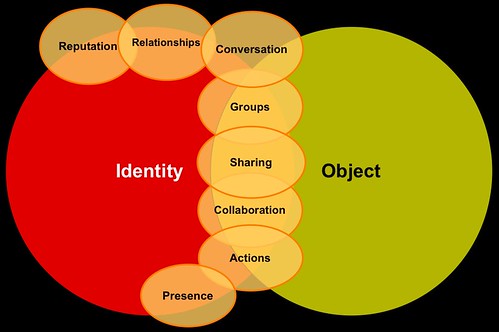
Kim points to Michael Zimmer who points to Fred Cavazza who has created this:

Which is all good. Except that something in the design irks me. We have boxes and clean lines and no overlaps. It needs to be a bit more like Thomas Vander Wal's stack.

The elements of identity are not distinct and I may engage in more than one activity at one time. To extent can we keep these actions separate and would we want to anyway?

Thursday, December 20, 2007

blog dress - further reflections on the pew report

Put on that dress
I'm going out dancing

These thoughts are triggered by seeing Hell Hath No Fury (which I enjoyed but also agreed with the opinions of the reviewer thru the link), the Pew report referred to in the previous post and the lyrics of PJ Harvey's Dress*.

As a teen, public display is important - esp. as your body changes under the influence of hormones. Are you wearing the right clothes? The wrong clothes? What do they say about you? Do they fit in with the people you want to fit in with? And from what I remember, this is more important for teenage girls than boys. And critically its much more social. Most of my male contemporaries did not talk to each other about style tips or haircare. But for girls, going shopping together for outfits was normal.

How do we clothe our identities online? Words are one way of doing it. Creating a lexical sheath for ourselves. Blogs are often compared to online diaries but they are also public displays. Has anyone done any work on fashion trends in teenage girl blogs? The apps? The fonts, colours and formatting? What's in this blogging season?

Also, to what extent is posting a comment on a blog a form of social grooming?


Photo: cryptdang


*Which on reflection also has too much of a man focus. Women mainly dress for each other, not for men, no matter what we may choose to believe.

Sunday, September 02, 2007

The technology of the secret

Secrets are inherently interesting things. Facts & stories about ourselves that we choose not to share with everyone. I remember one conversation with an acquaintance many years ago where we talked about our secrets. N.B. We didn't tell each other our secrets. We just talked about who we had shared them with. And why. He said: "Well, you are secrets, aren't you?"

Simply hiding something makes it more desirable to others. We may hide it for any number of reasons. It may be shameful, boring, illegal, hurtful. Whatever it is, we don't want people to know about it. We manage & maintain our identities and the exposure of a secret threatens that. Our secrets make us vulnerable. And because they are a part of ourselves that form us that we cannot publicly acknowledge, they can be a heavy burden. Many cultures have developed rituals & roles for the entrustment of secrets to others. The catholic confessional, the psychiatrist's couch.

Secrets (of ourselves & also of others) are powerful tokens of exchange. The secrets of others might be exchanged for material gain but our own secrets are offered to people to build trust between us. We often start with little vulnerabilities and then move on to the bigger things. And in a world where random connections are increasingly common, we sometimes fell happier giving our secrets to complete strangers instead of those close to us.

So why I am writing about secrets?

1. As a knowledge manager, I have been entrusted with secrets - of both groups & individuals. During lessons learned debriefs, participant interviews, all kinds of things. It surprised me when it began happening. I'd flatter myself that it's because I'm a good listener but I suspect it has more to do with the voracious need that people have to unburden themselves. There are fewer priests than there used to be and there is still a stigma (& a cost) attached to seeing a shrink for some people. It's not just knowledge managers - HR people get it to. Anyone who's reasonably sympathetic and without an obvious axe to grind.

Do we need to bring professional secret-keepers back?

2. These new communications technologies - not just the internet but mobile phones & digital cameras - require us to manage our identities in ever more complex ways. And they make our secrets increasingly fragile to exposure. We need some level of privacy, some control over our own identities. But it won't be the same as the forms we've had before. Whether it will be sufficient remains to be seen.

Saturday, September 01, 2007

I want to stay hidden

Jasmin Tragas writes about expressing yourself. Jasmin asks:
Is it Facebook Faux Pas to hide your “wall” or friends?

Being an Englishman, I have no problem with hiding any & every aspect of myself. Are you looking at me, pal? Got a problem, have you? I'll give you a ****ing problem.

Ahem

When I set up my Facebook profile, I filled in the "relationship" status fields. As more people I vaguely knew friended me (& I them, link slut that I am), I became less and less comfortable with this. So this week I removed these fields. Facebook chose to interpret this as "Matt is no longer single" and promptly made this a news item. I then got a string of emails from acquaintances asking what the gossip was, when the big day will be and whether children were in the offing. When I got sick of this, I set my relationship status back to "single*" again. And later that day, a work colleague (in the course of a business email) offered condolences for my newly single status - plenty more fish in the sea, etc.

I examined the privacy settings of Facebook very closely and shut down all my alerts. I then removed my relationship status. Single, married, straight, gay, celibate, rampant - this is my business and not yours.

So we need to be careful how we present ourselves. And we also need to use care in our readings of other people. Things may not be what they seem.

We are engaging in a massive experiment here. An experiment in redrawing the lines of public & private. And this experiment will not be painless. We can limit this pain by being generous with each other.

Jasmin then asks some more interesting questions:
Another question - is Facebook really about connecting or is it about embedding your identity? Do you get to know more about your friends or yourself by using FB and twitter? How much of this is manufactured identity?

Now Erving Goffman would have a few things to say about this. My take is that our identities are to some extent manufactured anyway. We have some influence over how we look and what we do (but not total control). But these identities are also co-created with those around us. We perform ourselves (to an extent). And others feedback to us whether they buy our performances or not through performances of their own. So tools like Facebook are about connecting AND embedding your identity - because the two are inseparable.

Human beings have always indulged in hypocrisy and double-standards. They enable us to survive. New technologies mean that we must invent new forms of hypocrisy and innovative double-standards to continue surviving. Because let's face it, we're certainly not going to be honest with each other.

*Please do not tell my Thai mail-order bride this piece of information.