Over the past few months, I've got involved in more & more online communities using a range of different tools.
Ning - Getting more & more popular, Ning offers a pretty good entry-level on-line community environment. You can create a personal profile & blog, you can incorporate a forum, video & photo uploading, all that stuff. Obviously Ning has been designed for "fun" communities than "work" communities. There is no native wiki functionality and no real document management capabilities. Boo!!!
Wordframe - As the name suggests, Wordframe is more about words. You get wiki stuff, a document library and the ability to incorporate external blog feeds into the environment. Wordframe is not available for free.
Facebook (again) - As noted earlier, I'm not too keen on Facebook. However given its omnipresence you could do worse for an online community environment. Apart from a forum & a wall, you don't get a whole heap of functionality and precious little customisation. But sometimes it's more about where you are than what you're doing.
This Techcrunch article is pretty good - though might now be out of date...
Showing posts with label social networks. Show all posts
Showing posts with label social networks. Show all posts
Thursday, July 17, 2008


Wednesday, April 09, 2008
global im networks & magic numbers
Following on from yesterday's post on the CMU/Microsoft research, there are two networks in the research: the buddy network and the communications network for that month.
The buddy network has 240 million nodes with 9.1 billion edges. Which equates to 75 contacts per node/person (9,100,000,000 x 2 / 240,000,000). This is an indicator of the size of an individual's weak-tie / acquaintance network.
The communications network has 180 million nodes with 1.3 billion edges. Which equates to 14 contacts per node / person (1,300,000,000 x 2 / 180,000,000). This is an indicator of an individual's strong-tie / tribal network.
How do these results link to the second and third of Dave Snowden's magic numbers?
The buddy network has 240 million nodes with 9.1 billion edges. Which equates to 75 contacts per node/person (9,100,000,000 x 2 / 240,000,000). This is an indicator of the size of an individual's weak-tie / acquaintance network.
The communications network has 180 million nodes with 1.3 billion edges. Which equates to 14 contacts per node / person (1,300,000,000 x 2 / 180,000,000). This is an indicator of an individual's strong-tie / tribal network.
How do these results link to the second and third of Dave Snowden's magic numbers?
Tuesday, April 08, 2008
bar camp sydney (4) - cash from social networks
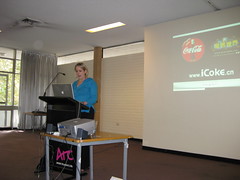
Want cash from social networks??? Well look, listen & learn to this presentation by Laurel Papworth.

Sunday, February 10, 2008
watts redux (2): influentials
Watts has also critiqued the influentials or two-step model (not to be confused with this). The mass media model posits an atomistic world where TV/newspapers/etc reach individuals (kinda like the Protestant view of Christianity, with the Marketer as God). The influencer model inserts a layer of intermediaries (like Catholicism with its Priesthood) who are especially influential. All the marketer has to do is reach the influencers and they then spread the message to everyone else.
Reading the paper available via the link above (and not pretending to understand it all), a few things stick out:
- In the models that Watts & Dodds build, influencers do have a role - but that role is dwarfed by the influence of the wider environment.
- Having a bunch of people who are susceptible to your message is more important than influencers (does this mean that followers are more important than leaders?).
- Rather than trying to reach influencers, how do you go about trying to first understand the environment of your audiences?
- It implies that you need multiple ways of intervening in this environment, rather than just dropping a line to some influential people.
watts redux (1): virals
Duncan Watts is getting a boost courtesy of this Fast Company article. For those of you after meatier stuff, the much of the original research mentioned can be found here. Now for some reflections...
Viral marketing campaigns mostly fail - i.e. they don't end up generating the huge amounts of buzz. Which is exactly what you would expect in a complex environment - the success of the viral campaign is at the mercy of its environment.
Watts, Peretti & Frumin discuss their concept of Big Seed marketing which basically adds some viral/sociable characteristics to a mass-marketing campaign. I'd like to take a different tack.
Going back to the viral metaphor, one reason that viruses can be so difficult to control is that they mutate and reproduce with unbelievable speed. They are in a constant state of "beta" (one for the nerds there). Most viral marketing campaigns are very unviral in this respect. The agency crafts a brilliant viral artifact and expects people to pass it on.
You don't want invest in creating a single, sterile virus - because the odds are that it will fail. Instead you want to create a virus-generating engine (which, when you think about it, is all a real virus is), something that will create lots of social objects connected to your product/brand. Most of these objects will remain immobile, a tiny fraction will spread.
Ten years ago, that would have been impossible. Thanks to the world of user-generated media, that is no longer the case. People are creating social objects by the truckload every day. A few points:
Viral marketing campaigns mostly fail - i.e. they don't end up generating the huge amounts of buzz. Which is exactly what you would expect in a complex environment - the success of the viral campaign is at the mercy of its environment.
Watts, Peretti & Frumin discuss their concept of Big Seed marketing which basically adds some viral/sociable characteristics to a mass-marketing campaign. I'd like to take a different tack.
Going back to the viral metaphor, one reason that viruses can be so difficult to control is that they mutate and reproduce with unbelievable speed. They are in a constant state of "beta" (one for the nerds there). Most viral marketing campaigns are very unviral in this respect. The agency crafts a brilliant viral artifact and expects people to pass it on.
You don't want invest in creating a single, sterile virus - because the odds are that it will fail. Instead you want to create a virus-generating engine (which, when you think about it, is all a real virus is), something that will create lots of social objects connected to your product/brand. Most of these objects will remain immobile, a tiny fraction will spread.
Ten years ago, that would have been impossible. Thanks to the world of user-generated media, that is no longer the case. People are creating social objects by the truckload every day. A few points:
- Viruses are by their very nature uncontrollable. Epidemics do not spread under the command of a master virus with its base in an extinct volcano somewhere.
- As Watts & co point out, viral marketing and mass marketing are not antithetical. You probably need some way of combining the two.
- How do you measure the effectiveness of virals. Again the Watts & co paper has some interesting measures. But you need a way of quickly sensing your environment to see which objects are spreading and which are not.
Some organisations are already doing this. Who are they?
Thursday, November 29, 2007
The identity arms race
Coffee with Brad today. We were talking about a whole bunch of things (soon to be blogged). Brad asked me why people would expose themselves on things like Facebook & MySpace. Two thoughts came to mind:
1. Pay to play. If you want to intereact with others in this environment then you have to give something in return. And is often information about yourself. You can keep yourself hidden but are you willing to pay the opportunity costs for doing so?
2. The identity arms race. If we do not shape our public identities then others shape them for us. Therefore we are engaged in a constant struggle to constitute ourselves. Arms races are driven by competition and technological innovation. We have a whole bunch of new technologies that are driving an arms race of online identity creation ("Facebook, Twitter, blog, Second Life").
1. Pay to play. If you want to intereact with others in this environment then you have to give something in return. And is often information about yourself. You can keep yourself hidden but are you willing to pay the opportunity costs for doing so?
2. The identity arms race. If we do not shape our public identities then others shape them for us. Therefore we are engaged in a constant struggle to constitute ourselves. Arms races are driven by competition and technological innovation. We have a whole bunch of new technologies that are driving an arms race of online identity creation ("Facebook, Twitter, blog, Second Life").
Monday, November 19, 2007
LinkedIn is not a social network (and even if it was it's useless)
TD's argument against LinkedIn seems a bit contrived. His point seems to be that: i. LinkedIn is not a social network and ii. it's not about business networking either.
Whilst TD might find the mixing of business and socialising "unseemly", I'm not sure the rest of us have such refined palates interaction-wise. I agree with TD completely that business networking is all about reciprocity. But LinkedIn has been a reciprocal experience for me. I tend not to accept links from people I don't know but my experience asking a question on LinkedIn about Green IT a few weeks ago was very powerful. All kinds of people got back to me. You can't just put your feet up as a user of these tools and whine that they don't seem to have any use. They have the uses that you put them to and are shaped by the way you respond to the uses of others.
LinkedIn could be an awful lot better at facilitating the exchange of information - not necessarily with business versions of Facebook's Zombies and Vampires ("NOOO, I have been bitten by a recruitment consultant").
Whilst TD might find the mixing of business and socialising "unseemly", I'm not sure the rest of us have such refined palates interaction-wise. I agree with TD completely that business networking is all about reciprocity. But LinkedIn has been a reciprocal experience for me. I tend not to accept links from people I don't know but my experience asking a question on LinkedIn about Green IT a few weeks ago was very powerful. All kinds of people got back to me. You can't just put your feet up as a user of these tools and whine that they don't seem to have any use. They have the uses that you put them to and are shaped by the way you respond to the uses of others.
LinkedIn could be an awful lot better at facilitating the exchange of information - not necessarily with business versions of Facebook's Zombies and Vampires ("NOOO, I have been bitten by a recruitment consultant").
Tuesday, October 30, 2007
Social working
Tom Davenport doesn't think that social networking sites are relevant for business:
TD is correct that no one joins FB for business purposes but he posits a clear delineation between "social" activities and "business" activities. Business activities clearly involve analysing stuff with spreadsheets and word docs and powerpoint slides. Social activities probably involve BBQs and fun. And never the twain shall meet.
Some jobs have no elements of social interaction. Some jobs are largely social interaction with a business purpose. For most people, their jobs fall in the middle. Our lives are messy. I have a phone that people call me on about both social and business things (imagine!). If I spent 8 hours a day talking to people about the evening's plans then that would be grounds for a dismissal. But then if I did that, what would that say about my manager?
Sometimes this messiness can cause problems. I wouldn't want a friend forwarding on marketing spam to me via email, or FB for that matter.
Does this mean that everyone should spend 8 hours a day on MySpace? No, but the claim that these sites cannot have business applications because they are primarily social is overly simplistic.
For some people (e.g. musicians), MySpace et al has had an immediate business impact. For most of us, the impact will be much more subtle. Elements of these tools will spread into enterprise applications. Patterns of technologically-supported behaviour (e.g. status updates as ambient presence) will be carried into corporations.
The very fact that Tom's children are not using these tools to start their own billion-dollar businesses or run for public office is a damning indictment of his parenting practices.
And remember, employees are just like children - big, ugly children...
A popular current myth is that social networking sites such as MySpace and Facebook are thriving with adults and companies because of their business
applications... ...But for what purpose do they use them? As far as I can tell, it’s almost always social.
TD is correct that no one joins FB for business purposes but he posits a clear delineation between "social" activities and "business" activities. Business activities clearly involve analysing stuff with spreadsheets and word docs and powerpoint slides. Social activities probably involve BBQs and fun. And never the twain shall meet.
Some jobs have no elements of social interaction. Some jobs are largely social interaction with a business purpose. For most people, their jobs fall in the middle. Our lives are messy. I have a phone that people call me on about both social and business things (imagine!). If I spent 8 hours a day talking to people about the evening's plans then that would be grounds for a dismissal. But then if I did that, what would that say about my manager?
Sometimes this messiness can cause problems. I wouldn't want a friend forwarding on marketing spam to me via email, or FB for that matter.
Does this mean that everyone should spend 8 hours a day on MySpace? No, but the claim that these sites cannot have business applications because they are primarily social is overly simplistic.
For some people (e.g. musicians), MySpace et al has had an immediate business impact. For most of us, the impact will be much more subtle. Elements of these tools will spread into enterprise applications. Patterns of technologically-supported behaviour (e.g. status updates as ambient presence) will be carried into corporations.
I confirmed this empirically with a highly scientific survey sample: my two kids. Both are big Facebook and MySpace users. I asked them, “What if you could share answers to homework problems or meet online about class projects through Facebook? Would that make it more or less attractive to you?” “Less,” was the
consensus response
The very fact that Tom's children are not using these tools to start their own billion-dollar businesses or run for public office is a damning indictment of his parenting practices.
And remember, employees are just like children - big, ugly children...
Tuesday, September 25, 2007
Mind the edge of the platform
WSJ says Microsoft wants a piece of Facebook. Charlene Li crunches some interesting numbers and works out that Facebook's 42 million users (which may be an overestimate) are worth somewhere between $142 to $238 each.
Gav talks about Facebook as a platform of influence and Ross talks about value shifting to social networks.
My own experience of Facebook is that it is morphing into a social collaboration portal - with people, links, events, updates. E.g. last week I discovered from his Facebook status that Stephen was in town and had the pleasure of meeting him.
But as a Googlesque pot of advertising gold, Facebook is not in the same league. A search engine deals expressly with fulfilling need - far more so than TV or newspapers who bribe viewers with content into watching ads. Google have effectively created a market. There may be some money in user-profiling & personalisation but part of the pleasure of FB is its lack of in-you-face advertising.
On Google, you get traffic when you give people what they want. And Google tells you what they want because they have told Google. On Facebook, you also have to give people what they want but it won't be brought to you on an Ad-Words plate. STA Travel have done some cool stuff - they not only have an FB Group that allows them to offer customer service to Facebook members, they've also built a handful of applications such as an "I'm outta here x days on my travels" countdown clock. Public customer service is advertising is public customer service.
All this talk of platforms may be right. Just as Java & Yahoo! & AOL were all supposed to take Windows out of the equation, so the descendants of Google or Facebook may do the same. However Windows does one simple thing. It hides the complexity of the technology in your PC. The one thing that hid the complexity of the technology on the web - the browser - has already been commoditised. In truth, Google/Facebook/etc can only hope to be like TV channels, not the TV screen itself.
Gav talks about Facebook as a platform of influence and Ross talks about value shifting to social networks.
My own experience of Facebook is that it is morphing into a social collaboration portal - with people, links, events, updates. E.g. last week I discovered from his Facebook status that Stephen was in town and had the pleasure of meeting him.
But as a Googlesque pot of advertising gold, Facebook is not in the same league. A search engine deals expressly with fulfilling need - far more so than TV or newspapers who bribe viewers with content into watching ads. Google have effectively created a market. There may be some money in user-profiling & personalisation but part of the pleasure of FB is its lack of in-you-face advertising.
On Google, you get traffic when you give people what they want. And Google tells you what they want because they have told Google. On Facebook, you also have to give people what they want but it won't be brought to you on an Ad-Words plate. STA Travel have done some cool stuff - they not only have an FB Group that allows them to offer customer service to Facebook members, they've also built a handful of applications such as an "I'm outta here x days on my travels" countdown clock. Public customer service is advertising is public customer service.
All this talk of platforms may be right. Just as Java & Yahoo! & AOL were all supposed to take Windows out of the equation, so the descendants of Google or Facebook may do the same. However Windows does one simple thing. It hides the complexity of the technology in your PC. The one thing that hid the complexity of the technology on the web - the browser - has already been commoditised. In truth, Google/Facebook/etc can only hope to be like TV channels, not the TV screen itself.
Monday, September 03, 2007
More on social software visualisation
Laurel goes nuts for socialistics. Facebook sees more & more innovation around "consumer SNA" - already noted here. These aren't analytics per se - no betweenness or centrality measures here. But they are giving people the new best friend of analytics - visualisations.
Ross talks about some specialist social networking sites here and their enterprise brethren here.
The collision of social networking tools with visualisation tools will accelerate the uptake of both. Those who have been banging on about SNA for the last 20 years may find themselves the flavour of the month. Interest in SNA/ONA got a resurgence in the corporate world a couple of years ago but now seems to be moving into the consumer environment*. I think this new round of social network mapping will be extremely messy & lacking in rigour. But it will also be a fascinating group experiment as individuals try to make sense of this stuff. And manipulate for their own ends (human beings are like that). And get caught out by incorrect inferences (as anyone with SNA experience can tell you - the map is not the territory).
*For once moving in the opposite direction to other social software trends.
Ross talks about some specialist social networking sites here and their enterprise brethren here.
The collision of social networking tools with visualisation tools will accelerate the uptake of both. Those who have been banging on about SNA for the last 20 years may find themselves the flavour of the month. Interest in SNA/ONA got a resurgence in the corporate world a couple of years ago but now seems to be moving into the consumer environment*. I think this new round of social network mapping will be extremely messy & lacking in rigour. But it will also be a fascinating group experiment as individuals try to make sense of this stuff. And manipulate for their own ends (human beings are like that). And get caught out by incorrect inferences (as anyone with SNA experience can tell you - the map is not the territory).
*For once moving in the opposite direction to other social software trends.
Saturday, September 01, 2007
I want to stay hidden
Jasmin Tragas writes about expressing yourself. Jasmin asks:
Being an Englishman, I have no problem with hiding any & every aspect of myself. Are you looking at me, pal? Got a problem, have you? I'll give you a ****ing problem.
Ahem
When I set up my Facebook profile, I filled in the "relationship" status fields. As more people I vaguely knew friended me (& I them, link slut that I am), I became less and less comfortable with this. So this week I removed these fields. Facebook chose to interpret this as "Matt is no longer single" and promptly made this a news item. I then got a string of emails from acquaintances asking what the gossip was, when the big day will be and whether children were in the offing. When I got sick of this, I set my relationship status back to "single*" again. And later that day, a work colleague (in the course of a business email) offered condolences for my newly single status - plenty more fish in the sea, etc.
I examined the privacy settings of Facebook very closely and shut down all my alerts. I then removed my relationship status. Single, married, straight, gay, celibate, rampant - this is my business and not yours.
So we need to be careful how we present ourselves. And we also need to use care in our readings of other people. Things may not be what they seem.
We are engaging in a massive experiment here. An experiment in redrawing the lines of public & private. And this experiment will not be painless. We can limit this pain by being generous with each other.
Jasmin then asks some more interesting questions:
Now Erving Goffman would have a few things to say about this. My take is that our identities are to some extent manufactured anyway. We have some influence over how we look and what we do (but not total control). But these identities are also co-created with those around us. We perform ourselves (to an extent). And others feedback to us whether they buy our performances or not through performances of their own. So tools like Facebook are about connecting AND embedding your identity - because the two are inseparable.
Human beings have always indulged in hypocrisy and double-standards. They enable us to survive. New technologies mean that we must invent new forms of hypocrisy and innovative double-standards to continue surviving. Because let's face it, we're certainly not going to be honest with each other.
*Please do not tell my Thai mail-order bride this piece of information.
Is it Facebook Faux Pas to hide your “wall” or friends?
Being an Englishman, I have no problem with hiding any & every aspect of myself. Are you looking at me, pal? Got a problem, have you? I'll give you a ****ing problem.
Ahem
When I set up my Facebook profile, I filled in the "relationship" status fields. As more people I vaguely knew friended me (& I them, link slut that I am), I became less and less comfortable with this. So this week I removed these fields. Facebook chose to interpret this as "Matt is no longer single" and promptly made this a news item. I then got a string of emails from acquaintances asking what the gossip was, when the big day will be and whether children were in the offing. When I got sick of this, I set my relationship status back to "single*" again. And later that day, a work colleague (in the course of a business email) offered condolences for my newly single status - plenty more fish in the sea, etc.
I examined the privacy settings of Facebook very closely and shut down all my alerts. I then removed my relationship status. Single, married, straight, gay, celibate, rampant - this is my business and not yours.
So we need to be careful how we present ourselves. And we also need to use care in our readings of other people. Things may not be what they seem.
We are engaging in a massive experiment here. An experiment in redrawing the lines of public & private. And this experiment will not be painless. We can limit this pain by being generous with each other.
Jasmin then asks some more interesting questions:
Another question - is Facebook really about connecting or is it about embedding your identity? Do you get to know more about your friends or yourself by using FB and twitter? How much of this is manufactured identity?
Now Erving Goffman would have a few things to say about this. My take is that our identities are to some extent manufactured anyway. We have some influence over how we look and what we do (but not total control). But these identities are also co-created with those around us. We perform ourselves (to an extent). And others feedback to us whether they buy our performances or not through performances of their own. So tools like Facebook are about connecting AND embedding your identity - because the two are inseparable.
Human beings have always indulged in hypocrisy and double-standards. They enable us to survive. New technologies mean that we must invent new forms of hypocrisy and innovative double-standards to continue surviving. Because let's face it, we're certainly not going to be honest with each other.
*Please do not tell my Thai mail-order bride this piece of information.
Monday, August 20, 2007
How Facebook will kidnap your children & demand a $3 trillion ransom*
Ah, mX wanders back into E2.0 territory yet again. And the results aren't pretty.
Surfcontrol make internet filtering software. So when they say that the internet is evil, we should believe them. And their research says that Facebook will cost Australian businesses $5 billion (link to SMH article). Using their rigorous scientific methodology, I can predict that coffee will cost Australian businesses $20 billion. Seriously, if 3.2 million Australian workers (say 4 from each of the 800,000 workplaces in Australia) spend approximately one hour a day drinking coffee with each other (about the same time the Facebook obsessives are on there, degrading themselves) then that means that coffee is four times as damaging to the Australian economy as Facebook.
Ban coffee now!!! As Dr Richard Cullen says, "It's only a matter of time before a security loophole is discovered and exploited." That soy decaff latte could be the last thing you ever drink!!!
Now the report has several anonymous interviewees who have apparently slacked off using Facebook and similar tools. I have no doubt that this goes on. But this kinda misses the point. If your employees will goof off at the drop of a hat, what does this say about the morons that hired them and are supposed to be managing them? N.B. I don't have a problem with workplaces monitoring the internet usage of their employees generally. Just so long as the policy on what is permissible is widely accepted and doesn't stop people from doing their jobs - which may legitimately involve networking with people outside the organisation.
Hat tips: Ross & Stephen C
*Based on extrapolations from the author's imagination.
UPDATE: Damn, Stephen L got in with the coffee gag first. That man is too hot to handle...
And Laurel's anti-MSM rant is pretty good. MSM's main selling point is supposed to be its objectivity and fact-based approach to news gathering - and yet it seems it will print any old rubbish on a slow day.
Well at least Surfcontrol got some cheap publicity, that's the important thing, eh?
Surfcontrol make internet filtering software. So when they say that the internet is evil, we should believe them. And their research says that Facebook will cost Australian businesses $5 billion (link to SMH article). Using their rigorous scientific methodology, I can predict that coffee will cost Australian businesses $20 billion. Seriously, if 3.2 million Australian workers (say 4 from each of the 800,000 workplaces in Australia) spend approximately one hour a day drinking coffee with each other (about the same time the Facebook obsessives are on there, degrading themselves) then that means that coffee is four times as damaging to the Australian economy as Facebook.
Ban coffee now!!! As Dr Richard Cullen says, "It's only a matter of time before a security loophole is discovered and exploited." That soy decaff latte could be the last thing you ever drink!!!
Now the report has several anonymous interviewees who have apparently slacked off using Facebook and similar tools. I have no doubt that this goes on. But this kinda misses the point. If your employees will goof off at the drop of a hat, what does this say about the morons that hired them and are supposed to be managing them? N.B. I don't have a problem with workplaces monitoring the internet usage of their employees generally. Just so long as the policy on what is permissible is widely accepted and doesn't stop people from doing their jobs - which may legitimately involve networking with people outside the organisation.
Hat tips: Ross & Stephen C
*Based on extrapolations from the author's imagination.
UPDATE: Damn, Stephen L got in with the coffee gag first. That man is too hot to handle...
And Laurel's anti-MSM rant is pretty good. MSM's main selling point is supposed to be its objectivity and fact-based approach to news gathering - and yet it seems it will print any old rubbish on a slow day.
Well at least Surfcontrol got some cheap publicity, that's the important thing, eh?
Monday, August 13, 2007
Saying (& hearing) "no"
danah boyd loses context for herself on facebook.
I don't know danah but I quite like her writing. However, saying "no" to others and accepting these refusals with grace is a critical part of human social interaction. Not every negotiation or transaction ends in "yes". That is something we have to be prepared for when we engage in these activities. Otherwise we may get offended, hurt, etc.
On the other hand, the risk of offending or hurting someone is not sufficient reason to say "yes" to something we think is a bad idea*. People get over refusal and rejection - often quicker than expected.
I am not famous so only people I know want to "friend" me. I have rejected connection offers with people I don't know on linkedin and I'm sure the same thing will arise on facebook (I'm a loose-linker but not an absolute link-slut).
If our world is getting more interconnected then we will face more opportunities for interaction & exchange. And this almost certainly means more acceptances & rejections. I'm not sure that we all need to develop hides as thick as telesales representatives but:
*This links to the power of Fuggetaboutit. Someone refused your offer of myspace/linkedin/facebook friendship? Get on with it. Let go. Really.
I'm a "public figure"... at least in the world of social network sites. People
see my name in the press and they friend request me and it's rude of me to say
no.
I don't know danah but I quite like her writing. However, saying "no" to others and accepting these refusals with grace is a critical part of human social interaction. Not every negotiation or transaction ends in "yes". That is something we have to be prepared for when we engage in these activities. Otherwise we may get offended, hurt, etc.
On the other hand, the risk of offending or hurting someone is not sufficient reason to say "yes" to something we think is a bad idea*. People get over refusal and rejection - often quicker than expected.
I am not famous so only people I know want to "friend" me. I have rejected connection offers with people I don't know on linkedin and I'm sure the same thing will arise on facebook (I'm a loose-linker but not an absolute link-slut).
If our world is getting more interconnected then we will face more opportunities for interaction & exchange. And this almost certainly means more acceptances & rejections. I'm not sure that we all need to develop hides as thick as telesales representatives but:
- Remember that any offer can be rejected.
- If you reject someone, say why. "I don't know you well enough" is acceptable.
- If you are rejected (for a job, in love, over a freakin' facebook invite), get over it.
*This links to the power of Fuggetaboutit. Someone refused your offer of myspace/linkedin/facebook friendship? Get on with it. Let go. Really.
Saturday, August 11, 2007
More gifts
Just found this article by Erika Pearson courtesy of danah boyd's SNS research list. The title is Digital gifts: Participation and gift exchange in LiveJournal communities so I found its contents of great interest - if a little schematic. Erika could get down deeper into actual examples of gift-giving but it's still useful.
At a basic level, gift exchanges within communities serve to tie people
together into loops of reciprocal obligation.
Subscribe to:
Posts (Atom)

 Posts
Posts

