Yet again mX deviates from Brangelina/Britney disaster stories into the world of Engineerswithoutfears.
Are you "funky*"? If so, your recruitment company may be using Facebook or MySpace to find "cool and crazy" (i.e. nuts) job candidates for you. First using social media was supposed to be career-limiting and now it's good.
Surprisingly, photos of drunken nights out or people having fun with their mates make profiles stand out to headhunters.
I guess it all depends which industry you are in eh? "Yes, I think you'll find we're surprisingly open to nudity at this accounting firm".
*If you are James Brown or Sly Stone, you are funky. If you are an HR manager within an organisation, you are in no way (and never will be) funky. Are we clear about the distinction here folks? In fact, anyone who uses the word "funky" is by definition unfunky. Look I don't make the rules, so stop complaining. Remember kids: James Brown is dead.
Monday, July 30, 2007


Train in vain
Ratecityrail is a site where you as a customer can do just that. Presumably it would be possible to set up sites for more public services - rubbish collection, ambulance arrivals. But there are few public services that we exposed to as often - may be utilities such as water, electricity, telephony & TV but for many urban dwellers trains & buses are a critical (if painful) part of everyday life. I await with interest to see what this experiment will yield...
Source: For once MX proves it's good for more than sodoku and celebrity shagging stories.
Source: For once MX proves it's good for more than sodoku and celebrity shagging stories.
Cure for pain
Servant of Chaos: But while the business world loves innovation and creativity, it is designed not to unleash innovation but to stifle it.
We say we want to improve ourselves and learn. But learning involves failure and change. And failure and change are painful. And we don't like pain very much (even you at the back with the leather paddle need a safe word). So we are trapped saying we like something that is ultimately good for us but gives us unpleasant short-term results. Far better to stay in the comfortable, cotton wool world of mediocrity & sameness.
Innovation also involves failure and change. If you can find a cure for pain then you can "normalise" innovation. Good luck.
Meanwhile Logic + Emotion gets told to "grow up". Never, ever remind adults that they are just children with more toys and a bigger vocabulary. That just makes everyone uncomfortable. We are very serious (and very important).
And what I remember about being a kid is being pre-genre. I didn't relate to music as rock, soul, jazz, etc. I didn't have the power to put things in boxes. To manage them. They overwhelmed me in an unsorted frenzy. And. And. And. And...
As noted in previous, creativity often emerges from saying "yes and" where others cannot see the (potential) join. "Don't be daft everyone knows that those two things don't go together".
If you want to make the future, how stupid are you prepared to be?
We say we want to improve ourselves and learn. But learning involves failure and change. And failure and change are painful. And we don't like pain very much (even you at the back with the leather paddle need a safe word). So we are trapped saying we like something that is ultimately good for us but gives us unpleasant short-term results. Far better to stay in the comfortable, cotton wool world of mediocrity & sameness.
Innovation also involves failure and change. If you can find a cure for pain then you can "normalise" innovation. Good luck.
Meanwhile Logic + Emotion gets told to "grow up". Never, ever remind adults that they are just children with more toys and a bigger vocabulary. That just makes everyone uncomfortable. We are very serious (and very important).
And what I remember about being a kid is being pre-genre. I didn't relate to music as rock, soul, jazz, etc. I didn't have the power to put things in boxes. To manage them. They overwhelmed me in an unsorted frenzy. And. And. And. And...
As noted in previous, creativity often emerges from saying "yes and" where others cannot see the (potential) join. "Don't be daft everyone knows that those two things don't go together".
If you want to make the future, how stupid are you prepared to be?
Sunday, July 29, 2007
Missing the point with Flickr
So Steven notes that Virgin Mobile have pulled the Flickr campaign and Katie weighs in with some observations. Now I find the following rather depressing:
The general agency spot poll consensus is “Yeah Flickr is a great place to get free photos”.
But Flickr is not a stock photo agency. It's a tool that people use to share their experiences. Most Flickr users are not after the money - there's istockphoto for that (although few people would turn down scads of cash if offered) - they are after the lurve, the sharing good times with friends.
The issue Virgin Mobile hit was less one of intellectual property & remuneration (although their slackness left them vulnerable to retribution via this method) but rather that they took away people's fun. Which is ironic because Virgin Mobile's brand is all about young people sharing their fun (presumably regardless of whether they are "cool" or not).
The question Virgin Mobile should have asked (and hindsight is always 20-20) was: How can we use Flickr to help our customers have more fun with our product? And in doing both market ourselves AND drive usage of our data services (a critical emerging source of revenue for mobile providers). Presumably some phone carrier in the world is smart enough to have done something around this already?
The general agency spot poll consensus is “Yeah Flickr is a great place to get free photos”.
But Flickr is not a stock photo agency. It's a tool that people use to share their experiences. Most Flickr users are not after the money - there's istockphoto for that (although few people would turn down scads of cash if offered) - they are after the lurve, the sharing good times with friends.
The issue Virgin Mobile hit was less one of intellectual property & remuneration (although their slackness left them vulnerable to retribution via this method) but rather that they took away people's fun. Which is ironic because Virgin Mobile's brand is all about young people sharing their fun (presumably regardless of whether they are "cool" or not).
The question Virgin Mobile should have asked (and hindsight is always 20-20) was: How can we use Flickr to help our customers have more fun with our product? And in doing both market ourselves AND drive usage of our data services (a critical emerging source of revenue for mobile providers). Presumably some phone carrier in the world is smart enough to have done something around this already?
Silence that tastes like "chicken"
Wonderful post of silence by Victoria Ward. The memories it triggers in me are related to silence as a weapon, silence as power.
The minion stands in front of the manager explaining/cajoling/selling and the manager sits in silence. The minion waits to be interrupted with praise or comment. Nothing does so. So the minion continues - overpromising, overplaying their hand until they trip up over their own eager words and the manager swoops in to take control. I have been that minion and suffered the consequences of the loquacious.
Once I didn't play that game. I was in the middle of a difficult phone conversation with a manager. I can't remember the exact exchange before the silence started but I think I had asked a question. There was a pause. The pause lengthened. I sat with the pause. It formed in my mind that we were playing "chicken". This might have been purely my interpretation (driven by biases and fears) but I felt the silence tempting me to break it, to dissolve the awkwardness and put me in the weaker position. It stretched out. I was outside on my mobile phone and can remember walking around looking at the trees and buildings. The pause must have lasted for a minute, maybe 90 seconds. A very long time. For once I resisted that temptation. Eventually he answered the question, somewhat unsatisfactorily. It was the best I was going to get.
In the end, I hadn't achieved anything really. But I hadn't been forced to speak against my will. A small (possibly pyrrhic) victory.
The minion stands in front of the manager explaining/cajoling/selling and the manager sits in silence. The minion waits to be interrupted with praise or comment. Nothing does so. So the minion continues - overpromising, overplaying their hand until they trip up over their own eager words and the manager swoops in to take control. I have been that minion and suffered the consequences of the loquacious.
Once I didn't play that game. I was in the middle of a difficult phone conversation with a manager. I can't remember the exact exchange before the silence started but I think I had asked a question. There was a pause. The pause lengthened. I sat with the pause. It formed in my mind that we were playing "chicken". This might have been purely my interpretation (driven by biases and fears) but I felt the silence tempting me to break it, to dissolve the awkwardness and put me in the weaker position. It stretched out. I was outside on my mobile phone and can remember walking around looking at the trees and buildings. The pause must have lasted for a minute, maybe 90 seconds. A very long time. For once I resisted that temptation. Eventually he answered the question, somewhat unsatisfactorily. It was the best I was going to get.
In the end, I hadn't achieved anything really. But I hadn't been forced to speak against my will. A small (possibly pyrrhic) victory.
Saturday, July 28, 2007
Trouble at the Rojo corral
So Rojo has suffered "a catastrophic failure". Which means I am suffering catastrophic RSS withdrawal symptoms. I'm hurting bad, mannnn. I just need one fix to keep me goin'.
I was sitting down for a coffee on Friday with a friend discussing examples of wikis & blogs (the usual) and the subject of RSS came up. He was a bit sniffy about it but for me RSS is critical to social media - inside & outside the firewall. An organisation can talk about blogs & wikis (B&W - the social media equivalent of T&A) but I know they're serious when they start talking about RSS.
Why? Because RSS holds this stuff together from a user perspective. News items, blogs, podcasts - all these can be delivered to my feedreader - assuming that its working. RSS will surely mutate but its promise is to shift one-to-many traffic away from email to a more manageable environment and leave what should be left for email: one-to-one or few-to-few.
N.B. Doing corporate comms, senior managers would often mistake sending an email for communicating with their staff.
"Look we've sent them an email, job done"
"And what do you do with emails you get from random people?"
"I delete them"
"..."
RSS could drive improved communications inside organisations if you measure how many people actually click through on feeds to the intranet page with your message then you get some idea of how many people have read it. And this sobering news might lead you to realise how few people do.
Of course it could also lead to a dog's breakfast. But the effectiveness of many corporate comms programs resembles the dog's breakfast post-digestion rather than beforehand - so that might be an improvement.
I was sitting down for a coffee on Friday with a friend discussing examples of wikis & blogs (the usual) and the subject of RSS came up. He was a bit sniffy about it but for me RSS is critical to social media - inside & outside the firewall. An organisation can talk about blogs & wikis (B&W - the social media equivalent of T&A) but I know they're serious when they start talking about RSS.
Why? Because RSS holds this stuff together from a user perspective. News items, blogs, podcasts - all these can be delivered to my feedreader - assuming that its working. RSS will surely mutate but its promise is to shift one-to-many traffic away from email to a more manageable environment and leave what should be left for email: one-to-one or few-to-few.
N.B. Doing corporate comms, senior managers would often mistake sending an email for communicating with their staff.
"Look we've sent them an email, job done"
"And what do you do with emails you get from random people?"
"I delete them"
"..."
RSS could drive improved communications inside organisations if you measure how many people actually click through on feeds to the intranet page with your message then you get some idea of how many people have read it. And this sobering news might lead you to realise how few people do.
Of course it could also lead to a dog's breakfast. But the effectiveness of many corporate comms programs resembles the dog's breakfast post-digestion rather than beforehand - so that might be an improvement.
Thursday, July 26, 2007
Narrative
I had the great pleasure of attending a workshop run by the Anecdote crew yesterday with a few other people. I first met Shawn back when he was in the IBM Cynefin Centre and I was impressed by the extent to which they had simplified and refined many of the ideas and added from other sources - such as Most Significant Change.
Key takeaway: narrative management is all about managing with stories rather than the management of stories. You cannot control stories but you can use them to gain a rich-picture understanding of your environment.
One thought: Lauchlan discusses an HBR article on innovation. The overall framework of the authors is useful as a diagnostic - and presumably narrative techniques could be applied to this. Anecdotes around successes, failures & managerial attitudes could be matched to 6 categories: If you have mainly positive stories around a particular area then good! If you have mainly negative stories then something needs urgent attention. If you have few stories then you have an opportunity to create a capability you don't currently have...
Key takeaway: narrative management is all about managing with stories rather than the management of stories. You cannot control stories but you can use them to gain a rich-picture understanding of your environment.
One thought: Lauchlan discusses an HBR article on innovation. The overall framework of the authors is useful as a diagnostic - and presumably narrative techniques could be applied to this. Anecdotes around successes, failures & managerial attitudes could be matched to 6 categories: If you have mainly positive stories around a particular area then good! If you have mainly negative stories then something needs urgent attention. If you have few stories then you have an opportunity to create a capability you don't currently have...
Tuesday, July 24, 2007
Storytelling with Saul
Just come back from a lunchtime presentation from Saul Carliner on the power of storytelling as applied to training design. Saul gave us a whistle-stop tour of design ethnography (looking at what people actually do vs. what you think they do or they say they do), story elicitation in interviews, simulations, cognitive task analysis and a bunch of other stuff.
Saul is talking about more than just straight storytelling - it's narrative, baby, narrative in all its richness. And there will be more on narrative tomorrow...
Saul is talking about more than just straight storytelling - it's narrative, baby, narrative in all its richness. And there will be more on narrative tomorrow...
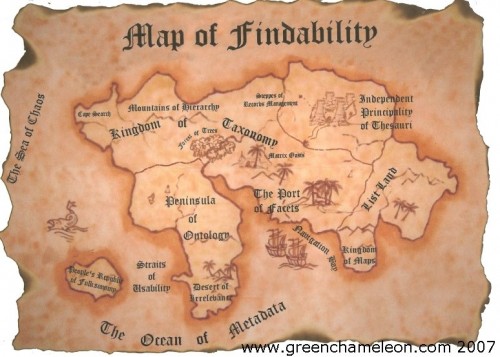
Map of Findability
Patrick Lambe gave us a fact-packed talk on taxonomies last night with this The Map of Findability as one of the highlights.
Monday, July 23, 2007
No, not really, you bunch of hoons
So Virgin Mobile have launched a campaign called "Are You With Us Or What?"
It features photos of people from Flickr with taglines such as "Dump Your Pen Friend" or "People Who Talk In Lifts Have Bad Breath". I can just picture a 'creative' yelling at one of his cretinous mates across a crowded room:
"Hey, Troy, look at these people, they're such losers. Wouldn't it be really cool to mock them in public across the country?"
Interestingly enough, the Virgin Mobile site offers the following advice to creeps: "If you are really freaking people out, know that this can result in criminal prosecution".
Steve Lewis makes the point: don’t post in public what you don’t want to be seen, used or abused
I think this is sad but true. I also think there is all the difference in the world between some random idiot saying you are a loser and a multi-national investing thousands of dollars in humiliating you in public.
Steven also adds: Is it all right for a company to use your pictures like this?
So for the litmus test for me is: Would the Virgin Mobile marketing department be happy if someone flyposted their pictures around Australia's major capital cities with the legend "dickhead" beneath each one?
It features photos of people from Flickr with taglines such as "Dump Your Pen Friend" or "People Who Talk In Lifts Have Bad Breath". I can just picture a 'creative' yelling at one of his cretinous mates across a crowded room:
"Hey, Troy, look at these people, they're such losers. Wouldn't it be really cool to mock them in public across the country?"
Interestingly enough, the Virgin Mobile site offers the following advice to creeps: "If you are really freaking people out, know that this can result in criminal prosecution".
Steve Lewis makes the point: don’t post in public what you don’t want to be seen, used or abused
I think this is sad but true. I also think there is all the difference in the world between some random idiot saying you are a loser and a multi-national investing thousands of dollars in humiliating you in public.
Steven also adds: Is it all right for a company to use your pictures like this?
So for the litmus test for me is: Would the Virgin Mobile marketing department be happy if someone flyposted their pictures around Australia's major capital cities with the legend "dickhead" beneath each one?
Corporate Blogging Strategies: Grass & Orchids
A few months ago I posted my version of a corporate blogging strategy - which basically says: "Open it up to as many people as possible, make it easy and see who's left standing".
You could call this the "grass" strategy - i.e. you seed the environment, give them a bit of encouragement and see what happens.
At the other extreme, you have one blog (possibly for the CEO). This is updated, cleaned and polished (probably with ghost-written articles). Comments may or may not be allowed and conversations are unlikely to emerge. You could call this the "orchid" strategy. It is important to note that the "orchid" strategy is not wrong - but it is a bit dull. However your organisation may like dull. In which case it should probably select this one.
However most organisations will end up with something that lies mid-way between grass and orchids. In fact, given what a blog is (a series of bite-sized chunks of content delivered at regular intervals with RSS alerts and reader comments), you will probably have a range of different bloggy "plants" (around departmental news or project updates or some persons fave links) in your organisational garden - some of which you will have cultivated yourself and some of which just got there. They will all be a bit different and require differing investments of time & energy. And recognising that these differences can be "OK" is an important first step.
You could call this the "grass" strategy - i.e. you seed the environment, give them a bit of encouragement and see what happens.
At the other extreme, you have one blog (possibly for the CEO). This is updated, cleaned and polished (probably with ghost-written articles). Comments may or may not be allowed and conversations are unlikely to emerge. You could call this the "orchid" strategy. It is important to note that the "orchid" strategy is not wrong - but it is a bit dull. However your organisation may like dull. In which case it should probably select this one.
However most organisations will end up with something that lies mid-way between grass and orchids. In fact, given what a blog is (a series of bite-sized chunks of content delivered at regular intervals with RSS alerts and reader comments), you will probably have a range of different bloggy "plants" (around departmental news or project updates or some persons fave links) in your organisational garden - some of which you will have cultivated yourself and some of which just got there. They will all be a bit different and require differing investments of time & energy. And recognising that these differences can be "OK" is an important first step.
Bloggers - where are you when your country needs you!
Ross Dawson laments the level of blogging in Australia. I'm half-and-half on this one. As an immigrant in a nation of immigrants, I want Australia to be connected to the world yet separate from it. As I will rant about regularly (generally after the 5 beer mark), Australia is an "edge culture" - the end of the world. If you can't experiment & explore at the end of the world, then where can you do that kind of thing?
And it needs to play this to its best advantage. As Thomas Barlow has indicated, we need to export Australians like they are going out of fashion. And then we need them to come back. And bring their virtual networks with them.
Also I think that some types of social software are more applicable to Australian culture than others - wikis & RSS rather than blogs. And BTW Facebook is hitting Sydney big time...
Anyways, I have a meat pie to put on the barbie...
And it needs to play this to its best advantage. As Thomas Barlow has indicated, we need to export Australians like they are going out of fashion. And then we need them to come back. And bring their virtual networks with them.
Also I think that some types of social software are more applicable to Australian culture than others - wikis & RSS rather than blogs. And BTW Facebook is hitting Sydney big time...
Anyways, I have a meat pie to put on the barbie...
Holding it in
So I read David DeLong's Lost Knowledge the other week. DDL's "Six Mistakes to Avoid When Implementing An Aging Workforce Strategy" are a pretty solid place to (not) start. A post on ACT-KM also generated some good responses from people (esp. Arthur Shelley, James Grey & Lindsay MacDonald) & some particularly useful material from TVA.
There was also a debate between those who wanted to pragmatically start somewhere (even if it's when those key personnel are about to retire next week) and those who advocated a particular approach which often identifying these people years beforehand. These kinds of debates seem to recur on ACT-KM and often seem to be between those who have to implement something within an organisation (however messy and flawed that might be) and the expert who wants to do it the "best" way.
In truth, the first time your organisation tries to consciously deal with a knowledge retention issue, it will probably screw it up. The key expert will be identified the week they are going to retire and a hasty interview may identify a couple of useful things. Everyone will say that this kind of thing is important and we should do it better. The critical thing will be: Can you use this experience to generate enthusiasm for a more sustainable approach?
There was also a debate between those who wanted to pragmatically start somewhere (even if it's when those key personnel are about to retire next week) and those who advocated a particular approach which often identifying these people years beforehand. These kinds of debates seem to recur on ACT-KM and often seem to be between those who have to implement something within an organisation (however messy and flawed that might be) and the expert who wants to do it the "best" way.
In truth, the first time your organisation tries to consciously deal with a knowledge retention issue, it will probably screw it up. The key expert will be identified the week they are going to retire and a hasty interview may identify a couple of useful things. Everyone will say that this kind of thing is important and we should do it better. The critical thing will be: Can you use this experience to generate enthusiasm for a more sustainable approach?
Sunday, July 22, 2007
Getting meta about metadata - creator vs. social tagging
Simon Carswell makes the following comment below:
Tagging is an interesting phenomenom - as this survey by Pew indicates. And I would split taggers into two groups:
Perhaps tagging/social bookmarking is the key to the context, though?
Tagging is an interesting phenomenom - as this survey by Pew indicates. And I would split taggers into two groups:
- Creators / Uploaders tagging their own content (blog posts, wiki pages, photos, videos, soundfiles, etc).
- Users tagging other people's content.
I suspect that the first kind of tagging is relatively common - esp. with photos. Photos are non-textual (unlike blog posts) and yet do not have a standard set of metadata lying around for them (such as the artist, title, album set for songs) so if you want to retrieve them then some form of tag is bloody handy (for both you & your users).
Why people tag the content of others is a little different. I may want to find something again (but if it's a file, I'd probably download it). But I might also want to share it with others. The "social" bit in social bookmarking is critical. These systems work when groups of people want to share things with each other. And yet sites like YouTube have "share this with a friend" buttons that obviates the need for that. So the tedious business of tagging is often unnecessary. If the purposeful social connections aren't there between people, I can't see it working on a large scale inside the enterprise.
Going back to Simon's comment, I think you need a common social context before you can engage in collaborative tagging activities.
Sunday link lurve - talking through another
Aidan Choles with the The Change House Cleaner - Lovely example of "how narrative allows people to displace accountability and responsibility for their stories". Clay or lego can do something similar.
Masks play a variety of roles in many cultures - one of which allows people to open themselves through hiding. This distancing can pose a risk - the mask allows me to falsely accuse you. But the use of masks is managed through ritual. The ideal that we only ever speak for ourselves and never through others is too heavy for us to bear so we develop ways of sneaking around it.
Last month I saw Ketut Yuliarsa don a mask during a poetry reading and masterfully spin an improvised patter. Ketut-in-the-mask told a tale about language and lies.
What is your favourite mask? I like to hide behind my glasses...
(Link thanks: Dave S)
N.B. This blog will remain a "Harry Potter"-free environment.
Masks play a variety of roles in many cultures - one of which allows people to open themselves through hiding. This distancing can pose a risk - the mask allows me to falsely accuse you. But the use of masks is managed through ritual. The ideal that we only ever speak for ourselves and never through others is too heavy for us to bear so we develop ways of sneaking around it.
Last month I saw Ketut Yuliarsa don a mask during a poetry reading and masterfully spin an improvised patter. Ketut-in-the-mask told a tale about language and lies.
What is your favourite mask? I like to hide behind my glasses...
(Link thanks: Dave S)
N.B. This blog will remain a "Harry Potter"-free environment.
Saturday, July 21, 2007
Do you want wikis with that?
Gartner have just come out with a research note entitled: "KM + Web 2.0 = Productivity and Innovation" - which explicitly links KM programs and Web 2.0 tools but doesn't do much else (keep up at the back there). Meanwhile Forrester have a survey that indicate Firms Use Wikis Mostly For Knowledge Management. The crowd split into three chunks of similar size: those with some wiki implementations, those with plans or pilots; and finally those with no interest at all. As the title suggests, "knowledge management" was the main use for these with collaborative content creation & project management down the scale. Good stuff but this survey highlights the paucity of data about the state of Enterprise 2.0 (or whatever we are calling it this week).
Thursday, July 19, 2007
Second Life ROI Nil - so far...
FOM post by Stuart Henshall
"I cannot help thinking that the examples of big brands and Fortune 1000 companies jumping into Second Life are just applying a Brand 1.0 type of model"
So here's a thought. Rather than be a property, make your brand a character. How does your brand live? What choices does your brand make? How does it interact with other users? If your brand could be a person, what would it look like? And what would other people say about it?
Someone's probably doing this already...
"I cannot help thinking that the examples of big brands and Fortune 1000 companies jumping into Second Life are just applying a Brand 1.0 type of model"
So here's a thought. Rather than be a property, make your brand a character. How does your brand live? What choices does your brand make? How does it interact with other users? If your brand could be a person, what would it look like? And what would other people say about it?
Someone's probably doing this already...
Content-ment
Apparently Web 2.0 is all about "user-generated content". Now you can break that content down by media type: blogs, photostreams, videos, podcasts, etc.
There is, however, another distinction (although a somewhat hazy one) between creating content to specifically put on the web for others to view and just making available content that you have created for some other purpose. "Broadcasting" & "narrowingcasting" might terms you could use, but they don't seem to be quite right. Most narrowcasters aren't consciously casting anything. They are just sharing.
Photos are an example of this. Very few people take photos to specifically post on the web. We take photos because that's one of our primary ways of recording events. Compare istockphoto (with over a million photos for sale by professionals & hopefuls & 14,000 new images a week) and flickr (with what seems to be 378 million photos and 2,264 uploaded in the last minute). Some of those flickr folk might be aiming to earn cash but many just want their friends to see what they've been up to.
Blogs & podcasts are a bit different. Most of us are not in the habit of creating weekly radio shows about our lives or handing out photocopies of our personal journals.
Video is an interesting halfway house. The profusion of digital recording and editing technology and the tradition of the "home movie" make it more like photography. But these will be videos that most people will not want to watch (other people's home movies are boring).
In some ways this reminds me of my content-based knowledge management experiences. Asking people to create content specifically for a KM activity is very difficult. Asking them to make available what they already have is still hard but easier. The promise of modern content management systems is that files and documents are caught in context. But most of these will not be documents that other people will want to see - the business equivalents of other people's home movies.
There is, however, another distinction (although a somewhat hazy one) between creating content to specifically put on the web for others to view and just making available content that you have created for some other purpose. "Broadcasting" & "narrowingcasting" might terms you could use, but they don't seem to be quite right. Most narrowcasters aren't consciously casting anything. They are just sharing.
Photos are an example of this. Very few people take photos to specifically post on the web. We take photos because that's one of our primary ways of recording events. Compare istockphoto (with over a million photos for sale by professionals & hopefuls & 14,000 new images a week) and flickr (with what seems to be 378 million photos and 2,264 uploaded in the last minute). Some of those flickr folk might be aiming to earn cash but many just want their friends to see what they've been up to.
Blogs & podcasts are a bit different. Most of us are not in the habit of creating weekly radio shows about our lives or handing out photocopies of our personal journals.
Video is an interesting halfway house. The profusion of digital recording and editing technology and the tradition of the "home movie" make it more like photography. But these will be videos that most people will not want to watch (other people's home movies are boring).
In some ways this reminds me of my content-based knowledge management experiences. Asking people to create content specifically for a KM activity is very difficult. Asking them to make available what they already have is still hard but easier. The promise of modern content management systems is that files and documents are caught in context. But most of these will not be documents that other people will want to see - the business equivalents of other people's home movies.
Wednesday, July 18, 2007
It's NOT not not about the technology
James Robertson on Andrew McAfee
"Magic bullet" thinking is a form of wish fulfillment found in two groups of people:
One difference I would highlight is that perhaps Andrew has only met with more enlightened organisations when he says: "I very rarely come across anyone these days who thinks that technologies are magic bullets." In my direct personal experience, I'm sadly still coming across plenty of organisations that are definitely still following the "magic bullet" approach...
"Magic bullet" thinking is a form of wish fulfillment found in two groups of people:
- Business people with a pressing problem and a weak understanding of the technology in question. Like a terminal cancer patient going to a faith healer to ward off imminent death - and indeed like all of us to some extent or another - people believe what they want (or need) to believe.
- Technology people with a wonderful tool and a weak understanding of the business in question. These people are like the faith healers - they have invested so much of themselves in their chosen path that it has to be miraculous. If only the lost could see that...
- There is a third group - possibly the biggest - who don't believe any of this but benefit from the delusions of the first two. Why be a party pooper and say what you really think?
N.B.I deliberately chose a religious metaphor as we all need something to believe in and technology provides many in the supposedly hard-nosed world of business with a beacon for the future - an eschatology if you will.
Where AM original post's gets interesting is that INATT (nice acronym) is used as a rhetorical move. And it can be used in several ways:
- To suggest that the best course of action is doing nothing as all this technology is the same and it didn't work the last time we tried it eh? (AM's comment)
- It can also be used to show that the speaker is harder of nose and more business-focused than their opponent (and we all know that the person that proves they are the most business-focused wins as those are the rules).
- It can be used to cover up ignorance on the part of the speaker - let's talk about something I actually understand rather than this technology malarky.
P.S. INATT reminds me of the "We just make music for ourselves and if anyone likes it, that's a bonus" line trotted out by bands (& universally loathed by music journos).
WebTrends 2.0?
So Web 2.0 got a big mention at the WebTrends roadshow although on reflection I'm not sure that much was said.
- Rich Applications (built with AJAX & Flash) were there and RSS & broadcasting got props too.
- It seems that web analytics have become very sophisticated in terms of the events they can track - you click, they know about it. And event-based metrics are very interesting to site designers - esp. if your site is transactional.
- User-generated content got heads up (the critical events being "view", "share" & "submit"). As did the existence of a wider system of forums, blogs & wikis outside your site.
For all this, web analytics is still about the interaction between a user and a site. What seemed to be missing was the social dimension of interactions between people through and about the site (except for people clicking on a "email this cool video/graphic/virtual custard pie to a friend"). The WebTrends model seems to place web analytics firmly in the camp of analytical CRM tools that allow to segment & dissect your customers to the nth degree but don't acknowledge that they might interact with each other independently of you.
In other words, we have got more precise & accurate over the last decade (and this is no bad thing) but our users have yet to become people.
Subscribe to:
Posts (Atom)

 Posts
Posts

