Wednesday, April 30, 2008

podcast - luis/patrick/alex - email detox (2): infrastructure & politics

Following on from the last post.

Download Part 2 now (20:23, 4.8 Mb)
  • 00:00 - Patrick raises the infrastructure question.
  • 03:00 - Luis brings up wikis.
  • 04:10 - Luis talks about discussing the detox with his team.
  • 07:55 - The laziness issue.
  • 09:00 - Do we love email?
  • 10:00 - Alex mentions email overload.
  • 11:00 - Generational issues.
  • 13:00 - Patrick raises the politics question.
  • 15:00 - Luis busts the whole thing wide open.

Monday, April 28, 2008

podcast - luis/patrick/alex - email detox (1)

I had the pleasure of conversing with Luis, Patrick & Alex about Luis's email detox programme. Here is the first part (of three) for your listening pleasure.

Download Part 1 now (16:48, 4.0Mb)
  • 01:00 - Luis describes his email detox moment in 2007.
  • 03:10 - Luis challenges his email correspondents within IBM.
  • 06:10 - How do you bring people round to the post-email world?
  • 11:00 - Where is email appropriate?
  • 13:00 - Instant messaging & social networking.

Sunday, April 27, 2008

podcast - puneet gupta - connectbeam

A couple of weeks ago, I had the pleasure of talking to Puneet Gupta, CEO of Connectbeam, a US social search company. Conntectbeam get a mention in the collaborative bookmarking presentation.

Download the mp3.
  • 00:45 - Introduction: Connectbeam = del.icio.us + LinkedIn for the enterprise.
  • 03:25 - How does Connectbeam actually work?
  • 05:20 - Which organisations are using Connectbeam?
  • 06:45 - Who is using the tech inside these organisations?
  • 08:00 - The knotty question of ROI.
  • 10:45 - The future of Enterprise 2.0 - Connectbeam as the Heart of Collective Intelligence.
  • 13:45 - I attempt to lighten the conversation & fail miserably but an interesting comment on tag clouds & cultures emerges from the wreckage.

presentation - showing the value of km

A presentation on demonstrating the ROI / Value of Knowledge Management to beancounters - based various experiences. Of course, I can't put the really juicy stuff in the presentation - you'd have to get me in to deliver it for that...

Tuesday, April 22, 2008

jumping the shark

A sure sign that an organisation's knowledge management programme has passed its prime would be its inclusion in the MAKE awards. Why? The MAKE awards are basically a beauty parade judged by execs & "experts". To get in there, you need to have written articles (preferably a book), schlepped the conference circuit, blown your own trumpet until your lips are cracked and dry. Which means that your best work is probably behind you and your organisation is presumably not getting your full attention.

A similar beauty-parade rigorous survey method is used by Boston Consulting Group to compile Business Week's list of the world's 50 most Innovative companies. It's actually very useful - but not quite for its stated purpose. It tells you what senior execs think innovation is:

  • Nifty design ("Yeah, those iPods & iPhones are cool, man. Why can't we make something that f***ing cool?")
  • Something about doing things better ("Didn't Toyota come up with six sigma? No? Huh, GE? Who then? Motorola??? Get the f*** outta here!!! S***!!! Can we can that six sigma rustbelt program already?")
  • Making truckloads of money ("Bill Gates is an a**hole. A total f***ing a**hole. God, I wish I was him. And as for those Google a**holes...")
  • Making stuff cheap ("That cheap Indian car. Yeah, you know the one that looks like it would fall apart if ya farted in it. That's f***ing innovation - you tell me that isn't f***ing innovative!!! But ugly, oh jesus, fugly as all hell. Not like my iPhone, my preciousssss...")

Meanwhile Millward Brown's list of the world's Top 100 brands (sorry, brandz) is interesting to compare to Interbrand's list of world's Top 100 brands from 6 months ago. Now is Google or Coca Cola the world's biggest brand? Or are they both? Is this going to be like school sports day - does everyone get a prize? Even the ugly, spastic kid with the mother and the sister who are the same woman*? I'm guessing this brand valuation thing isn't an exact science.

*Now answers on a postcard which brand that would be.

Thanks: Johnnie

social software round-up

Forrester says Enterprise 2.0 worth $4 billion - which puts it at about the same size as the online porn industry - based on my exhaustive research.
James Dellow says Enterprise 2.0 is not KM - good on yer, James.
5 Social Computing Benefits that Adoption Rates Don't Show - good on yer, Rex.

Saturday, April 19, 2008

text messages

Moving on from automated to human textual analysis, I've been having a bit of a look at XSight & NVivo from QSR. Back when I was doing my Masters, I recall a product called NUD*IST getting a mention. Basically this tool allowed the coding of interviews to help academics with quantitative analysis. This has become XSight for market research types & NVivo for academics.

XSight allows you to store your interview notes (ordered by research demographic) so you can annotate & tag them. You can create mind maps & research frameworks and then link them back to your source material & annotations. It's pretty handy but not as neat as the latest version of NVivo which allows you to code video and audio. NVivo makes less of the mind-mapping / white-boarding stuff and gets straight on with the multi-media tagging. It claims to have nifty collaboration & web publishing functionalities as well but I haven't put those to the test yet.

Now I've talked about hybrid human / automated metadata recently. I think we'll see hybrid semantic analysis tools emerging that mix automation & human involvement. SenseMaker is another example of this. We human beings are meaning machines. Just as we have created machines to enhance our vision & hearing so we need to develop technologies to aid our senses of comprehension.

workin' in a text mine

OK so what was the point of that last post? I suppose one thing that struck me using Leximancer was that these tools are neat but (like their data mining brethren) it'll be a long time before they move beyond specialist uses into the wider world. So much depends on skilled human operation in terms of framing a problem, selecting & screening terms, and interpreting results.

What experiences have you had with these tools?

Some resources:

leximancer duel - izzard vs hicks

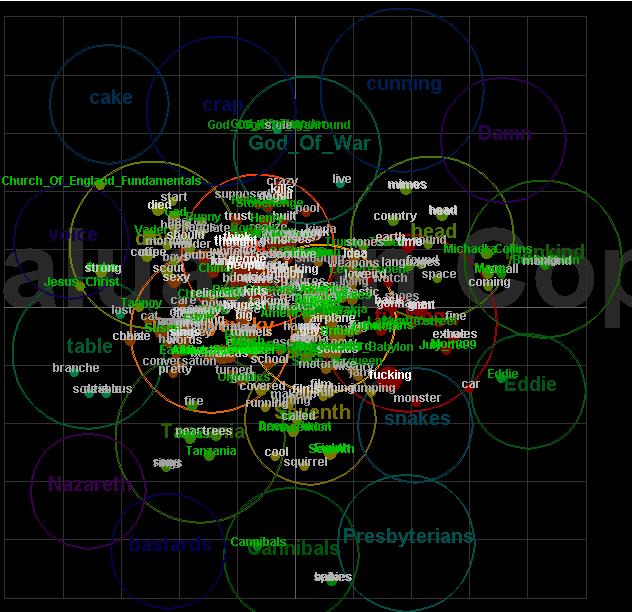
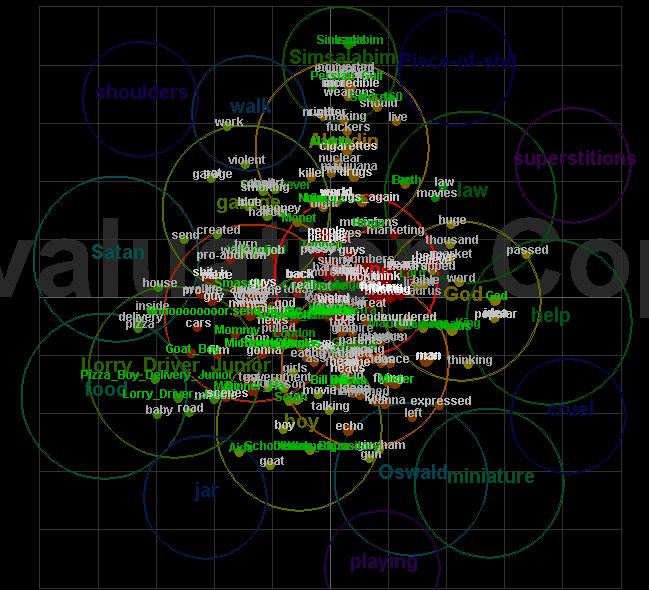
Barry Saunders' stuff has inspired me to have a look at some text mining tools. So I got a trial copy of Leximancer and got busy. I will feed Leximancer various texts over the next few days. I began with a rather hefty challenge: The transcript of Eddie Izzard's Dressed to Kill DVD.

The initial sweep on default settings yielded this (click to enlarge):


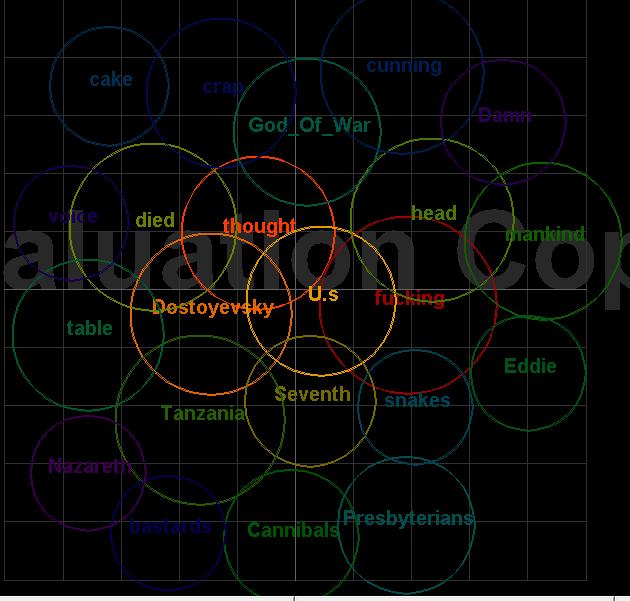
Massively increasing the terms (or concepts) yielded this (click to enlarge):

Which is a little clearer if you remove the concepts themselves and just leave the themes (click to enlarge):


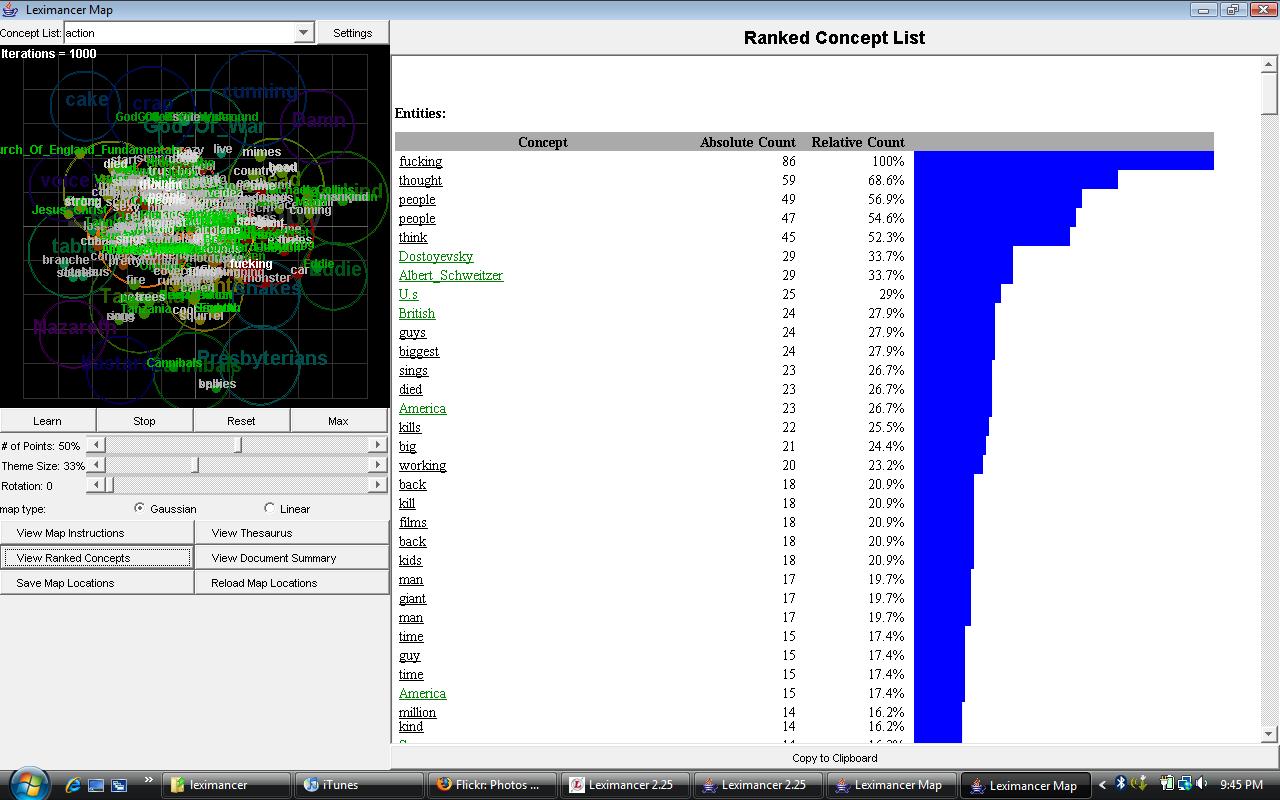
And here is some ranking (click to enlarge):


So what can we tell?
  • Eddie has a bit of a foul mouth.
  • Eddie has a "thing" about religion.
  • And war.
  • And cake.
  • Eddie is probably British.
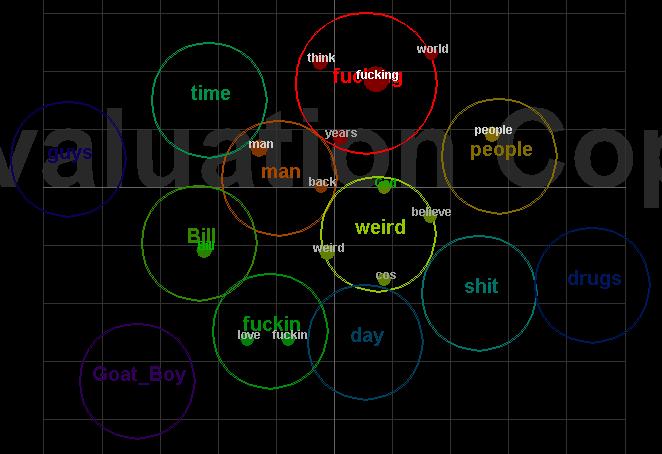
I then unleashed Leximancer on this transcript of Bill Hicks from the early 90s.
Some conclusions for Bill:
  • Like Eddie, Bill also has a foul mouth and issues with religion & food.
  • I really should use this stuff for something more serious.

Thursday, April 17, 2008

aiim findability survey

Following on from their Enterprise 2.0 Survey, Dan & Carl AIIM are doing something similar for Findability. Dan has provided an overview on their approach & requested feedback and also offered an initial list of technology solutions. I like their open approach to both constructing the survey & making the final report available for free (and altho Carl is probably right that the final result shouldn't be a wiki, it should be something more digestible than a single PDF).


One observation I would make about findability tech is that you basically have 3 groups:
  • Content creators / providers
  • Content users
  • Content managers (from both an IT & editorial perspective)

And these 3 groups can have 3 relationships to the tech:

  • Don't use
  • Consume but don't own / control
  • Own / control

Trad search is owned by content managers & consumed by content users. Trad taxonomies tend be owned by content managers (hopefully with some input from the business) & consumed by both content providers & users. Findability tools - esp. social software - tend to have broader spans of ownership/control which makes them simultaneously more power AND harder to manage.

Wednesday, April 16, 2008

podcast - nancy white & ed mitchell - blended facilitation

I had a blast recording this session with Nancy White & Ed Mitchell on "Blended Facilitation". It's a bit on the long side but I am loathe to cut it. We'll probably do another one and Mr Mitchell has requested "more structure".

Download the mp3 now.
  • 00:50 - Ed talks about doing a mix of online & offline facilitation with the Media Sandbox.
  • 04:00 - Nancy talks about 4 types of blending: Modalities (sight, sound, touch); Online/Offline; Individuals/Communities; Methods.
  • 06:00 - Nancy discusses Seeds of Compassion.
  • 09:50 - Matt mentions "extending the event horizon" & multi-modal poetry.
  • 13:00 - Online and/or Offline?
  • 15:30 - Ed's door intrusion leads to a discussion of Second Life.
  • 19:20 - Different strokes (or tools) or different folks - provided there are overlapping experience.
  • 22:30 - The thorny question of Generations (Y, X, Boomer) - going into broader diversity issues (e.g. participants from Africa with lo-bandwidth).
  • 26:50 - Mindfulness, feedback & signals - the ethics of sharing community data.
  • 30:10 - Facilitation + Manipulation = Facipulation.
  • 34:00 - The public, the private & ambient exposure. Where are the boundaries?
  • 38:50 - We hit the knotty question of identity
  • 39:40 - We lay into the culture of expertise.
  • 41:00 - I think we've all learnt a valuable lesson here, haven't we?
(It sounds like I'm cutting in & predicting what Ed & Nancy are saying but that's an artifact of the recording process, mostly - just shift my words back 10 seconds compared to Nancy & Ed)

collaboration tools: centricity

Most social software tools have a focus, a centricity. The focus of that tool will effect your use of it. You can try using Facebook as a wiki but it won't really work - because the focuses of each are different. Here are some suggested focuses. What would you change? What would you add?

[In fact, wouldn't this blog post be better as a wiki page?]

Tool

Centricity

Wiki

Page

Blog

Post

Tangler

Forum / Thread

Flickr

Image / Account

Facebook

Ego-based Network

Ning

Community

YouTube

Clip

podcast - james dellow - enterprise rss action day

Today I interviewed James Dellow about the Enterprise RSS Day of Action.

Download the podcast here (8Mb, 32:54)
  • 2:00 - Andrew McAfee & SLATES - Enterprise 2.0 is about more than just wikis.
  • 3:05 - Grey Areas - when social software isn't "social".
  • 5:30 - What is RSS? - Really Simple Syndication
  • 9:50 - So what about Enterprise RSS?
  • 11:40 - What are the benefits of Enterprise RSS? (the elevator pitch is longer than 30 seconds)
  • 14:30 - How will it impact the behaviour of users? It's all about AWARENESS...
  • 15:40 - How does it impact internal communications? Measurement & persistence...
  • 19:45 - The 10 things that James wants from Enterprise RSS.
  • 21:50 - The top 3 challenges to Enterprise RSS: Content / Technologists / Users.
  • 23:35 - How to get started with Enterprise RSS.
  • 25:50 - Vendors: Attensa & Newsgator.
  • 28:20 - Pervasive RSS - Feeds Everywhere.
  • 29:35 - Enterprise RSS Action Day.
Nice one James!

exploring the webs of citizen journalism

Barry Saunders (thanks Laurel) is doing some very interesting research into citizen journalism & issues on the web. His work interests me on two levels:
  • Citizen journalism itself - which simultaneously has been around for a very long time and is also very new in its current visibility.
  • The tools he is using to explore this. Issuecrawler and Leximancer look intriguing. Anyone else played with these already?

Tuesday, April 15, 2008

extending the event horizon - collaboration tools

The triggers for this pondering of collaboration tools have been a bunch of events that I am in some way involved with. Many are conferences (or sometimes unconferences). The aim is to "Extend the Event Horizon" (thanks Katie) both before and after the event - should participants want to do so.

Before: Sydney Bar Camp used both a blog - for news releases- and a wiki - for registration. NSW KM Forum also uses a blog for announcements.

During: The Enterprise 2.0 Forum used Tangler as a virtual interaction environment and several people were Twittering like crazy during Bar Camp Sydney. Second Life is becoming the place to do virtual events but I'm not so sure about that.

After: This is up for grabs. A key factor here is the technical savvy of participants. You may just want to stick with an email list. A step up from that might be a Facebook group. I think Facebook makes a pretty rubbish collaborative environment beyond simply pumping out information to interested parties. As Axel Brun (thanks Gav) puts it very well, it's too ego-centric, it mixes up all your relationships in one big pile of social slop & the activities you can engage in are pretty rudimentary. But then a nightclub is not the same environment as an office. Like Axel, I've developed a taste for Ning. If you want your event to be part of something longer-lasting, then I'd go for something Ning-y. But you (& your participants) might not have the appetite for something longer-lasting. In which case, the quick & dirty options (e.g. email) are just fine.

collaboration tools: stags

I've been thinking about different collaboration tools for various groups recently and I was pondering on some of the different factors you need to consider and I came up with this (click to enlarge):

Let's take each of these in turn:

Size - One thing to consider are the numbers of people who will be collaborating. Three rough groups sizes come to mind:

  • Teams (15 approx) - small number of people. Most collaboration in our world that is aimed at doing stuff (as opposed to talking about doing stuff) probably occurs in teams of 5-30 people.
  • Tribes (150 approx) - departments, small businesses, communities of interest, Christopher Allen's groups, will have 60-200 active members (plus as unspecified number of blow-ins, lurkers, guests, etc). Note: There may be 300+ people registered as users but the actual number of participants will be far lower. There will probably be less collaborative work and more discussion / show 'n' tell.
  • Wide-scale (150+) - Examples here might be IBM's WorldJam.

Assertion: Above 6 people, the size of a group is inversely proportional to its ability to get things done.

Timeframe - The time period over which people will be working together is also important and again I have gone for 3 rough divisions:

  • Synchronous (o seconds delay) - I need to work with people now. N.B. There is probably a limit to the number of people I can work with at once without going insane. It is probably less than I think.
  • Ephemeral (1 min to 1 week) - It will be over relatively quickly. Longevity & content persistence are minor issues here.
  • Project (1 week to 1 year) - For collaboration with a defined start and end.
  • On-going - It might be collaboration within an official group (a department) or an unofficial group (a community) but we don't know when it'll stop. Content persistence is important here.

Activities - When people collaboration, they need to do stuff. So this list is a little arbitrary. I'm sure that there's more that could go in there. But for me critical areas are:

  • Discussing - Talking about stuff. Ideally in a threaded environment so it's possible to track discussions.
  • Planning - Identifying tasks & their dependencies, giving those tasks timeframes & assigning people to those tasks. Project Management 101.
  • Creating - Probably co-creating written content to begin with (but also mindmaps & images). Yes I'm talking wikis here.
  • Sharing - Sharing documents - be they individual word/excel/ppt files or collaborative wikis/google docs. Also media files - images, audio & video.
  • Commenting - marking up documents & adding tags / commentary. BTW I have been having a look at QSR's Nvivo - which allows you to tag sections of audio & video files. This is a product aimed at social science researchers (with a price tag to match) - but there are obvious applications of this in the consumer space.

Geography - I'm not going to say too much about this but basically the more dispersed by space, timezone and culture the collaboration participants are, the more you need to make explicit and the less you can rely on workarounds. Persistence & easy finding of content is critical.

Similarity - So are these people all from the same organisation (with the same culture & infrastructure)? Or do they come from many organisations? This could also be called Security. Do I want to keep our collaboration private or am I happy to have it open to the world?

These are just the things that I've been thinking of. I'm sure that you could come up with more.

window shopping

ABB hits me with a Johari Window reference in the comments. It has something to do with presentation management, ambient exposure and mindfulness. I don't quite know what yet.

There's a pragmatic viewpoint of this in terms of personal data:
  • Hidden = C:/ drive
  • Open = Blog
  • Blind = CRM / Gov data (held about you of which you are unaware)
  • Unknown = Unknown data
There's another viewpoint that asks us to examine our relationships with others - that may or may not be mediated by social software. Do these tools make us more or less aware of what we put where and when?

There's a third viewpoint that queries who the "self" and "others" are here. Are there not multiple potential groups of "others". And is "I" always the same?

Anyway time for some cogitating...

a word to the wise

Patrick Lambe gets stuck into Wisdom Management. One sentence sticks in my mind: Wisdom management cannot but focus on the knowledge and ability of privileged individuals.

Some observations:
  • James Surowiecki would probably disagree with this.
  • There is a demographic driver here. The baby boomer generation is just about to retire. Forty years ago many of them sought enlightenment & nirvana. And now they hit their sixties, they want wisdom. I'm not sure it works that way. Nor am I sure that all of them lack it.
  • Decision-making & mindfulness are two closely related things that most of us I struggle with.
  • Those pushing wisdom-enhancing courses are probably some of the least-equipped to do so.
I like the notion of wisdom but I'm not sure I like the notion of having it sold to me.

Monday, April 14, 2008

incentives schemes and behavioural economics

I am currently reading (& loving) this book. I was reading chapter 4 on social vs market norms last night - excerpt here - and it explains why incentive programmes around knowledge sharing often run out of steam. Alfie Kohn has written at length on this topic but Dan Ariely puts it in a slightly different way.

When people share their experiences, skills or knowledge they either do it in a social context or a market context. If they do it in a market context they will expect to be rewarded appropriately - and if they are highly experienced (and expensive) it will cost you a lot. Conversely, if they do it in a social situation, they do not necessarily expect financial reward (but they will often expect some form of social reciprocation). However once you replace a social context with a market context it becomes very hard to bring social norms back. You are stuck in "**** you, pay me" situation. The interesting thing is that a gift is OK in a social situation provided you do not link it explicitly to money.

The issue with most incentive schemes designed to encourage collaboration is that collaboration is built on social norms that you destroy when you make it all about the money. And most KM programmes do not have enough budget to pay participants for their collaboration at the market rate.

DA goes on to write about the broader implications of social vs market norms for employers, employees and customers but I'll let you read that for yourselves.

Friday, April 11, 2008

dunbar's number online

This post generated a comment from Patrick. In posts here and here and in this presentation, Christopher Allen discusses the size of functional online communities - and comes to the conclusion that the Dunbar number is a limit rather than a mean. Most online groups will have around 60-80 active members.

Hmmm.

BTW I did some more analysis of the ACT-KM discussion list. See summary.