Saturday, May 12, 2007

Identity (Slight Return)


"Identity is the crisis you can't see"


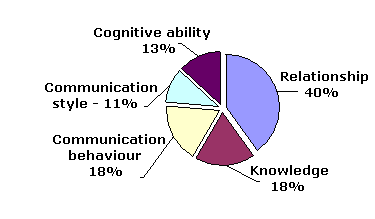
Probably of all the writers on the web, Dave Pollard is one the I find most consistently challenging. There are lots of other writers I like to read but few have pursued their thinking & its written expression with the engaged rigour that Dave has. I frequently find myself at odds with what he has written. I do not always relate to the emotional turbine that powers him across my screen (particularly with regard to gaia & environmental catastrophe). So I find myself considering his post We Are Not Who We Think. It triggers all the thinking about intention & identity (that found expression in this discussion with Miguel and my trying to read this book & failing to understand it) that something (which might be me) has been churning for the past few weeks. I agree with Dave that we are not who we think we are. I suspect that intentionality is a fiction to useful for us to ever discard.

If our actions are indeed "the tantrum of our genes", then where, in the 'product' that is each one of us, is us? If we are, as I would posit, simply our knowledge, our beliefs and our imaginings, figments of reality, and if these three fragile, fleeting figments are determined by our genes, our culture, and our senses, experiences and memories, and if in turn these figments determine what we do, and don't do, during our too-long, too-short 'lives', what control do 'we' have over any of it?


To remix Dave, the paradox of control applies us all as individuals. We are the product of genes, culture, sensation. We are meat puppets. We are masters of the universe. We make decisions. We carry on. There is no core of who we are, no homunculus pulling the strings. We are a jazz improvisation not a symphony under a conductor.

If we want to save the world then we must do so precisely because we are not autonomous. Our genes are not just ours but shared with all life on earth. Our identities do not stop at the edges of our brains or the surface of our skins. They spill out and mingle in a hideous intimacy with the whole of creation. We are the world* and frankly that's a bit scary.

If we want to save the world then we must use all the resources that constitute us. The genetic heritage of millions of years that fuel & form us. The cultures that shape & are shaped by us. The sensations & experiences that are unique to each individual yet can be common enough to withstand the (t)errors of communication.

Now I just have to get off my fat arse & do something.


*N.B. We are not the children.

Flattened

As a follow up to recent post on globalisation, I want to talk a little about Tom Friedman's Flat World. There is a lot of great reportage in this book - although it's a little breathless. Tom doesn't present a world with many choices in - except winning the economic race or losing it. And whilst he states that he is a technological determinist but not historical one, it's kinda hard to see the difference in practice. The effect is a Marx in negative - with globalised, hypercompetitive capitalism taking the place of a world socialism utopia.

If you take the book as a wake call to its American audience then it's in favour of much good stuff (lifelong learning, improved education opportunities, industrial deregulation). Given the prominence of globalisation in the executive worldview (which is the fancy English word for Weltanschung), it will probably be remembered as the business book of the decade (in the same way that this was for the 80s and this was for the 90s). However the vivid sense of place that Friedman's writing conveys together with the character vignettes set it apart from the prescriptive egoism of much of the "Business" shelves*.


*Friedman, Gladwell, Surowiecki - all journalists. Not consultants. Not retired CEOs. Instead writers who can string words together in a compelling way for regular people to read rather just ambitious middle managers & paranoid executives eager for the next big idea to pilfer.

Friday, May 11, 2007

Singapore Sling Shot


So I've just come back from an enjoyable if not wholly satisfying trip to Singapore. As much as I like the Island of a Thousand Shopping Malls, it often feels like some state-controlled experiment in consumer capitalism. Offices, retail outlets & restaurants acting as temples for the officially sanctioned activities of working, eating & shopping. The brightly-coloured malls are the alter egos of the dowdy concrete monuments to state socialism in Eastern Europe.

An oasis of calm & order in the tropical craziness of South-East Asia, Singapore has been called the Switzerland of the East (N.B. Like Switzerland it has four official languages). Only with laksa & sentosa instead of cheese & the alps. Singapore is an experiment (economically, racially), a vision of the future and - as a city state built on trade - a throwback to the past. If Australia is the edge of the world then I sometimes wonder if Singapore may be its new centre.

Very much on the plus side, I got to meet:

Wednesday, May 09, 2007

War On Talent


So we have a War on Drugs & a War on Terror. I love declaring armed conflict on the general (I can't decide between a War on Flowers & a War on Nervousness as my targets next week). There is also the War for Talent. Malcolm Gladwell rips into it here back in 2002. And Bob Sutton has a more recent go here.

Historically wars have often been about access to scarce resources. In the agricultural age, that meant land & the people to maintain it. In our present age, we face conflicts around oil & the other raw materials of production. We also apparently face a war for talent. There isn't much talent about so we must fight each other to possess it. And when we get it, we must keep it safe behind a wall of large bonuses.

The thing is, I don't think talent is that scarce. Has the world suddenly got more stupid? I do not believe this to be so, despite evidence to contrary. Is the workforce contracting? Many baby boomers are just starting to retire - N.B. Retire, not die. Those pension funds will buy a lot of health care - these people will be around for a while. And there's only so many games of golf you can play without wanting to indulge in some a bit more substantial.

If something isn't actually that scarce, then what is the point of fighting a war over it?

Calling for a Talent Ceasefire

  • McKinsey's "up or out" policy means they have a network of advocates now working for potential clients. IBM is starting to get its head around this with "Greater IBM". CIO Update & HCI have some info about corporate alumni programs.
  • Buying talent is expensive. Growing people in your organisation is probably a lot cheaper. Do you know what your people are good at to begin with?
  • Are you getting the best out of your employees? If you know what your employees are good at, do you have them doing that? Or something else just to fill the boxes?
  • Are the systems & processes you have in place working properly? Or have you set your talented, expensive employees up to fail?
  • Are you using the talents of your customers, suppliers & partners? Or is collaborative innovation just something a guy from Bain asked you about on the phone at the end of last year?


Two footsoldiers in the War on Talent photographed yesterday

Monday, May 07, 2007

Surfing the Web Abnormal


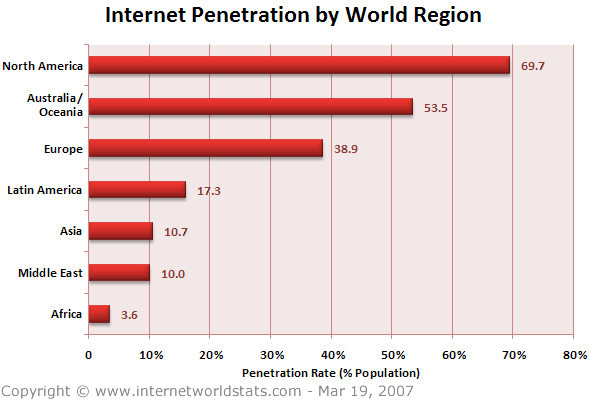
So in the comments thread about the Web 2.0 Beliefometer - I was reminded of a simple fact: Using the internet is still an abnormal experience for most inhabitants of the globe. Their lives may be touched by it but they don't see it.

The other thing it prompted me to do is look at global illiteracy rates. These have halved (from 36% to 18%) since 1970 for those aged 15 & above - Yay! This masks huge differences - over 50% of women in West & South Asia are illiterate as opposed to less than 2% in Europe - Boo!

[N.B. Does anyone have any figures on worldwide TV & radio usage?]

We worry (or in some cases rejoice) that our societies are becoming post-literate when many societies are still coming to terms with the whole reading thing.

Those of us who work with computers (social or otherwise) tend to assume our experiences are typical when in fact we are statistical freaks (damn it - that's what I should have called this blog all those months ago!)

Sunday, May 06, 2007

Web 2.0 Beliefometer


So I disagree with Luis about the impact of Web 2.0. Seeing as there's been this debate on the web (Tom Davenport, Andrew McAfee, etc) about Web 2.0, I have created a a fool-proof Web 2.0 Beliefometer to test your view of Web 2.0. Originally I was going to plot the positions of various people (Luis, James Dellow, Euan Semple, etc) but then I decided that I would instead let others do it for themselves.

If you know me, I have I positioned myself accurately here? Or am I completely delusional?

Ghost Writer


Luis Suarez writes 5 excellent reasons why ghost-written CEO blogs are a rubbish idea:
1. Trust
2. Authenticity
3. It will no longer be your own Personal Knowledge Management tool
4. Faking relationships
5. Lack of passion & involvement

For some reason, this all reminds me of Larry "The Surrogate" Mittleman, George Bluth Snr's stand-in from Arrested Development.

Flowchart


Saturday, May 05, 2007

2x2 Matrix


Richard Pryor: Thought Leader


Last night I watched a DVD of Richard Pryor in Concert. Pryor is amazing, getting laughs out his heart attack, his arrest by the police, getting beaten as a child. My housemate made the comment that all comics are like Pryor now. Which is true, but 40 years ago, they weren't. Between them, comedians such Pryor, Lenny Bruce & George Carlin changed what was possible to say on stage, what it was possible to discuss in public as a comedian.

"Leadership" is talked about a lot in the management literature. I was listening to the HBR ideacasts whilst wrestling with some HTML coding the other day at work. It seemed like every second item was the 7 secrets of leadership this & the 3 core competencies of leadership that. After about 5 or 6 of these babies, I ODed. I felt my hair going all pointy & the urge to inflict random acts of leadership on strangers became almost unbearable. I tore the headphones from ears & ran from the room screaming.

The reason we talk so much about leadership is it's scary. Underneath all the words, being a leader is a very simple thing:
Going somewhere that no one else can or will go & getting other people to come with you

Note the first part: If you are going somewhere everyone else is going how do you know that people are following you and not someone else? And going there by yourself is no good. And getting other people to do stuff ain't always easy. Hence the focus on incentives, rhetorical techniques such as storytelling, etc. Because if people are like machines then "point & click" leadership is possible.

And this applies completely to "proper" thought leadership. Most of the stuff put out under this rubric is really marketing bumpf with a survey attached ("75% of Ukrainians like cheese, please buy our software/consulting/toilet tissue"). If there isn't some shock on reading then it's not really telling you anything you don't know already. Pryor was arrested for public obscenity. Are you ready to get arrested for what you write or say? Does this mean all your thought leaders need to be sent on a program of cocaine freebasing & spousal abuse? No (but don't dismiss it out of hand).

One point I would make is that often we are given the choice between saying what we think is true & what we think will make others like us. Most of us end up going for the latter option. If you always do that then you will never be a thought leader. N.B. They tend to be them arsey so-and-sos. They may need other people to sell their ideas for them. Pryor was very charming but he had champions inside show business to smooth over the messes he made.

We tend to focus on individuals as leaders - possibly because we are still infatuated with charismatic saviours. My own experience has been that 2-3 people can act as a "thought leadership" team. They need to trust each other tightly & respect each other's abilities but it is possible. One to find the ideas, one to tell the first one when they're full of it & a third to sell the vision to the group as a whole.

What are your experiences of collective or individual leadership?

Thursday, May 03, 2007

Posing The Question


I don't give a good **** what you know... I'm gonna torture you anyway


So Lt Columbo's application for the KM team went through fine. There is still some debate about Mr Blonde however. His loyalty & tenacity are admirable but he lacks something in the people skills department. He is certainly a passionate self-starter but we have a strict policy on ear removal here & he didn't follow it. In the end it comes down to results and he failed to identify the rat. Loser. And also Michael Madsen was better looking than me in 1992.

There has been some debate in the US regarding "interrogation techniques". Let me just say that waterboarding should not be used in Lessons Learned workshops unless absolutely necessary (may be I've watched too many seasons of 24).

Questioning is skill that few people master properly. The basic fact of the matter is that people lie - or rather they do not tell the truth. In answering a question, the priorities generally are:
1. What do I think makes me look good.
2. What does the other person want to hear.
3. What might the facts support.

For example, a friend of mine was in a loss review with an account team. When asked to provide a reason for the loss, the account manager began to say "Because the price was too hig-" just my friend (who is responsible for pricing) pointed to a graph that indicated their prices were the lowest in the marketplace. Hmmm - time for a new story. There is an old adage that a bad workman blames his tools. It is more acccurate to say that any workman blames their tools when their manager's boss asks.

When trying to do a lessons learned exercise, indirect questions that focus on events rather than individuals are preferable. Multiple, diverse points of view also provide a reality-check.

This also impacts the validity of survey data. People lie in surveys. Or rather I have lied in surveys. And I am extrapolating this survey sample of one to the entire population. Surveys may provide indicators of what people would like to believe about themselves or what they think you want to hear but caution is required.

I like data that indicates what people actually do rather than what they say they do. And as Gavin indicates virtual environments provide lots of opportunities for data collection. But be careful - people are canny. You don't need words to lie...

N.B. We are still reviewing Dr House's application. We fear that we will get cast in the role of exasperated yet supportive boss - and that's nowhere near as much fun as being the know-it-all jerk.

One In A Million?


John Hagel posts about living in the world of Pareto rather than Gauss. If you have encoutered The Long Tail then you know all about Pareto distributions - hell if you've been to see a blockbuster movie or started a blog then you know all about Pareto distributions.

Now this links to at least two previous posts on this blog. Do the results of Andrew McAfee's research into the impact of IT spending imply that certain forms of IT can turn industries Paretian rather than Gaussian?


The other topic concerns events. Hagel & the authors he cites suggest that apparently "one in a million" events are more common in a Paretian world than a Gaussian one. Benoit Mandelbrot - the dude who should have invented the etchasketch - has done fascinating research on the Paretian nature of financial markets. We may miscalculate the chances of rare events if we do not understand the nature of the system properly. This also implies that as the agents in a system become more interlinked the predictability & probability of behaviours & outcomes will change.

Hectik Social Vhirl Dahlink


So last night was both Step Two's 10th Anniversary. James Robertson was briefly in the country to host this. There's a rumour that he doesn't actually have an Australian passport & therefore can only stay here for 1 month at a time or risk deportation. If you want to put in for that working holiday visa, James, I'm happy to be a reference. The Step Two offices are quite funky & decorated in the colours of their Intranet Roadmap. Stories that every staff member has had said Roadmap tattooed on their torso remain unconfirmed. Remember everyone: See major surgery or unintentional nudity as less about pain & embarrassment and more about brand reinforcement. The food & company were good - thanks people.


Continuing the Web theme, Joe Jaffe was in town for a flying visit & a group of bloggers turned for dinner & podcasting. Joe had a camera that may count as a concealed weapon in some states & endearingly cheap sound recording equipment. I got to chat a bit to Lukas, Michael, Paull, Steven & both Sarah & Mercurius. Now a confession, Gavin "No Show" Heaton told me about this event. I had never heard of Joe (though there was an air of hushed expectation whenever he spoke*) prior to this. He seems to be doing some cool stuff & anyone willing to record a podcast with complete strangers (& involve everyone) deserves full kudos points. At one point, Katie encouraged me to share my annoying passion for value networks. The response reminded me of the effect bringing out my fourth volume of rare Begian stamps has at dinner parties. Bit of polishing on the pitch required. So good drinks & good company. Hey ho.

*Reminding me that charisma is something you ask other people to give to you.

Wednesday, May 02, 2007

Herds


Just finished Mark Earls' book Herd. Mark's background is advertising & marketing and his basic proposition is that we are not primarily individuals but in fact social animals. And any attempt to understand us as customers/employees/etc must take into account our social nature. Mark is an intelligent writer and his book draws on neuroscience, anthropology & Peter Kay to argue for our herd nature. Along the way he critiques WoM marketing, focus groups & Taylorism.

Those of you with an interest in social complexity (and Dave, he even mentions Welsh rugby) will find some new examples to delight them. What I particularly liked was the focus on C2C rather than B2C communication - i.e. the notion that what customers or employees tell each other is more important than the messages from managers & companies. Earls does not fall into the trap of saying that those in power can control these exchanges. Instead he suggests that companies can co-create these with customers and that they can only do this from a position of integrity - i.e. they must believe what they say. Or else no one else will.

Talk of brands pretty much brings me out in hives in much the same way that the phrase "customer relationship management" sends a shiver down my spine (Do you want a relationhip with me or or is it my wallet you're after? Come on, look at my face when I'm talking to you, not down there) but this book is relatively free of BS. Even if advertising people seem obsessed with winning awards. Are they not getting enough love from non-advertising folk? I sense a "Hug a Marketer" campaign coming on - go on, share the love...

Which brings me back to the Social Technographics report. Whilst the demographic data is interesting what it does not do is indicate how these different identities (creator, critic, etc) interact - which implies the serious limitations of survey-based data for understanding the social media ecosystem (real or potential) around your site. You may actually need to join the herd to do that, rather than watch it from afar.

Globalisation - Does It Suck?


I've generally shied away from the big questions here because I'm a shallow & apathetic hedonist. However given the glib gibe about globalisation in a previous post on innovation, I feel honour bound to return to the subject.

Philippe Legrain
was in Sydney a couple of months back to talk about his new book on immigration (I hate immigrants, taking the jobs of honest, hardworking Australians such as myself). It's not immigration I want to talk about but the topic of Legrain's previous book. The immigration talk at the Seymour Centre largely brought out the "knit your own yogurt" crowd, who whilst hating the current federal government, are too impotent to do anything about them. Had they read Open World they may well have booed him off the stage or thrown fair trade goods in his general direction (I guess coffee & chocolate wouldn't be so bad - but do they have fair trade mace spray?)

Why? Because Legrain is an avowed fan of globalisation - esp. international trade & foreign direct investment. He is also a fan of strong government legislation to control the reach of multinational corporations and manage capital flows. He isn't too keen on intellectual property legislation.

I am also a fan of certain forms of globalisation. I like trade. I like being able to live many thousands of miles from where I was born. However I still see a role for national governments - and for all of us as citizens of those states rather than merely consumers of traded products. For me, Legrain hits the critical issue: Not whether globalisation is "good" or "bad" but which aspects of globalisation we as voters, consumers & shareholders should encourage & which we should oppose. Naturally I have a particular view (and strong opinions on immigration & life-long learning) & that colours my view off the world. But what do I do about this? [Answers on a virtual postcard please]

What I find depressing is that globalisation advocates often paint a world without choices whereas the anti-globalisation paint a world without a common future. Neither seems very enticing - what other options are there?

Tuesday, May 01, 2007

Lessons Learned


I sometimes wish that Lt. Columbo was real. Then I could hire him to be part of my KM team. He was great at asking questions (plus he'd make me look like a snappy dresser). The kind of questions that could unpick a murder's alibi like a badly darned sock. "Ma'am, there's just this one thing that's been bothering me. Maybe you could help me out..." And that would be it. The series itself was anti-whodunnit. You knew in advance what was going on. The pleasure came in the remorselessness with which the dogged detective worked out what had really gone on. Which is a great place to start talking about Lessons Learned programs.

So organisations do stuff again & again (see previous post about the importance of recurring events). Sometimes they do it well. And sometimes they do it badly. And they want to get better at it. Shawn's third diagram (Plan -> Act -> Reflect -> Learn -> Plan) captures this desire well. Mostly people plan then act then plan again. The idea of stopping to reflect is viewed as inefficient. Of course, the cost of not reflecting & learning can be high. So there has been a recent discussion on ACT-KM about lessons learned. If you want to find out what was said by Dave Snowden, Patrick Lambe, Toby Cooper, Han van Loon, Alan Dyer, Cory Banks, Gemma Smyth & Allan Crawford then you're going to have to sign up & join. For now, I will make 2 observations:

1. The learning cycle needs to run at different scales. We as individuals need to reflect on our actions & learn from them. Teams need to do this (preferably during a project as well as after). And whole organisations need to do this. The questions can be simple:

i. What went well
ii. What could be improved
iii. What we will do next time

Or

i. What was supposed to happen?
ii. What actually happened?
iii. Why were there differences?
vi. What can we do different right now?

It is vital to note that a lesson is only learned when we do something differently the next time.

2. I remember once being a in meeting where we were discussing collecting key lessons learned around project management best practice.

"So we just need to collect the gems."
"Can you specify what a gem would be?"
"You know, the gems."
"Can you give me an example of a gem?"
"Er..."

This went on for about half an hour. Needless to say, nothing came of this exercise. People know a gem when they see it. And beauty is in the eye of the beholder.

Now we often have to dig for gems. And the importance of questioning in these activities becomes obvious:
"Why was the project a success?"
"We had a great team" -> What successful project doesn't have a great team? How was this team different to normal?
"We followed the project plan" -> Beware of this one. It's possible but rarely true.
"We communicated with the client" -> Ah, we have employees with the gift of speech (our hiring policy must be improving). Now how did you communicate with the client?

The 5 Whys are very useful here. And the good Lt. wouldn't go amiss either.

Overtaken By Events

"If only we could get the right information to the right people in the right palce at the right time"

How many times have you heard someone say that? And it's true. It would be good if we could. However, this is a question that needs to be answered backwards. If you try to answer it forwards you will come unstuck.

The traditional approach to start with the "right information" piece. We collect information. Lots of it. Then we look at who are the "right people" - who are our target audiences to bombard with this stuff? If we are smart, we ask them if we have got the right information. And generally they say "Huh, yeah, I think so. I'm busy with something else right now". And then we set about building the "right place" - a database with a taxonomy & probably mobile access, etc. Generally,we get half way through doing this and then the money runs out. Or we finish it & no one uses it.

We never get as far as the "right time" but this is really crucial question. Remember the answer that the users gave you 6 months ago? That - like so much in life - was all about timing. The critical question to ask is: "How predictable are the information needs of this user group?" And what that really boils down to is: "How predictable are people's jobs?"

If they are very predictable then everything is easy. You can simply push information to users when they need it. However a characteristic of most knowledge workers' jobs (and I include knowledge workers in factories as much as in offices) is that they are highly unpredictable. The order in which tasks occur may vary. Methods provide a useful guide for the intelligent / experienced but not a repeatable process. So you are dependent on them pulling the information they need at the point that they need it. That assumes that they know your system sufficiently well to use it, that they trust what is in there and that your system is usable for them. Those are big assumptions. Esp. if they hardly ever use it because it sits outside their normal working activities.

So here are two hypotheses:
1. Push approaches to information provision can work well when they are linked to predictable events.
2. You need to work on pull approaches for unpredictable events. And pull approaches, by their very nature, must be user-driven.

KM strategies started off as document-centric (& some still are). They have become people-centric (CoPs, PKM). Do they also need to become event-centric?

I feel a 2 x 2 matrix coming on that plots events by frequency vs. impact. You might identify events using narrative techniques (such as future backwards), incident logs, process maps or participant observation. You would then identify events that are handled successfully vs. those that are not. There is much to learn by studying both...

Video Conference with the Dalai Lama

Carol Kinsey posts about video conferencing and its relationship to empathy.

We all appreciate the importance of visuals. Most people reading this blog will have watched TV & been to the cinema. Which makes me wonder a bit about video conferencing.

  • Will we have to sit through 10 minutes of trailers for future meetings before the main feature starts?

  • Will there be popcorn?

  • And more importantly, will this lead to a drop in productivity - because everyone uses pointless conference calls to catch up on their email or is that just me?


So mirror neurons are important. And yet people are still a**holes to each other F2F. Isn't that evolutionarily impossible?

Interestingly F2F is not the most reliable medium in terms of honesty. That position belongs to email. F2F ranks with IM and the phone comes last. Now if your video conference is recorded then it is probably better than F2F but on a par with email based on Dr Hancock's drivers.

Frankly if you have some really, really important news to tell people ("I didn't bring these black binliners for environmental reasons") then actually travelling & meeting with them F2F signals that this is important for you. Any form of virtual communication is second best because it highlights your convenience over theirs.

Enterprise 2.0 - Redux

Just to clear the decks of data before moving onto other topics, Ross wrote about a series of Enterprise 2.0 surveys from Forrester & McKinsey a month ago.

Forrester's two surveys are with CIOs. In the first, CIOs indicate that they would rather buy blogs/wikis/RSS/podcasts/tags/networking as suites from existing major vendors. This is hardly surprising as CIOs would rather buy most things as suites from existing vendors unless a niche vendor can give them something mission-critical that will make them look like hero in front of the CEO. The report mentions concerns over integration with existing infrastructure & lack of professionalism from smaller vendors. I would take this further & suggest that most CIOs do not see Web 2.0 tech as mission critical but rather as something that will quickly become commodified in the future.

The second Forrester survey asks CIOs why they have adopted at least one Web 2.0 tech (blog, wiki, RSS, tags, podcasts, networking) why they did & those that haven't, why they didn't. For the takers, greater efficiency & competitive pressure were given as the top 2 reasons. Now "greater efficiency" is the answer an exec gives when they don't really know why they did something. It's the macho business equivalent of saying "a big boy done it and ran away". Competitive pressure means "another CIO told me he was doing it over drinks at a strip bar one night and it sounded cool". Interestingly the argument made by Web 2.0 devotees - that employers who used Web 2.0 tech in their lives outside work would demand its implementation inside - is only ranked fifth as a reason.

For the passers, the top reasons were no current need for the technology & more critical problems to solve. Translation: "Wuh?" & "Go away".

The McKinsey report involves more executives & has data weighted in all kinds of fancy ways - as all McKinsey surveys do (I bet these guys love their spreadsheets almost as much as me). The McKinsey survey defines Web 2.0 to include the usual blogs/wikis/RSS/networking/podcasts but then it morphs a bit. Tagging is bagged but Mash-ups, P2P networking (which seems to be bitTorrent but also might include virtualisation & grid computing), Web Services & Collective Intelligence are included. This latter includes "common databases for sharing knowledge" - which sounds suspiciously like 1st Gen KM to me. This shopping list is a little outside the standard E2.0 list but I suppose these guys are from McKinsey - it's all computers talking to each other isn't it, hang on is that my Blackberry going off?

Web Services, Collective Intelligence & P2P Networking are by far & away the most popular with more saying they have them (or plan to soon) than don't. The others are much less popular. Unsurprisngly the top 3 are seen as more immediately relevant to existing business issues with Web Services streaking away like a sprinter on steroids & SOAP.

From a regional perspective, China stands out for its interest in collective intelligence & social networks and India wants to spend more money.

Churning through all this data, I am left with the impression that execs know what they like and that's stuff they understand and can see an immediate application for. And there's nothing wrong with that. The E2.0 path will be a rocky one - but hey, you knew that already didn't you?

Stalled Or Stabilised?

James Dellow also talks about the Forrester research together with this news from Technocrati. Only someone who never leaves their computer would think that everyone would be blogging in a year (and I leave my computer several times a day, esp. after that unfortunate incident with the catheter).

What really interests me is the level of churn. How many of those 15 million active blogs are the same as those from 12 months ago. The other point to note is that the definition of active is one post in the preceding 90 days. [Do not put Technocrati down as your next of kin on an emergency contact form. You'll be liquid by the time the cops break down the door.]

This interests me because blogging is not just about posting stuff. It's a process, an activity, a journey [shoot me now]. People go through that experience. Then they might run out of things to say. Or they might have learnt all they need to from this experience and want to move onto something else - say fencing or extreme motor sports. How many people have gone through that process or are going through it now?

Hmmm - I said i wasn't going to blog about blogging...

Social Technographics: Interesting But I Don't Buy The Ladder

In my last post, I rhetorically asked where I would get my statistics in the event of a physiological catastrophe. The answer came to me in an overnight email: Forrester. They were offering review copies of their Social Technographics study to bloggers & they kindly sent me one on request.

This is based on two surveys (1 x adults, 1 x kids) carried out in late 2006 among US consumers. There is much crunching of data but the centrepiece of the report is Charlene's Ladder:


It's a brave position but I have a problem with Charlene's Ladder. It perpetuates a series of myths about how people actually use social media & the act of creativity in general. Creators are at the top of the ladder. Spectators are at the bottom. And those people interacting with stuff & others somewhere in the middle. As Jack Vinson notes people do not neatly fall into these categories. Like Jack, I occupy each of the six roles simultaneously, depending on context. Now the report as much as admits this but then it takes a wrong turn. Those activities higher up the ladder do not indicate higher levels of participation but rather different participation activities. People are doing qualitatively different things with each of those tools rather than quantitatively more of the same thing. In their own ways, the critics & joiners are being just as creative & participative as the creators - they just aren't making stuff under their own name. Whether those who engage mainly in critic & joiner activities go up the ladder is not a foregone conclusion. I await with interest a longitudinal study that will prove that. In our society we tend to valorise creative individuals at the expense of others. Where as the truth is, everyone is creative. Not in an Oscar-winning film way but in all sorts of ways. That's where the power of social computing lies - in finally making visible the collaborative nature of creativity.

That said, I agree with some of the recommendations at the end of the report - esp. the point "Create Multiple Participation Points". If you want to interact with your customers/consumers - and more importantly if you want them to interact with each other - give them plenty of different ways of doing that & see what happens. I think trying to understand the social technographic profile of your audience has some value but is ultimately a waste of time. Why analyse when you can see for yourself by looking at what people do?

Monday, April 30, 2007

Tooling Around - Blogs


Yes, Dave. I am Johnnie's evil twin, exiled to other side of the world by the Moore Clan. The Moore Clan run everything. That latte you had yesterday? Us. Iraq? Us. Wolfmother? That was us too (sorry). I look exactly like Johnnie except for a neat yet unflattering goatie beard.

Anyway back to tools. I don't want to blog too much about blogging - it's onanistic & boring. I worry about disappearing up my own fundament - if I did that then where would I get all my statistics from? However, the main addition I would make to Bain's advice is: Don't start with the blog.

My corporate blogging method would be:

  • Give everyone in your organisation permission to set up their own blogger/typepad account. Ask them to give you a link to their RSS feed when they've done that.
  • Give them a list of things they absolutely cannot talk about. Try to make it relatively short. You can't make this list short? Then may be you aren't ready for this yet. If they want to check anything with you then give them that option & respond quickly & decisively.
  • Make it clear to their managers that blogging should not be punished - provided people are doing their jobs. If they are not doing their jobs then find out why - don't just blame the blogging.
  • Advise them to be nice to people. Remind them that this is in public. "The evil that men do lives after them".
  • Advise them to think of 3-4 business-related things that they are passionate about.
  • Advise them to find 10 people that blog about each of those things. Look at the posts. Look at the comments fields. Do these people link to each other? What world are they about to step into?
  • Let them get on with it. They can work out when they feel ready to step into conversations. They can talk about that with you if they want.
  • Read their RSS feeds & give them a bit of encouragement. Be their first audience.
  • Only intervene if someone really screws up. You can't handle someone screwing up? Then may be you aren't ready for this yet. Suggest that your bloggers talk to each other about their experiences.
  • Don't treat them as another "channel" for messages - they are not a ventriloquist's dummy. But do treat them as conversational partners.
  • See who has kept it going after 6 months. Do something nice for them (preferably involving the blog).

Blogging allows you to:

  • Talk to customers & partners at all levels.
  • Scan the environment for change.
  • Identify potential thought leaders.

All for very little cost.

I am not going to pretend that there's anything maddenly original here but what do people think. Have I over engineered this? Underengineered it? What have I missed?

P.S. I am with Dave on the inaccurate use of methodology. Putting ology on the end of something does not make you cleverer.

More Change

Following on from the last post, one of the most insightful books I have read recently on the topic is by Patricia Shaw and called Changing Conversations in Organizations. Shaw is part of the shadowy & secretive Complexity & Management Centre based out of the University of Hertfordshire (though I think they're just a front for someone else). An organisation so shadowy & secretive, they have published a large number of books* (including the book by Philip Streatfield mentioned below) and run numerous masters & doctorate programs. If I was a documentary maker, I'd probably be drawing all kinds of sinister conclusions from the incontrovertable fact that Ralph Stacey once had a scone at tea shop run by Richard Pearle's nephew's piano teacher but for now I'll just have to talk about Changing Conversations.

The beauty of this book is that it does not attempt to make things simple for the reader. Change in the book is messy. The central case study (although the result is nothing as clinical as that term implies) concerns a change programme at an Italian Chemicals Factory (the chemical factory bit somehow manages to cancel out the Italian part in the glamour stakes, eh?). This is leavened with references to complexity science, the shortcoming of trad organisational development theory & some episodes where Prof. Shaw interviews herself as a way of reflecting on events in a dissociative manner. As with individual gambits described in the book, the result is is a calculated risk that eventually works. There is no papering over failure & changing the our world with others is never presented as anything less than a contingent, partial, ongoing business. I reckon this book should be required reading for all would-be "change agents**".

*Routledge do their bit to try to keep the CMC shadowy & secretive by charging an arm & a leg for hardback copies of these.

**Does a change agent get 10% of all the change that occurs - like a theatrical or literary one?

Words & Meaning: (5) Change

For some people, organisational change is a bit like this:


And sometimes they are right. You point in one direction & off your troops go, in nice neat lines. We have plans & communications. We have articulated the benefits for change to all concerned. We have incentive plans in place & measurement systems that will track the necessary conformity to our goals.

Great.

However, with all that in mind, why does change more often feel like this?


John Kotter is one of the world's foremost authorities on change management lays down the following eight steps for change:

1. Establish a Sense of Urgency
2. Form a Powerful Guiding Coalition
3. Create a Vision
4. Communicate the Vision
5. Empower Others to Act on the Vision
6. Plan for and Create Short-Term Wins
7. Consolidate Improvements and Produce Still More Change
8. Institutionalize New Approaches

All of which is good stuff. But just as "innovation" is a darn sight messier than what it says on the label, so is change. The metaphor that keeps going through my head around KM & change (and if you don't think KM is all about change then go to the back of the class now) is moving an enormous boulder. If you try to lift it with your arms, you will break your back. Instead you have to find a leverage point. A place you can stick a crowbar and use your whole weight (and this where it actually comes in handy if you are a desk-bound manager with a weakness for tim-tams) to make some kind of difference. The point I made in the previous post about finding a group of people with a real (preferably solvable) business problem is related to this. They are your leverage point. It may be about lessons learned or virtual teaming, you have to start somewhere.

And this ties into Kotter's first point. It is very hard to establish a sense of urgency for KM projects. It is impossible to manufacture it ("If we don't set up a new product development community of practice, we risk imminent invasion from Mars!!!"). So find some people who already have a sense of urgency about something. KM practitioners have to be (N.B. metaphor alert) ambulance chasers. Be careful, this group of people may have a million other people wanting to solve their problems for them. They may even have hired the A-Team. So only step in if it is genuinely an issue where you can add value because you don't want to have to face down Mr T in a powerpoint duel now do you?

Tool Time

Martin Roulleaux Dugage & Tom Davenport both refer to the Bain Tools Survey. This survey is very useful & virtually unique - provided you take it for what it is. Which is basically what is perceived as "in" and "out" by various executives. Harsher souls than I would call it the business fad hit parade.

Newbies on the block Corporate Blogging (I want a corporate blog, just like that dude @ GM, I'm as important as he is goddammit!!!) & Consumer Anthropology (voyeurism given a satisfyingly scientific sheen) get mentions for the first time and demonstrate low levels of usage & satisfaction (everyone wants to beat up the newbies and take their dinner money).

Old war-horse Knowledge Management (I think it's something to do with intranets) rises to eighth place despite no one liking it much (KM = the Celine Dion of business?!?). Nearly 70% of organisations surveyed said they were doing some kind of KM activity. Apparently smaller firms were more satisfied than larger firms.

Which makes intuitive sense. Nearly eight years bitter experience have indicated to me that KM just doesn't scale very well. If you want to do KM properly in a 10,000 employee business, you actually have to find a much smaller group (say around 150 mark max) with a specific business problem and start there. Linking those groups of 150 with their different business problems is absolutely possible but really not something you'd want to rush into.

Looking forward to 2007, the main loser seems to be benchmarking. It seems that copying your classmate's work is going out of fashion (well, he was a bit "special" anyway, so no great loss there).

Sunday, April 29, 2007

Internal Co-opetition & Value Networks

Co-opetition - an ugly word formed by splicing "competition" & "cooperation" - refers to organisations that compete in some markets & cooperate in others. Like the TV serial cliche (usually hit upon late in the second season or early in the third) where sworn foes must collaborate against a common enemy or face extinction. Unlike TV serials (where both sides are at each other hammer & tongs again at the end of 60 minutes - although with an extra frisson of sexual tension) such relationships may go on on for years.

Obviously the bigger the footprint of your corporation, the more likely you are to hit on co-opetition. IBM operates in the hardware, software & IT services markets and both cooperates & competes with the likes of Accenture, Oracle, etc. In fact the IT industry is similar to your standard high-voltage TV soap* in terms on bed-hopping & revenge plotting. But even the evil twins in daytime soaps have better personalities than half the IT industry (and yes, of course you, dear reader, are obviously in the better half - any visitor here demonstrates taste & style).

One observation I would make is that most people assume co-opetition occurs outside the enterprise, that corporations are bounded entites. In fact co-opetition is alive & well inside most organisations. But surely business units must cooperate to grow & survive I hear you say, why would they waste time on internicine warfare? Well for two reasons:
- Resources within firms are limited. And "Limited" may mean only "billions of dollars" but trust me, factories, fancy advertising, IT systems and oodles & oodles of people can't be bought with Monopoly money. Business units compete for captial & investment.
- Business units may well be closer to their partners outside the business and other groups within their own enterprise. After all, these people might literally be buying them lunch rather than just metaphorically. Have you ever enjoyed a metaphorical lunch more than a real one?

Canny executives will move managers between business units in a bid to stem the latter problem but usually undo these efforts with siloed measurement systems that focus on individual product sales rather than total returns from a customer or territory. If you are being paid to work with your new friends and screw your old ones then many people find a way to live with the cessation of christmas cards and BBQ invites.

Most organisations find some sort of compromise to deal with this. More people are moved, cross-LOB teams are formed, measurement systems are tweaked and heads are knocked together (though some might be rolled).

A useful tool you could use for analysing this situation are value networks. Only rather than dealing at the corporate level, focus on roles that explore units with both your organisation & your partners. Now if someone has already done that, I would love to hear about it.

*Back to TV again, don't go to business school - 2 years siting in front the box with "The Bold & The Beautiful" on repeat is easily equivalent to an MBA. End up as obese as the average middle manager for a mere fraction of the cost!

Saturday, April 28, 2007

Turbulence & Complexity: Why all IT is not the same

Andrew McAfee has just published a study on the impact of IT in different industries in the lasst decade. I am a little suspicious of the findings on methodological grounds (correlation vs. causation) but I want make some different observations here.

So Andrew finds that industries with a high IT spend have experienced more concentration & turbulence over the last decade. As the last decade has seen a great increase in IT spending in certain industries, Andrew assumes that this increased competitiveness is due to increased IT investments. The WSJ article & the methodological article both identify two key areas of IT spend:
- Internet technologies.
- ERP technologies.

The WSJ article then notes with that IT is supposed to make things more stable than less. What can be going on?

I want to suggest this data obscures two opposite trends that were going on during the 90s.

1. The first trend was standardisation. ERP systems drive conformity through organisations. In many ways, ERP systems were the technical manifestations of BPR & corporate centralisation programs designed to instigate control. This is not necessarily a good or bad thing but it is not scary (to senior management).

2. The second trend was the internet. Whilst the major ERP vendors eventually made their platforms internet-compliant, the internet was initially seen as irrelevant and then disruptive, disintermediating and seemingly uncontrollable. In short, it was scary.

So the question I would pose is, is the concentration and disruption in certain industries a function of IT spend (which would have been ERP-based for most of the 90s) or a change in their operating environment triggered by the emergence of the internet?

The point on which this question turns is: Were the industries with high IT spend in the 90s also those most vulnerable to disruption by internet technologies? Because the sales turbulence graph in the WSJ looks awfully like the NASDAQ (which was primarily powered by dot.coms). My guess is yes, but I don't really have the numbers to prove it.

The theoretical underpinning for this would be Alexrod & Cohen. A complex system is understood in terms of variation, interaction & selection of entities in an environment. The extent to which different manifestions of IT impact these qualities will drive the complexity of the system (if such a thing is possible to measure). I see the internet as positively impacting interaction between entites (and ERP being neutral) as it offered many more P2P channels than had existed before. I see the internet postively impacting variation as more business models became possible (and ERP being neutral). I see neither the internet or ERP having a direct impact on selection criteria.

To get philosophical, Andrew's position is somewhat comforting in that it tells organisations: "If you make the right IT choices, you will ultimately be successful. Your future is in your hands". This may be partially true but the more discomforting perspective is: "You have less control over your future than you think. Your nightmares about disruptive technologies and new competitors are real".

What do you think?

How do I get my employees more passionate?

Hmmm - this is a tricky one. There are many contributing factors but number one is: Don't beat the passion out of them in the first place.

Bottom-line: There is no cast-iron guaranteed way to make others care. They are called "intrinsic motivations" for a reason.

Here are a few things that won't help:

  • Beating people up a lot. Some research I saw on the front of someone else's newspaper on train last week stated that negative evaluations have 4 times as much impact as positive ones (can someone confirm whether I just made that up please?). Which means that you have to be nice to people at least 80% of the time or else they will think that you think they suck. And hate you for it.
  • Not caring that much yourself. If my boss doesn't care then why should I? And not just saying that you care but showing it by offering time & resources to it. Words are cheap, actions are a bit less cheap. Attention is the scarcest resource for most executives & therefore the resource most appreciated.
  • Making people do stuff they hate. Everyone has to do a bit of something they don't like. It's good for us (in a Victorian school marmish kinda way - you eat that soggy, overboiled veg now). I may be unusual but I like doing stuff I am good at and am often good at doing stuff I like. Not always (I am fond of male catwalk modelling but that career is still on hold) but often. If people are put in the wrong roles then do not expect them to get passionate about them without a super-human effort of will.
  • Motivational speakers. Now these words aren't cheap. I have seen & heard many truly inspiring people. Wonderful, wonderful people. Have they all changed my life? No. Because a depressing environment (the things I have just written about) will squash all that post-talk inspiration as flat as a little flightless bird under the remorseless tracks of a tank.
  • Bribery. Shawn Callahan recently quoted Alfie Kohn - who has spent years indicating why the uses of rewards as motivational tools have limited value.

So what can you do? Well, David Maister gives a wonderful example of inspirational management here.

Friday, April 27, 2007

Words & Meaning (4): Passion

Patrick Lambe blogs about passion - or what passes for it these days.

Why do people say they are "passionate"? It seems mere competence isn't enough. Do I want a passionate airline pilot or competent one? "I can't fly this baby for **** but god I love wearing this uniform!!!"

So I think some of it comes down to trust & measurement. As the things people do become less tangible, we find it harder to judge their competence. But if they're passionate, well, we can just see the passion bursting across their faces in paralytic spasms. They must be good!!!

Plus if people actually want to do their jobs you can pay them less to do them - no matter how much junk you hit them with. Intrinsic motivation in employees, customers or partners is great because you as a manager/supplier have to do less work yourself.

So we say we want "passion". And people tell us they have what we want. Of course, both sides in this tawdry transaction could be lying. Is passion actually really truly like drugs?

Punter: "You got some stuff?" (Translation: "This activity scares me the heck out of me but I'm trying to look cool in front of my friends - esp. the cute chick on the left who thinks I got my appendectomy scar in a gang fight. I'd rather be at home having a bath right now.")
Pusher: "Yeah, I got some good stuff" (Translation: "I have some headache tablets I crushed with my shoe. I will sell you these at 10 times their actual value. This street corner is cold, windy & dangerous. I'd rather be at home having a bath right now.")

Where is Barry White when you need him?

Standing in the Way of Control


Just finished The Paradox of Control in Organizations by Philip Streatfield. In some ways Streatfield is the anti-Trump. Dear ol' Don & his ilk (and yes that means you Jack "Winning Guts" Welch) tell us stories of how gosh darn great they are and how we should be just like them if we want to do what matters in this world (make heaps of $$$, run large corporations, appear in our own TV shows). I have no qualms with their own pursuit of this lifestyle. Not too keen on it myself - but then I'm not a kid from the wrong side of the tracks made cliched (unless you count Bognor as the wrong side of the tracks - and Arun Council's tourism officer would register a protest if you did).

Streatfield does not run his own corporation but he did rise to a senior position at SmithklineBeecham before joining Entertainment UK. And as you read the following it's important to remember that his background is in supply chain ("trucks 'n' ****ing sheds" as one supply chain practitioner once theorised it to me) not chakra alignment or group hugging.

The paradox that Streatfield talks about is that managers like to think of themselves as "in control". People look to us to tell them what to do. So we tell them. People behave as if we know what we're doing. And we feel it rude to disabuse them of this notion. If we are particularly naive/arrogant/high we might even belief that ultimately we are in control. We have methodologies, measurement systems, MBAs, speakerphones on our desks ferchrissakes!!! What Streatfield bravely fesses up to as a practicing manager is that ain't necessarily so. We are in control in some senses - and in others we are not. And that is a bit scary.

Learning to deal with that anxiety in yourself & others is a critical skill for a manager. The first big project I managed (well, big for me - I need a gant chart to change a light bulb) felt like driving an articulated lorry down a steep hill with the brakelines cut - and small, fluffy, endangered species jumping out in front of me at random times (budget cut, budget back again, scope changed, stakeholder replaced, team member replaced, etc). Initially my stress levels went through the roof, then after a while I just got on with it. [N.B. I recommend a state of detached engagement. If you fail, will people die? If the answer to that question is "yes" then you better have good support & a strong stomach. But for most people, the answer is "no" - no matter how much of you secretly wants it to be "yes".]

If you want to find out more, read the book.

There are two lies. One that we are not in control of our own destiny - what happens to us is the responsibility of others. Now this can be true - if you are a new-born infant. The other is that we are solely responsible for the outcomes of our lives. And this is true for no one - unless you gave birth to yourself (which I know to be physically impossible - I have diagrams). The truth is that whilst we are not wholly in control of our lives, no one else is either and we have the biggest stake in looking after ourselves. And the other thing to remember is that everyone else is in this position as well. So welcome to the club - treat the other members nice.

Post title brought to courtesy of The Gossip.

Words & Meaning (3): Innovation

So back in 2001 when we had blown grandma's life savings on "investments" in bungyjumpingterriers.com stock (and after all that advice she had given us about consultants too), all anyone wanted to talk about was cost-cutting & firing people - sorry "strategic profit improvement". So we cut out the fact-finding trips to Barbados & fired some people - sorry "strategically improved our profits" - and then wondered what to do next. "Growth" was the word on everyone's lips. So we rubbed our hands greedily over China & India and then got the shock of our lives when we realised that "growth" meant their right to grow into our consumer goods & professional markets and our right to grow very afraid and our children's right to grow poor (N.B. I don't necessarily believe that a larger world market overall means that the West will be disadvantaged but I couldn't let that stand in the way of rhetoric - more on that another time).

So the rallying cry became "innovation". Now what does innovation mean? From my extensive reading around the subject and exposure to some of the world's finest research labs, I can say that it means: "Doing something new that makes things better". That may mean new income streams or greater efficiency or whatever.

There are different types of innovation. Tidd et al differentiate product, process, positioning & paradigm. To which you might add organizational and others from here. But basically anything you can ask a questions about (who, how, what, where, why, when, so what) you can innovate around. In fact, anything you do, say or think; you can do, say or think differently.

But there's a problem here. We don't like to do things differently - esp. if some moron we don't know is telling us do things differently. Innovation inherently involves change & conflict. And here are two things that most organisations are bad at doing well. If instead of "innovation", we called it "annoying large numbers of existing employees & customers" then it may lose its allure a tad.

Which brings me to the incremental / radical distinction. To me, this is simply an issue of scale. All innovations are radical to someone - otherwise their value is presumably small. The radical / incremental distinction actually boils down to: "Does this merit a whole slide in the CEO's next quarterly investor call?"

So let me bring on Bob Sutton. Bob is currently getting a lot of well-deserved attention for a book with a rude word in the title (penny in the swearbox, Bob). Before that book, he wrote this one. It has 11.5 rules in it to encourage innovation. I refer you to rule 8: Find some happy people & teach them how to fight. Constructive conflict is good (but that doesn't give you a free pass to behave like the title character in Bob's new book) - and it is only through constructive conflict that innovation will happen. If you want to find out more, read the book.

N.B. There is "good" innovation and "bad" innovation. Modern sewage systems in cities to reduce cholera & typhoid = Good. Enron-style creative accounting = Bad.

Words & Meaning (2): Excellence

So we are all In Search Of Excellence and we all need A Passion For Excellence*. However there is also The Paradox Of Excellence. Hang on - I thought excellence is good? How can it be bad? Someone should tell these guys. In some ways this is a relief as all those times I thought I was screwing up I was actually unconsciously avoiding the paradox of excellence. Phew!

So excellence seems to boil down to: "Doing stuff well". Or even "Not screwing up". So far, so uncontroversial. However, this means that if you tell your people "We expect excellence" and then don't tell them what that actually means, you have pretty much given them a cast-iron, 5-star guarantee to fail. Unless you have hired telepaths. In which case they know all about that almost-forgotten tryst with the CFO's wife in a yuletide stationery closet. These are not people you can fire without expensive "favours" from New Jersey's finest waste disposal consultants. This factor may outweigh their abilities to predict your every whim in the cost/benefit stakes.

So communicating intent becomes important. Klein talks about 7 things that need to be communicated:
1. Purpose of task (higher level goal)
2. Objective of task (image of desired outcome)
3. Sequence of steps in plan
4. Rational for plan
5. Key decisions that need to be made
6. Antigoals (unwanted outcomes)
7. Constraints

To find out more, read the book. So bear this in mind when asking for excellence. If you don't ask for a sandwich, don't be surprised is someone hands you one of these high value items instead.

*This is a book that claims to "take you from behind". Call me picky, but I don't like my literature to assault me. Any book that tries to get me in a chokehold will find itself in the shredder pretty darn quick. My grandmother warned me about consultants like you, Peters.

Words & Meaning (1): Value

Three. Little. Words. That trigger my gag reflex. First up...

1. Value:
"What is the value proposition?"
"Have you delivered value?"
"Have you demonstrated value?"
"We add exceptional value."
So what is this value stuff? It's not cold, hard cash, because if you replace "value" with "cash" in the above phrases they become even less meaningful than they were to begin with. Presumably it's what people will pay cold, hard cash for. And as we well know, people will pay cold, hard cash for virtually anything.

So value = virtually anything? Hmmm. Well that doesn't make much sense: "Let me show how I added virtually anything". Not going to cut it.

We must follow the lovely Dr House & remember that "Everybody Lies". Or rather they do not say what they mean (which amounts to the same thing, surely).

When someone asks you whether a certain activity is adding value, what they often mean is: "Am I going to get fired or promoted for doing this or letting you do this for me?"

If you know they are definitely going to get promoted for this activity, say: "The value proposition is clear as demonstrated by these examples of other people who got promoted for doing this". The technical term for these examples is "case studies".

If it could go either way, say: "There is value potential here, as demonstrated by these charts. Why don't we do a value pilot and measure the value-add?" A pilot is wonderful face-saving device that whilst it doesn't guarantee promotions, also protects people from getting fired.

If it will definitely get them fired, then tell them whatever you like. If they're brighter than you, they'll spot it a mile off and you'll be out of the door. If they're dumber than you, they deserve it anyway (it's a Darwinian thing).

Brainstorming as Improv Method

[Another ACT-KM reprint]

I've been thinking a lot about brainstorming & creativity recently. It took me a surprisingly long time to realise that brainstorming is formally equivalent to the improv exercises I had done in some acting classes a few years ago. In some ways this will be hard to understand unless you have done this stuff but here goes.

Many people dread getting up on stage. Many more people dread getting up on stage without a script (or even a detailed set of powerpoint charts). The fear is "I will say something stupid, or not say anything at all, and people will laugh at me & I will feel bad". We developed filters to prevent ourselves saying or doing things that may lead to humiliation.

Improv attempts to create the conditions for group creativity. This involves the application of rules & practice to allow trust to emerge between individuals. If you observe a new group doing improv exercises, it takes them time to develop this trust (generally about 2-3 hours) - esp. if they are novices. And the weird thing is, anyone can do it. Take someone who says "I am not creative / I have no imagination", give them the rules and let them get on with it and they will be amazed with what they come out with.

[N.B. I am coming to believe that trust is a complex responsive process between identities based on a first-fit pattern match - but that's another post & you'll just have to take my word on that for now.]

So what does this have to do with brainstorming? Well here is a definition I found on the web: "A method of shared problem solving in which all members of a group spontaneously contribute ideas."

We (and that includes me) normally do brainstorming badly. Someone will come up with an idea and it will either be ignored or critisized. Now the criticism may be perfectly valid but it tends to stop the flow of creativity. Brainstorming tends to be a painful, unfun activity that ends prematurely. Studies also vary in their opinion of its effectiveness.

I propose that for brainstorming to be truly successful it needs to follow some of the rules of improv:
1. Set the scene & be specific. When you offer your problem/challenge make it as concrete as possible. Give an example. Give slightly too much information. And it should be phrased as a problem or challenge rather than an assertion. Because you can only agree or disagree with an assertion.
2. Say "Yes and". If someone makes an offer (even a ludicrous one) build on it and take that one stage further.
3. Don't Block. Rather than say why an idea won't work, say what is required to make it work. If you ask a question of someone then try to add more information while doing so.
4. Leave the analysis to the end. Analysis of options should be a separate activity. Some passive/unconscious analysis occurs anyway because people will respond more to certain offers than to others.

Some links:
Johnnie Moore
Improv Rules

Return on Investment & Other Dramas

[This is a reprint from the ACT-KM list a couple of weeks ago - prompted by posts from Patrick Lambe & Joe Firestone]

People rarely say what they really mean. A senior executive will say: "Give me the ROI for KM" when they often actually mean is: "I do not understand this activity or what you do - prove it in a default language that I understand & feel comfortable with".

Now to be blunt, the numbers most ROI calculations come up with are baloney. But they grab attention. The Accenture book 'Return on Learning' demonstrates this (in my opinion). Accenture's training department had to justify their existence & they put together a rigorous case that indicated that every $ spent on training generated $3.5 in extra revenue (in terms of improved productivity, greater retention).

The $3.5 number is just bait. But in putting this together they identified what the drivers were that they impacted. Which led to an interesting dicussion about the role of & future for training.

The other observation I would make is that managers portray their organisations as rational entities driven by calculation. Sometimes they are, and the further you get away from the front line then that's all you are left with - the numbers. But the dirty little secret is that organisations are run as much on perception as on analysis. If all your subordinates (and indeed your superiors) tell you that something is the bees knees then you don't tend to ask for numbers - unless everyone is in the proverbial.

Which is where a technique like MSC comes in - it makes the outcomes from an initiative real for people. It allows executives to feel the value. "This stuff is important for my people & it makes them more effective in these concrete ways".

So some conclusions:
- You can't just tell people, you have to show them.
- You have to have the numbers (as the invitation to the dance) but people have to feel them.

So if someone asks you for ROI:
- Think about the measureable bits of the business that you impact.
- Find some data that shows you might conceivably rock.
- Get your foot in the door & take the listener on that journey.
- Ensure that while you are doing this, people are feeding your key stakeholder lots of examples of where you have actually rocked.

Can anyone come up with examples of where they have done this?

Cost of Knowledge

"In fact employees spent, on average, less than 17 percent of their time searching and scheduling, and more than 80 percent eliciting, interpreting and applying. The results are consistent across organizations and for workers of all ages, positions and lengths of tenure."

So we spend more time interpreting & using than finding - who woulda thunk it?

Value Networks

So I've been a bit obsessed with Value Networks recently. The Value Networks crew have established an Open Source site. In addition there is Oliver Schwabe's blog.

I find it is often good to start with the pictures. Most people can grasp a picture quicker than they can big chunks of text.

At the Sydney Bloggers Meeting, I got talking to a few marketing types about VNA. A post the the VN list generated a link to Ecosystema. I am waiting for a demo & I will let you know how it goes...

Thursday, April 26, 2007

I Don't Care What You Know


I like charts. I prefer graphs but charts will do. Whilst pondering Wilson & Olsson I encountered this article by Maureen MacKenzie.

I also like Rorschach inkblot tests - but not on Fridays. Can you tell me what you see?

NSW KM Forum: Dead French Guys

I am no longer a committee member of the NSW KM Forum but I reserve the right to attend and heckle speakers for having the temerity to hold opinions other than my own.

Tuesday's speaker was Michael Olsson. Michael talked a bit about Descartes, a little about Foucault and about the debate between himself & Tom Wilson. Tom likes cats. Tom doesn't like knowledge management. Michel & Rene are French and dead. Tom & Michael are neither of those.

Michael deserves props for bringing Foucault into KM and also using Foucault to discuss power. Discussions about power tend to get people hot under the collar. Those who have it don't want to draw too much attention to it (with some exceptions) as those without it might start asking some hard questions.

KM Books Wiki

Is there a book on Knowledge Management that you love? Or hate?

Do you yearn to share your love (or hate) with others?

Then help is at hand. Behold: The KM Books Wikispace!!!

Spread the literacy lurve.

Sydney Bloggers Meetup

So despite not having been an active blogger for nearly a year outside the firewall, I went along to the Sydney Bloggers Meeting. I got poked into starting blogging again.

Thursday, July 20, 2006

Green Chameleon

OK - so I'm in Singapore this week & I finally got to meet Patrick, Paolina & Edgar from Straits Knowledge / Green Chameleon (thank you for lunch, people). Goh Su Nee (thanks for the lift home) of NTU / IKMS & Denise Quay (thanks for making it happen).

Given that 4 of us are (or have been) librarians, the conversation get a bit old skool (ah MARC, AACR2).

It was in the restaurant where we went to dinnerr that I encountered the story of the Samsui women for the first time.

Thursday, July 13, 2006

Happiness

Simon Reynolds points to an article on happiness studies in the New Yorker. And a Princeton study tells us that Happiness & Money are not linked.

I think most people pursue cash for reasons other than the pursuit of happiness. We are not hard-wired by evolution to be happy but to survive & reproduce. These activities involve competition for status & resources. I don't think we can ever escape that.

As for happiness, as Darrin McMahon observes, the expectation that we have a right to be happy is a comparatively recent one.

What does this mean for organisations? Should they spend time trying to ensure that their employees are happy?

Concept of the week: Astroturf

i.e. fake grassroots organisations. Article from Trevor here.

Larfs

Euan on levity

My sense of the ridiculous gets me into trouble. Many people have a hard time understanding that you can be funny & serious at the same time. It's one or the other.

And business is serious. And I am important.

Oh Yes.

Passion

David Rymer talks about passion.


Lots of business people talk about "passion". Passion for the customer, passion for excellence, passion for innovation. Passion all over the place - apparently. Do we believe them?


Passion has its positives (joy fulfilment) & negatives (obsession, delusion). If organisations say they want passion, do they mean it? Are they prepared to deal with the consequences?


I have met lots of genuinely passionate people in businesses. I have also met many who could not give a toss. The small-minded would say that Australian passion did not allow the team to win the World Cup...

Monday, July 10, 2006

Rumours

No, not a Fleetwood Mac reference. This post from Trevor has got me thinking. Whilst the report is OK, it assumes that 1. rumours are bad and 2. the key reponse of management to rumours is to squash them.

Whilst there is some very sound advice here (e.g. if you tell the truth regularly then people might trust you more) there is a missed opportunity. Does the nature of the rumours circulating through your organisation tell you anything about values, culture, employee attitudes, etc? Should not be trying to systematically understand what drives rumour patterns in you organisation without being invasive about it?

Thursday, June 22, 2006

Blogging not "a nightmare"

Enraged by a potent cocktail of crappy weather & Alan Kohler's article in the SMH as referenced by Trevor Cook, I fired off an intemperate email to author. To his great credit, he replied that he might have been excessively negative...

Apart from the blogging diss, it's an interesting PoV on Aussie TV.

Wednesday, June 21, 2006

My Headphones...

Success by The Winnie Coopers - downloadable here - catch the video...

Jesus Walks by Kanye West - Yes, yes, I know it's been around for a while but still, it gives me goosebumps...

Pretty much everything from Radiohead's tour...

Success!

The joint session with ISPI I referred to earlier went very well.

Robert Perey & John Loty did a fantastic session based on Appreciative Inquiry around the topic of "Marriage".

N.B. Altho everyone walks away from an AI session feeling sunny & happy, it did not lead to me getting hitched. So a 50/50 on the success score there...

Strategic Questioning

The Facilitators Network ran a session on Strategic Questioning. The focus was on big questions about things rather than questions about big things (if you see the distinction).

Fran Peavey asks on the page linked to above: "Were you ever taught how to ask questions?"

If you were a researcher in the social or natural sciences then the answer is "yes". However, you are taught to ask a very specific kind of question - the testing of a hypothesis.

In other walks of life, we are not taught this skill. Which means there are vast tracts of our lives we do not approach properly because we either ask the wrong question or none at all.

Feel free to post questions you find interesting in the comments field. Here are a few to kick things off:
- What would it take to make people as excited about their local environment as their national football team?
- Why do businesses downsize employees & not shareholders?
- Why don't public relation people ever talk to the public?

Sustainability

ISPI Sydney ran a session on sustainability last night. As advertised, it was something of a mixed bag.

Andrew Ashner's talk on green manufacturing was fascinating & depressing. He went thru Industrial Ecology, Cleaner Production, Eco-Efficeny, Lifecycle Management & a host of other initiatives.

Paraphrasing his conclusions:
- If we carry on they way we are going we are screwed.
- There are lots of fine words about sustainability but comparatively little action.
- The methods & frameworks are good but too complicated for business people to get their heads round.

The Megaplanning approach to strategy also looked intriguing.

I suspect that Sustainability will have a similar role in the next decade to the one that globalisation has in this one & technology had in the 90s. Whether we can meet that challenge or not remains to be seen.

Why KM is hard to do

A Green Chameleon posts on why KM is hard to do.

The issue they focus on is that of "infrastructure" - systems & institutions that simultaneously enable & constrain.

The answers they come up with are:
- Consult intensively, but keep decision-making simple
- Establish and maintain clarity of purpose
- Acknowledge the baggage
- Manage the timeline
- Shorten and leverage learning curves
- Use social networks
- Provide for habit-changing strategies
- Demonstrate impact to stakeholders

Now there is some good stuff in the article - esp. observations on the nature of infrastructure. And the recommendations are solid & commonsensical.

KM is simple. Yet KM is hard. Reasons why this might be so have been occupying my thoughts recently.

As practical as the article is, I think it leaves out some key reasons why KM is hard to do:
- We think more is better. More knowledge is better knowledge. This assumption rarely holds.
- We have trained each other to be uncooperative from an early age. There is another word for collaboration at school... cheating.
- Most organisations begin KM programmes because they are responding to a traumatic change in their internal or external environment. However the result often ends up reinforcing the pre-change organisation more than the desired end state. It becomes a conservative part of the infrastructure that Patrick describes, a hindrance rather than a help.

Thursday, May 11, 2006

Cognitive Edge

The Artists Formerly Known As Cynefin has a new home...

Real-Life KM Book for free

Real-life KM @ KnowledgeBoard. Check it out...

Feeds for Speed

I've started using Rojo as my RSS feed reader. Seems to work quite nicely, thank you. The extra interesting functionality is that it allows you to tag entries and then share these tags with your contacts. I'd love to do this but I don't know any other users. Anyone fancy volunteering?