Over the past few months, I've got involved in more & more online communities using a range of different tools.
Ning - Getting more & more popular, Ning offers a pretty good entry-level on-line community environment. You can create a personal profile & blog, you can incorporate a forum, video & photo uploading, all that stuff. Obviously Ning has been designed for "fun" communities than "work" communities. There is no native wiki functionality and no real document management capabilities. Boo!!!
Wordframe - As the name suggests, Wordframe is more about words. You get wiki stuff, a document library and the ability to incorporate external blog feeds into the environment. Wordframe is not available for free.
Facebook (again) - As noted earlier, I'm not too keen on Facebook. However given its omnipresence you could do worse for an online community environment. Apart from a forum & a wall, you don't get a whole heap of functionality and precious little customisation. But sometimes it's more about where you are than what you're doing.
This Techcrunch article is pretty good - though might now be out of date...
Thursday, July 17, 2008


plaxo vs facebook vs linkedin - social network showdown
Andrew McAfee recently added to the Serena Facebook-As-Intranet case study. Which prompted an SNS review thang in my head.
I still have issues with Facebook. I think it's a bit of a mess and doesn't give enough control to the individual in terms of identity management. 80 million active users (according to Facebook) would disagree. However it is still a trail-blazer in terms of application development (even if most of them are really annoying).
LinkedIn has 24 million members (according to LinkedIn). If anything, LinkedIn is not messy enough. The Q&A functionality is nice. LinkedIn is the kind of social networking tool you could introduce to your mother (after your rebellious phase of wearing a leather jacket and hanging out with MySpace). As I once got a job via LinkedIn, I can't really complain but there is so much missing from here - e.g. some network visualisation stuff would be cool. LinkedIn seem to know this and have added status updates and some feed integration. But no one would make LinkedIn their intranet.
Plaxo is surprising me. After it gained an uneviable reputation as a spam machine a few years back, I went back in there a few weeks ago to be confronted with LinkedIn's cooler cousin. The design is smooth and spare. And the Pulse page pulls together your connections' blogs, Twitter, Flickr, del.icio.us, etc. Again - a bit lacking on the visualisation front.
I think it takes a particular kind of organisation to have Facebook as their intranet. However there are an increasing number of organisations creating SNS applications within the firewall. Over the next 12 months, we're definitely going to see links between these internal applications and the external ones listed above. And that's without mentioning the acquistion of VisiblePath by Hoovers....
I still have issues with Facebook. I think it's a bit of a mess and doesn't give enough control to the individual in terms of identity management. 80 million active users (according to Facebook) would disagree. However it is still a trail-blazer in terms of application development (even if most of them are really annoying).
LinkedIn has 24 million members (according to LinkedIn). If anything, LinkedIn is not messy enough. The Q&A functionality is nice. LinkedIn is the kind of social networking tool you could introduce to your mother (after your rebellious phase of wearing a leather jacket and hanging out with MySpace). As I once got a job via LinkedIn, I can't really complain but there is so much missing from here - e.g. some network visualisation stuff would be cool. LinkedIn seem to know this and have added status updates and some feed integration. But no one would make LinkedIn their intranet.
Plaxo is surprising me. After it gained an uneviable reputation as a spam machine a few years back, I went back in there a few weeks ago to be confronted with LinkedIn's cooler cousin. The design is smooth and spare. And the Pulse page pulls together your connections' blogs, Twitter, Flickr, del.icio.us, etc. Again - a bit lacking on the visualisation front.
I think it takes a particular kind of organisation to have Facebook as their intranet. However there are an increasing number of organisations creating SNS applications within the firewall. Over the next 12 months, we're definitely going to see links between these internal applications and the external ones listed above. And that's without mentioning the acquistion of VisiblePath by Hoovers....
the sorting out
I have been pondering the purpose of this blog. And I'm still pondering. But here are some preliminary conclusions:
- I'm kinda over republishing links to content without adding anything to them. You can see what's floating my boat on del.icio.us.
- There is the other blog - which will be the home of all things to do with the business. In the end, I may merge the two (which means bad news for half of the extensive ghost writing teams I use - come on guys, polish those insights or it's back to road sweeping for you). At the moment, I want Engineers without Fears to be more playful & collaborative. The podcasts will still be coming via this channel.
- If it's short, it'll be on Twitter - unless it's really, really good. I mean Oscar Wilde good.
- There may be some more media experimentation. The podcasts are fun but I think this can all be taken further...
Tuesday, July 15, 2008
podcast - zombie marketing - sean howard & katie chatfield
Join Sean Howard, Katie Chatfield & myself for a discussion of: Zombie Marketing. I don't know much about marketing by Sean & Katie do.
Download the mp3.
Show Notes:
00:00 - Interesting Moose
01:20 - Zombie Marketing 1: Crazy Rug Sale Marketing
02:40 - Zombie Marketing 2: Late Night Ads In The Early Evening
03:20 - SuperBowl
05:00 - Angelina Jolie's Lips
08:30 - Mobile Advertising
09:00 - Pharmaceutical Mystery Stories
11:00 - Beauty Products & White Coats
12:30 - Science Montage Advertising
13:55 - The Justice League Of Brands
14:20 - Product Placement - Gossip Girl
16:00 - Product Placement - Drugs & Guns
17:00 - Clothing & Branding
20:00 - Anti-Zombie Marketing
21:30 - Not Letting You Love It
23:30 - Showers
26:30 - Phone Spammer Bus Burning Vacation
27:00 - AT&T Outbound Atrocity
Download the mp3.
Show Notes:
00:00 - Interesting Moose
01:20 - Zombie Marketing 1: Crazy Rug Sale Marketing
02:40 - Zombie Marketing 2: Late Night Ads In The Early Evening
03:20 - SuperBowl
05:00 - Angelina Jolie's Lips
08:30 - Mobile Advertising
09:00 - Pharmaceutical Mystery Stories
11:00 - Beauty Products & White Coats
12:30 - Science Montage Advertising
13:55 - The Justice League Of Brands
14:20 - Product Placement - Gossip Girl
16:00 - Product Placement - Drugs & Guns
17:00 - Clothing & Branding
20:00 - Anti-Zombie Marketing
21:30 - Not Letting You Love It
23:30 - Showers
26:30 - Phone Spammer Bus Burning Vacation
27:00 - AT&T Outbound Atrocity
Monday, July 14, 2008
hybrid meaning making: human / computer cognition
Basil: Can't we get you on Mastermind, Sybil? Next contestant Sybil Fawlty from Torquay, special subject the bleeding obvious.
Back in April, I posted about the Powerhouse Museum's use of human tagging along with automatic indexing.
A flood of things have triggered some further thoughts on this topic. I finally got round to reading Clay Shirky's stuff on gin, sitcoms & cognitive surplus. Then CapitalD sent out tweet with this video presentation by Luis von Ahn on human cognition. Big Lou is running a game called ESP that generates metadata on photographs under the guise of providing entertainment. Sneaky huh?
Meanwhile on the other side of town...
I am doing some research around photography & images at the moment - and encountered the Second international Photo Metadata Conference held in Malta a month ago. One presentation that caught my eye was by Chris Town on Imense.
Imense is a search engine that uses automated image processing to generate results.
Time for a showdown: Imense vs Google Images.
Round One. Let's start with something simple: a "Syndey sunset". Here is Imense & here is Google. Really not that much in it. Some good stuff and nothing wildly off-beam. A tie.
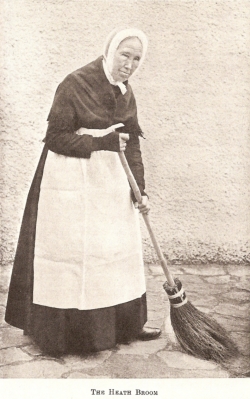
Round Two. How about "an elderly lady holding a broom"? Here's Google. The image on my list is a palpable hit however number 3 ain't even close. Over to you Imense. Er, Imense? What's that? "Sorry, no results found. Please change the query or search options and try again." Nul point there.
Round Three. Time for something metaphysical - how about "sadness"? Google comes back with these and Imense comes back with these. On the whole, both pretty darn miserable. Another tie. Keep going.
Round Four. OK - I like the work of Powell & Pressburger so how about something from The Red Shoes. So in goes "red shoes movie" and out comes? Well Google's first link is for this but by image number 4 it gets there. And Imense? Not even close.
It's 2-4 to Google. This is may simply be down to the number of images that Imense is dealing with - a larger pool with give better results. But it seems that while Imense may work with obvious stuff ("I need a picture with 3 people being chased down a beach by a dog"), it doesn't seem to handle the non-obvious stuff better.
How could Big Lou's approach dovetail with Chris's?
My suspicion is that our attempts to deal with the vast amounts of stuff (words, pictures, sounds) that we are producing will require a human/computer hybrid approach. This will make two groups unhappy - those that believe that raw computing power can solve any problem and those that believe that machines have no role to play in human meaning making.
For the rest of us, it's all very promising.
Back in April, I posted about the Powerhouse Museum's use of human tagging along with automatic indexing.
A flood of things have triggered some further thoughts on this topic. I finally got round to reading Clay Shirky's stuff on gin, sitcoms & cognitive surplus. Then CapitalD sent out tweet with this video presentation by Luis von Ahn on human cognition. Big Lou is running a game called ESP that generates metadata on photographs under the guise of providing entertainment. Sneaky huh?
Meanwhile on the other side of town...
I am doing some research around photography & images at the moment - and encountered the Second international Photo Metadata Conference held in Malta a month ago. One presentation that caught my eye was by Chris Town on Imense.
Imense is a search engine that uses automated image processing to generate results.
Time for a showdown: Imense vs Google Images.
Round One. Let's start with something simple: a "Syndey sunset". Here is Imense & here is Google. Really not that much in it. Some good stuff and nothing wildly off-beam. A tie.
Round Two. How about "an elderly lady holding a broom"? Here's Google. The image on my list is a palpable hit however number 3 ain't even close. Over to you Imense. Er, Imense? What's that? "Sorry, no results found. Please change the query or search options and try again." Nul point there.
Round Three. Time for something metaphysical - how about "sadness"? Google comes back with these and Imense comes back with these. On the whole, both pretty darn miserable. Another tie. Keep going.
Round Four. OK - I like the work of Powell & Pressburger so how about something from The Red Shoes. So in goes "red shoes movie" and out comes? Well Google's first link is for this but by image number 4 it gets there. And Imense? Not even close.
It's 2-4 to Google. This is may simply be down to the number of images that Imense is dealing with - a larger pool with give better results. But it seems that while Imense may work with obvious stuff ("I need a picture with 3 people being chased down a beach by a dog"), it doesn't seem to handle the non-obvious stuff better.
How could Big Lou's approach dovetail with Chris's?
My suspicion is that our attempts to deal with the vast amounts of stuff (words, pictures, sounds) that we are producing will require a human/computer hybrid approach. This will make two groups unhappy - those that believe that raw computing power can solve any problem and those that believe that machines have no role to play in human meaning making.
For the rest of us, it's all very promising.
apple: technology that chicks like
There is an old, old diss in electronic dance music: "It's OK I guess. Yeah, I can really see gurlz liking that".
Because blokes like nerdy detail - fiddling about with basslines & noises & gadgets & suchlike. Design as an autistic journey up your own fundament. Whereas chicks tend to prefer music that makes sense as more than pure experiment - as something social & sociable, as something useful & desirable. Of course, the irony was: whenever chicks left a scene (be it jungle, UK garage, etc), the originality of the output would nosedive. The tension in dance music is between giving people what they want and then showing them what they never knew they wanted. Between experiment & familiarity.
Anyway, I was mildly surprised by the level of excitement shown by various women in my life about the new iPhone. These aren't just gadgets - these are designer objects (like a Marc Jacobs or Prada creation). And all designer objects are ultimately social objects of one sort or another.
I am not sure what the links between the iPhone &, say, Funky House are. But I suspect they could get me into very hot water. What do you think?
Because blokes like nerdy detail - fiddling about with basslines & noises & gadgets & suchlike. Design as an autistic journey up your own fundament. Whereas chicks tend to prefer music that makes sense as more than pure experiment - as something social & sociable, as something useful & desirable. Of course, the irony was: whenever chicks left a scene (be it jungle, UK garage, etc), the originality of the output would nosedive. The tension in dance music is between giving people what they want and then showing them what they never knew they wanted. Between experiment & familiarity.
Anyway, I was mildly surprised by the level of excitement shown by various women in my life about the new iPhone. These aren't just gadgets - these are designer objects (like a Marc Jacobs or Prada creation). And all designer objects are ultimately social objects of one sort or another.
I am not sure what the links between the iPhone &, say, Funky House are. But I suspect they could get me into very hot water. What do you think?
Sunday, July 13, 2008
search as point of sale
Google has become an advertising powerhouse because it catches people at that special moment: When they know they need something and are trying to find it. They may not be willing to spend money then & there but they are more willing to hand over the cash than when they are engaged in some non-related activity such as brushing their teeth or walking the dog.
Intranet or internal search within an organisation should be prized by those offering internal services - such as HR, Training, Facilities, etc. It offers you that opportunity to reach people when they need you - esp. in large organisations where actually finding the people responsible for these is often tricky.
Yet based on the lack of effort put into search engine effectiveness, these groups do not seem to get this. Why is that?
Intranet or internal search within an organisation should be prized by those offering internal services - such as HR, Training, Facilities, etc. It offers you that opportunity to reach people when they need you - esp. in large organisations where actually finding the people responsible for these is often tricky.
Yet based on the lack of effort put into search engine effectiveness, these groups do not seem to get this. Why is that?
Tuesday, July 08, 2008
value networks & new media
This is what I wanted for Pubcamp. Full respect to the Journalism That Matters crew.
Hat tip: Patti Anklam
Hat tip: Patti Anklam
Sunday, July 06, 2008
podcast - viv mcwaters & geoff brown on facilitation
More podcast goodness with Viv McWaters & Geoff Brown (who have their own podcast channel called Winkipod).
Download the mp3.
Show Notes:
00:00 - Introduction - Sick kids, adrenalin junkies & improvisation.
05:00 - Geoff's camping holidays: Being Prepared vs. Having A Plan.
09:30 - Matt bounces up and down on the unscripted trampoline.
11:30 - Facilitation begins long before the event.
16:30 - Facilitation as transformation.
18:20 - What happens "beyond the event horizon"? What are the transitions?
20:00 - "Random Acts of Traction" - Before, During & After.
25:50 - The offer of support.
29:00 - Facilitators as Collective Memory.
Download the mp3.
Show Notes:
00:00 - Introduction - Sick kids, adrenalin junkies & improvisation.
05:00 - Geoff's camping holidays: Being Prepared vs. Having A Plan.
09:30 - Matt bounces up and down on the unscripted trampoline.
11:30 - Facilitation begins long before the event.
16:30 - Facilitation as transformation.
18:20 - What happens "beyond the event horizon"? What are the transitions?
20:00 - "Random Acts of Traction" - Before, During & After.
25:50 - The offer of support.
29:00 - Facilitators as Collective Memory.
Thursday, July 03, 2008
the new gig
So Innotecture now exists as a formal company. With an ACN, ABN, TFN 'n' everything. Which is all very well but what it really requires is some clients with needs & cash...
Tuesday, July 01, 2008
enterprise 2.0 lunch in sydney - tuesday 8 july
Next Tuesday there'll be an informal lunch for Enterprise 2.0 enthusiasts @ 1 pm Tues 8 July @ Sussex Centre Food Court, Level 1, 401 Sussex St, Haymarket, NSW 2000. I will have some kind of sign.
Pass it on.
*"social software inside the enterprise" to give it an ever so slightly less annoying title.
Pass it on.
*"social software inside the enterprise" to give it an ever so slightly less annoying title.
podcast - madelyn blair & shawn callahan on storywork
I had the pleasure of discussing storywork with Madelyn Blair & Shawn Callahan this morning. Madelyn & Shawn set up the Ning Worldwide Story Work group and Madelyn is also involved with the Golden Fleece group. Enjoy!
Download the mp3.
Show Notes:
00:00 - Introductions: Madelyn & Shawn's first introduction to storywork.
04:00 - Stories that stick in your mind: Madelyn's story of the Swedish ambassador, the mosque & the stone.
06:00 - Shawn distinguishes between storylistening & storytelling.
08:30 - "Storytelling" as a bit overwhelming vs things that you do everyday.
11:15 - The use of objects in storytelling - Madelyn applies this to mission statements.
13:00 - The importance of context & duckus duckus.
16:00 - Getting different groups to talk.
18:10 - Scientific papers as mystery stories.
Download the mp3.
Show Notes:
00:00 - Introductions: Madelyn & Shawn's first introduction to storywork.
04:00 - Stories that stick in your mind: Madelyn's story of the Swedish ambassador, the mosque & the stone.
06:00 - Shawn distinguishes between storylistening & storytelling.
08:30 - "Storytelling" as a bit overwhelming vs things that you do everyday.
11:15 - The use of objects in storytelling - Madelyn applies this to mission statements.
13:00 - The importance of context & duckus duckus.
16:00 - Getting different groups to talk.
18:10 - Scientific papers as mystery stories.
sun writing (1): the first photo

Do you know where the first photo is?
Not who took it (it was Joseph Nicéphore Niépce).
Not where it was taken (Chalon-sur-Saône, France).
But where it is now.
It's in Austin, Texas.
Niépce called his new technology heliography - or sun writing.
Sunday, June 29, 2008
running odiogio
Check out my talking blog feed from odiogo below. The Blogger widget doesn't want to install for some reason however...

Saturday, June 28, 2008
podcast - tim noonan on accessibility
Yesterday I had the pleasure of discussing accessibility, technology and the future with Tim Noonan (more on him here and here). The result is an intriguing podcast.
Download the mp3.
Show Notes:
00:00 - Tim tells us about his first experiences with technology via a braille machine.
02:20 - Tim reduces the fear factor for people.
03:40 - The Christmas Card and the liberating privacy of email.
06:00 - The double-edged sword of technology.
06:50 - The visual nature of current technology.
08:40 - The return of audio via podcasts & mobile devices.
11:20 - Technology should be transparent & smart - the barriers must be removed!
14:00 - Accessibility: It's not about desexying stuff.
16:30 - How do we make technology more inclusive to more people? Universal design.
19:00 - Separating the information from the presentation.
19:40 - Elevators, ramps, wheelchairs, strollers. Accessibility benefits everyone!
22:10 - Twitter as an example of accessible design.
Download the mp3.
Show Notes:
00:00 - Tim tells us about his first experiences with technology via a braille machine.
02:20 - Tim reduces the fear factor for people.
03:40 - The Christmas Card and the liberating privacy of email.
06:00 - The double-edged sword of technology.
06:50 - The visual nature of current technology.
08:40 - The return of audio via podcasts & mobile devices.
11:20 - Technology should be transparent & smart - the barriers must be removed!
14:00 - Accessibility: It's not about desexying stuff.
16:30 - How do we make technology more inclusive to more people? Universal design.
19:00 - Separating the information from the presentation.
19:40 - Elevators, ramps, wheelchairs, strollers. Accessibility benefits everyone!
22:10 - Twitter as an example of accessible design.
Thursday, June 26, 2008
phone spam
I have recently been the victim of Premium SMS Spam. It works this way, you enter a survey or competition (such as one run by these parasites) and in the fine print it mentions they'll start sending you premium SMSes that cost you $2 a pop. These are a significant problem in many countries a brief Google search will tell you.
Now I don't blame the SMS spammers. They are just doing what greedy people do the world over. It's the phone carriers who are driving me up the wall. The attitude of my carrier (Vodafone) is: Your problem. They are quite happy to bill me for this junk but they are unwilling to do anything about it. I was told by their customer service people that they cannot stop premium SMS being sent to my phone. Apparently that is not true - but if they stop premium SMS I also lose access to international numbers. As my family live in the UK, this is unacceptable.
I believe the other carriers aren't much better. They can create a zillion different (& confusing) billing plans but they can't (or won't) block Premium SMS. Cheers guys. Love your work.
Now I don't blame the SMS spammers. They are just doing what greedy people do the world over. It's the phone carriers who are driving me up the wall. The attitude of my carrier (Vodafone) is: Your problem. They are quite happy to bill me for this junk but they are unwilling to do anything about it. I was told by their customer service people that they cannot stop premium SMS being sent to my phone. Apparently that is not true - but if they stop premium SMS I also lose access to international numbers. As my family live in the UK, this is unacceptable.
I believe the other carriers aren't much better. They can create a zillion different (& confusing) billing plans but they can't (or won't) block Premium SMS. Cheers guys. Love your work.
- I will happily give my business to an operator that will block premium SMS and also offer a comparable level of service at a comparable cost to the others. This is a deal breaker for me - do you understand? Can anyone suggest such an operator in Australia?
- Given the proliferation of mobile devices & data services, we can expect more & more crap to hit us. Carriers seem to view this nightmare for consumers as a non-issue for them - in fact consumer frustration may be a moneymaker.
km methods cards
Patrick gave me a pack of these today. I'll probably be writing a more formal review elsewhere but here I'm wondering what games you could play with them:
Buy some.
- KM Poker - Everyone sits round the table and mentions something that no one else has heard in a bid to appear more expert. They may not know what it is themselves. They may or may not get called on that bluff. If you can pull it off, a tasty consulting engagement may emerge. If you fail, there will be hours of email list
abusedebate. - KM Strip Poker - You play the above game as your budget gets divested with each round. The results are often embarrassing for participants.
- KM Solitare (it's the only game in town) - A lonesome KM practitioner plays with their cards while everyone else in the organisation ignores them.
- KM Tarot - You pretend to know what the future holds for the gullible. Gypsy scarf and gold earring optional.
- KM Snap - You discover that everyone else has the same challenges as you.
- KM Soccer Cards - Your pack has 80 cards - but 2 sets of 40. You must trade cards with others to get a full set. There may be fisticuffs in the playground.
- KM Top Trumps - You claim your method is better than everyone else's. There will be hours of email list
abusedebate.
Buy some.
Wednesday, June 25, 2008
kiva poetry auction winners (3)
- Shahnoza Juraeva - "She has applied for a Kiva loan to buy seasonal materials and additional national dresses" in Tajikistan.
- Saneam Soeur Village Bank Group - "Fourteen people in Preak Thom Village in Kandal Province [Cambodia] form one group in one Village Bank".
- Khuraman Sheydayeva - "Now this family requests a loan to buy 2 calves" in Azerbaijan.
- Myriam Lugo - Selling jewelry in Paraguay.
the public sector & social software
I was down in Canberra at the Information Architecture in the Public Sector 2008 - where I presented this:
I enjoyed myself. I'm pretty sure they did too. The real fun was the workshop on the second day. I used the Cynefin framework to discuss social software (for the third time) and we got cracking on discussing business cases, making friends & influencing people.

I enjoyed myself. I'm pretty sure they did too. The real fun was the workshop on the second day. I used the Cynefin framework to discuss social software (for the third time) and we got cracking on discussing business cases, making friends & influencing people.
Monday, June 23, 2008
kiva poetry auction winners (2)
Our next four winners are:
- The Ram Group in Sierra Leone are going for some firewood.
- Sergei Avromenko is selling clothes and shoes in the Ukraine.
- Adela Flores Fierro sells cosmetics in Nicaragua.
- Mounitarou Yakoubou will be buying spare parts and a motorcycle to repair and sell.
podcast - jason ryan & social software in government
I recently had the pleasure of interviewing Jason Ryan of the New Zealand State Services Commission on the use of social software by governments (esp. the kiwis) and very enlightening it was too.
Download the mp3 here (24:38, 5.6 Mb)
Show Notes
00:00 - Jason introduces himself.
01:00 - Jason begins blogging himself. NZ Aid and the Retirement Commission experiment with blogs.
02:45 - Social software is not the solution to every problem.
04:00 - Should governments use hosted services?
05:20 - Principles for government use of social software. Why is sovereignty important?
06:38 - Social marketing, Bebo & a sense of optimism.
07:30 - You don't want the government to be your dad dancing at a party.
08:30 - Two contrasting cases: Police Act Review wiki vs. Safe As forum.
14:40 - Other examples from around the world.
18:00 - What's the future for social software in government?
20:00 - The risks of Facebook for employees and what we should do about it.
23:00 - What do you think?
Download the mp3 here (24:38, 5.6 Mb)
Show Notes
00:00 - Jason introduces himself.
01:00 - Jason begins blogging himself. NZ Aid and the Retirement Commission experiment with blogs.
02:45 - Social software is not the solution to every problem.
04:00 - Should governments use hosted services?
05:20 - Principles for government use of social software. Why is sovereignty important?
06:38 - Social marketing, Bebo & a sense of optimism.
07:30 - You don't want the government to be your dad dancing at a party.
08:30 - Two contrasting cases: Police Act Review wiki vs. Safe As forum.
14:40 - Other examples from around the world.
18:00 - What's the future for social software in government?
20:00 - The risks of Facebook for employees and what we should do about it.
23:00 - What do you think?
Thursday, June 19, 2008
kiva poetry auction winners(1)
You may remember this. Well, lesser kudu ponied up $300 (to which I will add $100). Most generous of LK - so three cheers from everyone please.
I am in the middle of writing LK's poem on hope - of which there will be many variants I suspect. In the meantime, here are the first four entrepreneurs I have given the money to:
I am in the middle of writing LK's poem on hope - of which there will be many variants I suspect. In the meantime, here are the first four entrepreneurs I have given the money to:
- Youssef - who needs a new floor-polishing machine.
- Fabiola Dilone - who needs to buy some inventory for her clothing business.
- Seang Sok - who is gunning for a motorcycle and a pumping machine.
- Rose Mensah - who is up for more stock for her food trading.
a fairy tale (1)
Once upon a time there were two brothers: Colin Content and Barry Business.
Colin Content loved writing stuff. He took great pride in writing and presentation. He had honed his skills in journalism school and on all manner of publications. His years spent sub-editing had also left him a bit picky. He didn't like numbers very much and had three unpublished novels in a drawer at home. Here is Colin:
 Colin's brother Barry was very different to Colin. Barry liked money. He had started in ad sales, selling space in the publications that Colin had written for. He had got an MBA. The only things he liked reading were bonus cheques and earnings statements. He had three sports cars in a garage at home. Here is Barry:
 Colin and Barry didn't like each other very much but both needed the other.
As far as Colin was concerned, Barry was the kind of philistine who didn't know what "philistine" meant. Why couldn't Barry get him the money he needed to expand his publications? Colin dreamed of the day when his words would sell themselves.
Meanwhile as far as Barry was concerned, Colin was just there to fill the space between his ads. Why couldn't Colin produce content quicker and cheaper? Barry dreamed of the day when computers by themselves could produce words that consumers would want to read.
Then one day, the internet appeared. Barry & Colin were excited. Lots of people like Barry & Colin invested money in it and lost most of it.
There was a pause.
Then ordinary people realised that they could write stuff and record stuff and copy stuff. Most of the stuff they made was for their friends and family - which was fine because it was stuff only your mother could love. Most of the stuff they copied had been made by people like Colin and had made money for people like Barry. Barry & Colin were excited again. And a little scared. Maybe they could finally be free of each other.
Along came someone new: Simon Social Media. Simon had a background in technology rather than business or media. He had three open-source programming projects in his desktop at home. He blogs and twitters and wikis and all that other stuff. Here is Simon:
 Simon thinks Colin & Barry are old-fashioned, elitist and stupid. Meanwhile Colin thinks Simon has no quality standards and Barry think Simon has no business sense.
What can Colin, Barry & Simon say to each other that is friendly & nice & productive?
Or are they doomed to huff and puff forever?
Colin Content loved writing stuff. He took great pride in writing and presentation. He had honed his skills in journalism school and on all manner of publications. His years spent sub-editing had also left him a bit picky. He didn't like numbers very much and had three unpublished novels in a drawer at home. Here is Colin:
 Colin's brother Barry was very different to Colin. Barry liked money. He had started in ad sales, selling space in the publications that Colin had written for. He had got an MBA. The only things he liked reading were bonus cheques and earnings statements. He had three sports cars in a garage at home. Here is Barry:
 Colin and Barry didn't like each other very much but both needed the other.
As far as Colin was concerned, Barry was the kind of philistine who didn't know what "philistine" meant. Why couldn't Barry get him the money he needed to expand his publications? Colin dreamed of the day when his words would sell themselves.
Meanwhile as far as Barry was concerned, Colin was just there to fill the space between his ads. Why couldn't Colin produce content quicker and cheaper? Barry dreamed of the day when computers by themselves could produce words that consumers would want to read.
Then one day, the internet appeared. Barry & Colin were excited. Lots of people like Barry & Colin invested money in it and lost most of it.
There was a pause.
Then ordinary people realised that they could write stuff and record stuff and copy stuff. Most of the stuff they made was for their friends and family - which was fine because it was stuff only your mother could love. Most of the stuff they copied had been made by people like Colin and had made money for people like Barry. Barry & Colin were excited again. And a little scared. Maybe they could finally be free of each other.
Along came someone new: Simon Social Media. Simon had a background in technology rather than business or media. He had three open-source programming projects in his desktop at home. He blogs and twitters and wikis and all that other stuff. Here is Simon:
 Simon thinks Colin & Barry are old-fashioned, elitist and stupid. Meanwhile Colin thinks Simon has no quality standards and Barry think Simon has no business sense.
What can Colin, Barry & Simon say to each other that is friendly & nice & productive?
Or are they doomed to huff and puff forever?
Wednesday, June 18, 2008
pubcamp
So much respect due to Jed White for putting on PubCamp. I walked away with mixed feelings.
We had a blizzard of 6 minute presentations - some obvious pitches, some dull, some sharply observational - favourites were Tim Noonan's session on accessibility and Ben Gerholt's advice on how to be a media mogul. Bronwen Clune & Richard Walsh debated whether new media was "a dagger in the heart" for both producers and consumers - and they are both smart, articulate people but the debate format felt sterile. Defending or attacking a proposition is all very well but it rarely takes you anywhere interesting. Conversations tend to be more inspiring that debates.
Which brings me to the panel. We had a bunch of people with decades of media experience between them - and nothing really interesting came out of it. The whole physical set up was oppositional - the panel on the podium facing the audience. Now quite a few people in the audience were frantically twittering with each other and the twitterstream was put up on the screen - but it didn't lead much in the way of insightful questions. But the whole thing degenerated into "big media bad", "no, big media good, "journalists vital", "no, journalists not vital", "no...". It felt like an unfocused waste of time. The panel format is actually hard to pull off well - it needs a focus and an engagement on the part of all involved. At future PubCamps (which would be great Jed), I'd like to see smart people engaged in a different way or more focus given to the questions the panel have to answer and the conversations they have with each other.
So then there was the unconference bit - which was an organisational disaster. The slots were all shifted about and I had no data projector for the slides below - so I ended up holding up my laptop like an accordion in front of my little group. The talk was an attempt to articulate how a value networks perspective might be applied to new media. It's early days and not there yet - so comments welcome.
We had a blizzard of 6 minute presentations - some obvious pitches, some dull, some sharply observational - favourites were Tim Noonan's session on accessibility and Ben Gerholt's advice on how to be a media mogul. Bronwen Clune & Richard Walsh debated whether new media was "a dagger in the heart" for both producers and consumers - and they are both smart, articulate people but the debate format felt sterile. Defending or attacking a proposition is all very well but it rarely takes you anywhere interesting. Conversations tend to be more inspiring that debates.
Which brings me to the panel. We had a bunch of people with decades of media experience between them - and nothing really interesting came out of it. The whole physical set up was oppositional - the panel on the podium facing the audience. Now quite a few people in the audience were frantically twittering with each other and the twitterstream was put up on the screen - but it didn't lead much in the way of insightful questions. But the whole thing degenerated into "big media bad", "no, big media good, "journalists vital", "no, journalists not vital", "no...". It felt like an unfocused waste of time. The panel format is actually hard to pull off well - it needs a focus and an engagement on the part of all involved. At future PubCamps (which would be great Jed), I'd like to see smart people engaged in a different way or more focus given to the questions the panel have to answer and the conversations they have with each other.
So then there was the unconference bit - which was an organisational disaster. The slots were all shifted about and I had no data projector for the slides below - so I ended up holding up my laptop like an accordion in front of my little group. The talk was an attempt to articulate how a value networks perspective might be applied to new media. It's early days and not there yet - so comments welcome.
Wednesday, June 04, 2008
clues and clouds
In his famous 1980 article "Morelli, Freud and Sherlock Holmes: Clues and Scientific Method", Carlo Ginzburg discusses the importance of clues. He talks about the art historian Giovanni Morelli- who looked at hands and the minor details of art works to establish their authenticity. He discusses Sigmund Freud and his predilection for parapraxes. Sherlock Holmes gets a mention as well*.
The plethora of new media that we engage with can be seen as clue-creation machines. When Nancy White was using del.icio.us to bookmark a bunch of sites on breast cancer as part of some client work, she got a stream of concerned emails from those who had put 2 and 2 together and got 5.
Are we aware of the clues we create ourselves and those we sense from others?
*Ginzburg notes that Morelli, Freud and Conan-Doyle were all trained as doctors. More posts on medicine shortly.
The plethora of new media that we engage with can be seen as clue-creation machines. When Nancy White was using del.icio.us to bookmark a bunch of sites on breast cancer as part of some client work, she got a stream of concerned emails from those who had put 2 and 2 together and got 5.
Are we aware of the clues we create ourselves and those we sense from others?
*Ginzburg notes that Morelli, Freud and Conan-Doyle were all trained as doctors. More posts on medicine shortly.
to live and die in la
Los Angeles is a strange place - less of a city than Sydney - more a bunch of surburbs that thought it would be, y'know, cool to hang out together but not get trapped in anything, y'know, too serious. Like any form of urban planning. Thanks to Joe & family for their hospitality.
Back in the day, Los Angeles was viewed as a postmodern harbinger of the future - a decentered, autoparadise compared to the modernism of Chicago & Manhattan. We'll see what rocketing fuel prices do to that one.
Monday, June 02, 2008
i left my social network in san francisco
San Francisco was a bit of a trip:
- The Center for Digital Storytelling were remarkably open to a last-minute visit.
- John Maloney proved to be surprising affable and unsurprisingly insightful.
- Stewart Mader (Atlassian Wiki Evangelist) was a pleasant drinking/ranting companion.
The rest of the time was spent with KT checking out bridges, cable cars, trainers & bars.
seattle sound
Yes - as the trip continues, the title references are getting worse. Seattle was spent in the awesome company of Nancy White and her kin. Nancy has forgotten more about online community development than I will ever know. We talked about her recent trip to Ethopia, her whitepaper with Shawn & Mark, the forthcoming book with John D Smith & Etienne Wenger, the fantastic work of the Skillet Street Food Company.
Tuesday, May 27, 2008
nyc - big apple
NYC was remarkably unwork-related as I spent most of my time with KT checking out this and this and this.
Very pleasant morning spent with Jenny Ambrozek discussing network analysis, collaboration and our surprising number of mutual acquaintances.
Seattle next...
Very pleasant morning spent with Jenny Ambrozek discussing network analysis, collaboration and our surprising number of mutual acquaintances.
Seattle next...
put your hands up for detroit
Stan Garfield* arranged a one-day Mid-West KM meet - featuring attendees from GM, Ford, the US Airforce, Deloitte, The Fed and others. Stan kindly picked me up from Detroit bus station and introduced me to the finer points of Mexican cuisine. The one-dayer was a darn good start - and I'll be posting the mp3 files to the SI KM Leaders list when I return to Australia.
*In its infinite wisdom, HP has decided to disband Stan's KM team. If you need an inspirational KM evangelist then look no further...
*In its infinite wisdom, HP has decided to disband Stan's KM team. If you need an inspirational KM evangelist then look no further...
Tuesday, May 20, 2008
toronto - funky cold spadina
Toronto has been a lot of fun so far - not least because it is a long weekend here (Victoria day?)
Sunday involved doging the rain and seeing Bonde Do Role and The Death Set.
Monday was spent having lunch with Dave Pollard and then an afternoon with Sean Howard and Eli McIlveen. The evening ended with me in an Irish bar somewhere on College Street having lost the power of speech. At that point, I thought it wise to go home.
Detroit tomorrow...
Sunday involved doging the rain and seeing Bonde Do Role and The Death Set.
Monday was spent having lunch with Dave Pollard and then an afternoon with Sean Howard and Eli McIlveen. The evening ended with me in an Irish bar somewhere on College Street having lost the power of speech. At that point, I thought it wise to go home.
Detroit tomorrow...
Sunday, May 18, 2008
signals
On Saturday, lots of people pegged me as being Irish. I don't speak with any trace of an Irish accent despite having a good Irish surname (derived from Mordha meaning "noble") and (allegedly) some Irish ancestry. But I was wearing a bright green T-shirt (thanks again TripAdvisor) and I think people were picking up on that cue.
boston
So I missed the Boston KM Forum but Jack took to me Popsignal in the evening. You had to pre-book and for a moment I thought we weren't going to get in. When Jack said his name, the woman in front of us (who was already in) yelled "JACK!!! JACK VINSON!!! GREAT TO SEE YOU!!!" - which kinda sealed it. So in we went. Jack got busy with the Wii while I went after free T-shirts from TripAdvisor and slingpage followed by some vociferous debating with the HBSP online crew. Several people offered me a job - but that was before I told them i. I wasn't a programmer & ii. I was only in town for 3 days.
The following day I had lunch with Bill Ives & Dan Keldsen after wandering around Cambridge for the morning. I then had drinks at the Harvard Club with Nat Welch who now works for CFAR and pleasant dinner with Lisa Abrams - an old IBM colleague.
My last day in Boston was spent having lunch with the effervescent Doug Cornelius. It was a lovely suny day so I spent the afternoon hanging out by the MIT campus and watching the boats on the river.
Many thanks to everyone who made my stay so enjoyable.
The following day I had lunch with Bill Ives & Dan Keldsen after wandering around Cambridge for the morning. I then had drinks at the Harvard Club with Nat Welch who now works for CFAR and pleasant dinner with Lisa Abrams - an old IBM colleague.
My last day in Boston was spent having lunch with the effervescent Doug Cornelius. It was a lovely suny day so I spent the afternoon hanging out by the MIT campus and watching the boats on the river.
Many thanks to everyone who made my stay so enjoyable.
Thursday, May 15, 2008
chicago - swings & roundabouts
So yesterday morning I rocked up to a gig on Enterprise Performance Support Systems put on by Dirk Tussing from Executive Learning Exchange & some dudes from Tata Interactive. An EPSS is an embedded tool that supports inexperienced workers focues processes and systems (e.g. call centre staff or claims agents). There were muffins and some nice conversation.
Then I spent the afternoon with Tim "Podcast" Keelan. Tim has a knack for constructing cool P2P learning content and a penchant for ranting - which are both good things.
I bought a ticket for this show and actually made it to the performance this time.
However, I did miss my flight this morning (boo) but by chance got to see Cory Doctorow* doing his thing at Chicago Public Library. Which kinda rocked with fists of steel.
*Kim - This guy hates CCTV and believes we must take back our own privacy - you'd love him.
Then I spent the afternoon with Tim "Podcast" Keelan. Tim has a knack for constructing cool P2P learning content and a penchant for ranting - which are both good things.
I bought a ticket for this show and actually made it to the performance this time.
However, I did miss my flight this morning (boo) but by chance got to see Cory Doctorow* doing his thing at Chicago Public Library. Which kinda rocked with fists of steel.
*Kim - This guy hates CCTV and believes we must take back our own privacy - you'd love him.
Wednesday, May 14, 2008
iinterestiing south
I was gutted to be missing this but glad the guys & gals pulled it off. Go team!!!!
chicago - km & exhaustion
Yesterday I went to the KM Chicago gig with Stefan Lafloer & Dave Simmons & the Kroll dudes. I recorded these sessions and will be making the results available when I get back to Sydney. I finally got to meet Alice Dunlap-Kraft (who I knew from my IBM days).
Then it was full steam ahead to the Art Institute of Chicago, Millenium Park and Lake Michigan. Which is a lake so huge you could mistake it for the ocean. I even bought a ticket to the Annoyance Theatre improv gig - but passed out instead.
I am not a mornings person but jetlag tends to get me up early and then knock me out early.
Then it was full steam ahead to the Art Institute of Chicago, Millenium Park and Lake Michigan. Which is a lake so huge you could mistake it for the ocean. I even bought a ticket to the Annoyance Theatre improv gig - but passed out instead.
I am not a mornings person but jetlag tends to get me up early and then knock me out early.
Tuesday, May 13, 2008
washington - storytelling weekend - golden fleece
So the Golden Fleece Storytelling conference takes place in Chevy Chase*, Maryland - just north of DC. I'm navigating while Prof. Golden is driving the small rental car through driving rain from Reagan National Airport. We make it in enough time to see Kelly Cresap open show.
- Cilian Fennell does a masterful presentation on the hero's journey as it relates to innovation. I think the Joseph Campbell stuff has been overused somewhat but it is hard not to warm to a session that included gorgeous pictures of the Irish landscape, parasitic biology, recent Irish economic history and the question: "What colour is the Gaelic language?"
- Oran Sandel's session involves physical theatre and movement which normally I'm not adverse to. But for some reason I have a bit of block with it and hide in the coffee room. Oran's a good guy though.
- I finally get to meet Victoria Ward from Sparknow. She presents with Ellen Collins from the MLA on this research. Love it. Especially the part about using stories to define the boundaries of "knowledge transfer" in this this context.
- I am ashamed to admit that I have to leave Leif Josefsson's presentation on the Metafari to pass out from jetlag. Oh well.
- Gerry Lantz & Deb Maher talked about Appreciative Inquiry - which is a positive way to end the day.
All in all, a fun day. There was a student film crew wandering around so I wonder if we'll see any outputs from that...
*I think Fletch was his finest hour - how about you?washington - storytelling weekend
So the Friday of the Washington DC Storytelling event took place in the S Dillon Ripley Center at the Smithsonian. It was a Steve Denning production with four speakers and Madelyn Blair MCing. The auditorium was huge but the seats were bolted down lecture-style which didn't make for a particularly collaborative experience. I believe Steve recorded the sessions so I'll put a link up to those when they are ready but in the meantime, some observations:
- I liked Madelyn's intro - esp. her story about the antique shop-owner's comment.
- Dorthothy Leonard was pretty darned good as a presenter - as you'd hope a university professor to be. I'm a fan of Deep Smarts so was interested to hear her take on the role of story in the innovation process. The key thing it reinforced for me: If you want to find out an organisation's attitude to innovation - and therefore what forms of innovation will succeed - then listen to its stories.
- Linda Coffman has been working on the uses of digital storytelling in learning at P&G. It seems that P&G have started some work in this area - the question is: will they actually deploy it? Of the two stories made, one is pretty dire (as Linda herself acknowledged) but the second one is very powerful (although the subject matter initially baffled some men in the audience). A suggestion to P&G: Easy on the emotive soundtrack - it felt a but manipulative. The more powerful your story, the simpler your visual and audio cues. BTW check out the Center for Digital Storytelling.
- Claudia L'Amoreaux is (if she'll pardon the expression) a hippy. And Education Community Developer for Second Life's Linden Labs. Her discussion on Second Life really brought home to me how those immersed in the SL environment are using it creatively and flexibly. I remain to be convinced that it's quite right for me but I am willing to give it another go.
- Finally Steve Denning was up - talking about creating dynamic team/organisational "hot spots" through story. By this stage, I had been awake for about 48 hours and crashed part-way through Steve's presentation. I am looking forward to the recording though.
Monday, May 12, 2008
cell phone ring tone
My cell phone number while in the US is +1-202-560-4885. Feel free to ring or txt if ya wanna.
Wednesday, May 07, 2008
America
So it's all booked. I'm in the Qantas Lounge @ Sydney about to board my flight. Check out the Dopplr widget to the right. Or post a comment here if you want to meet up.
Washington from May 9th to 11th.
Chicago from May 12th to 14th.
Boston from May 15th to 17th.
Toronto from May 18th to 20th.
Detroit from May 21st to 22nd.
New York from May 23rd to 27th.
Seattle from May 26th to 29th.
San Francisco from May 29th to 31st.
Los Angeles from June 1st to 2nd.
Washington from May 9th to 11th.
Chicago from May 12th to 14th.
Boston from May 15th to 17th.
Toronto from May 18th to 20th.
Detroit from May 21st to 22nd.
New York from May 23rd to 27th.
Seattle from May 26th to 29th.
San Francisco from May 29th to 31st.
Los Angeles from June 1st to 2nd.
Thursday, May 01, 2008
podcast - luis/patrick/alex - email detox (3): tools or solutions?
Download the final part of the email detox podcast.
- 00:00 - Alex agrees with Luis on email politics.
- 01:20 - Humans as political animals - in public or in private?
- 03:00 - Should we be selling tools or solutions?
- 06:00 - Applying social software to business problems.
- 08:00 - The email detox workout video.
- 10: 00 - Wrap up & next steps.
Wednesday, April 30, 2008
podcast - luis/patrick/alex - email detox (2): infrastructure & politics
Following on from the last post.
Download Part 2 now (20:23, 4.8 Mb)
Download Part 2 now (20:23, 4.8 Mb)
- 00:00 - Patrick raises the infrastructure question.
- 03:00 - Luis brings up wikis.
- 04:10 - Luis talks about discussing the detox with his team.
- 07:55 - The laziness issue.
- 09:00 - Do we love email?
- 10:00 - Alex mentions email overload.
- 11:00 - Generational issues.
- 13:00 - Patrick raises the politics question.
- 15:00 - Luis busts the whole thing wide open.
Monday, April 28, 2008
podcast - luis/patrick/alex - email detox (1)
I had the pleasure of conversing with Luis, Patrick & Alex about Luis's email detox programme. Here is the first part (of three) for your listening pleasure.
Download Part 1 now (16:48, 4.0Mb)
Download Part 1 now (16:48, 4.0Mb)
- 01:00 - Luis describes his email detox moment in 2007.
- 03:10 - Luis challenges his email correspondents within IBM.
- 06:10 - How do you bring people round to the post-email world?
- 11:00 - Where is email appropriate?
- 13:00 - Instant messaging & social networking.
Sunday, April 27, 2008
podcast - puneet gupta - connectbeam
A couple of weeks ago, I had the pleasure of talking to Puneet Gupta, CEO of Connectbeam, a US social search company. Conntectbeam get a mention in the collaborative bookmarking presentation.
Download the mp3.
Download the mp3.
- 00:45 - Introduction: Connectbeam = del.icio.us + LinkedIn for the enterprise.
- 03:25 - How does Connectbeam actually work?
- 05:20 - Which organisations are using Connectbeam?
- 06:45 - Who is using the tech inside these organisations?
- 08:00 - The knotty question of ROI.
- 10:45 - The future of Enterprise 2.0 - Connectbeam as the Heart of Collective Intelligence.
- 13:45 - I attempt to lighten the conversation & fail miserably but an interesting comment on tag clouds & cultures emerges from the wreckage.
presentation - showing the value of km
A presentation on demonstrating the ROI / Value of Knowledge Management to beancounters - based various experiences. Of course, I can't put the really juicy stuff in the presentation - you'd have to get me in to deliver it for that...
Tuesday, April 22, 2008
jumping the shark
A sure sign that an organisation's knowledge management programme has passed its prime would be its inclusion in the MAKE awards. Why? The MAKE awards are basically a beauty parade judged by execs & "experts". To get in there, you need to have written articles (preferably a book), schlepped the conference circuit, blown your own trumpet until your lips are cracked and dry. Which means that your best work is probably behind you and your organisation is presumably not getting your full attention.
A similarbeauty-parade rigorous survey method is used by Boston Consulting Group to compile Business Week's list of the world's 50 most Innovative companies. It's actually very useful - but not quite for its stated purpose. It tells you what senior execs think innovation is:
A similar
- Nifty design ("Yeah, those iPods & iPhones are cool, man. Why can't we make something that f***ing cool?")
- Something about doing things better ("Didn't Toyota come up with six sigma? No? Huh, GE? Who then? Motorola??? Get the f*** outta here!!! S***!!! Can we can that six sigma rustbelt program already?")
- Making truckloads of money ("Bill Gates is an a**hole. A total f***ing a**hole. God, I wish I was him. And as for those Google a**holes...")
- Making stuff cheap ("That cheap Indian car. Yeah, you know the one that looks like it would fall apart if ya farted in it. That's f***ing innovation - you tell me that isn't f***ing innovative!!! But ugly, oh jesus, fugly as all hell. Not like my iPhone, my preciousssss...")
Meanwhile Millward Brown's list of the world's Top 100 brands (sorry, brandz) is interesting to compare to Interbrand's list of world's Top 100 brands from 6 months ago. Now is Google or Coca Cola the world's biggest brand? Or are they both? Is this going to be like school sports day - does everyone get a prize? Even the ugly, spastic kid with the mother and the sister who are the same woman*? I'm guessing this brand valuation thing isn't an exact science.
*Now answers on a postcard which brand that would be.
Thanks: Johnnie
social software round-up
Forrester says Enterprise 2.0 worth $4 billion - which puts it at about the same size as the online porn industry - based on my exhaustive research.
James Dellow says Enterprise 2.0 is not KM - good on yer, James.
5 Social Computing Benefits that Adoption Rates Don't Show - good on yer, Rex.
James Dellow says Enterprise 2.0 is not KM - good on yer, James.
5 Social Computing Benefits that Adoption Rates Don't Show - good on yer, Rex.
Saturday, April 19, 2008
text messages
Moving on from automated to human textual analysis, I've been having a bit of a look at XSight & NVivo from QSR. Back when I was doing my Masters, I recall a product called NUD*IST getting a mention. Basically this tool allowed the coding of interviews to help academics with quantitative analysis. This has become XSight for market research types & NVivo for academics.
XSight allows you to store your interview notes (ordered by research demographic) so you can annotate & tag them. You can create mind maps & research frameworks and then link them back to your source material & annotations. It's pretty handy but not as neat as the latest version of NVivo which allows you to code video and audio. NVivo makes less of the mind-mapping / white-boarding stuff and gets straight on with the multi-media tagging. It claims to have nifty collaboration & web publishing functionalities as well but I haven't put those to the test yet.
Now I've talked about hybrid human / automated metadata recently. I think we'll see hybrid semantic analysis tools emerging that mix automation & human involvement. SenseMaker is another example of this. We human beings are meaning machines. Just as we have created machines to enhance our vision & hearing so we need to develop technologies to aid our senses of comprehension.
XSight allows you to store your interview notes (ordered by research demographic) so you can annotate & tag them. You can create mind maps & research frameworks and then link them back to your source material & annotations. It's pretty handy but not as neat as the latest version of NVivo which allows you to code video and audio. NVivo makes less of the mind-mapping / white-boarding stuff and gets straight on with the multi-media tagging. It claims to have nifty collaboration & web publishing functionalities as well but I haven't put those to the test yet.
Now I've talked about hybrid human / automated metadata recently. I think we'll see hybrid semantic analysis tools emerging that mix automation & human involvement. SenseMaker is another example of this. We human beings are meaning machines. Just as we have created machines to enhance our vision & hearing so we need to develop technologies to aid our senses of comprehension.
workin' in a text mine
OK so what was the point of that last post? I suppose one thing that struck me using Leximancer was that these tools are neat but (like their data mining brethren) it'll be a long time before they move beyond specialist uses into the wider world. So much depends on skilled human operation in terms of framing a problem, selecting & screening terms, and interpreting results.
What experiences have you had with these tools?
Some resources:
What experiences have you had with these tools?
Some resources:
- A comparison of unstructured text mining tools from Virginia Uni.
- The National Centre for Text Mining in the UK.
- Marti Hearst & NY Times talk Text Mining.
leximancer duel - izzard vs hicks
Barry Saunders' stuff has inspired me to have a look at some text mining tools. So I got a trial copy of Leximancer and got busy. I will feed Leximancer various texts over the next few days. I began with a rather hefty challenge: The transcript of Eddie Izzard's Dressed to Kill DVD.
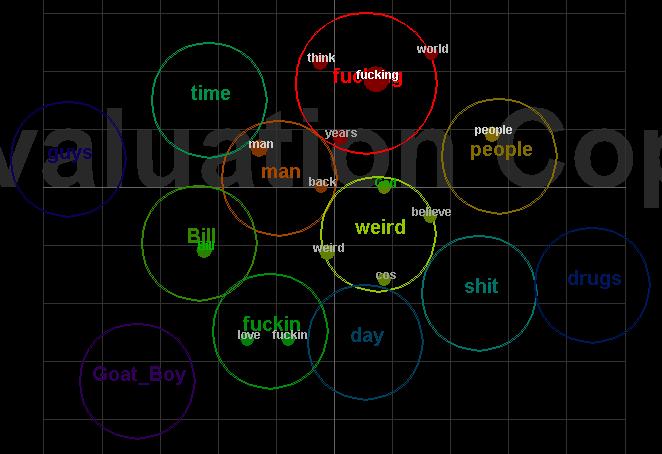
The initial sweep on default settings yielded this (click to enlarge):

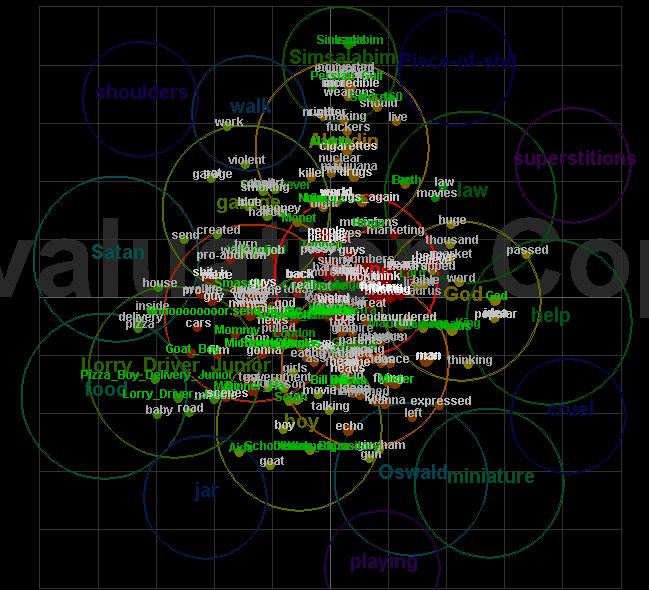
Massively increasing the terms (or concepts) yielded this (click to enlarge):
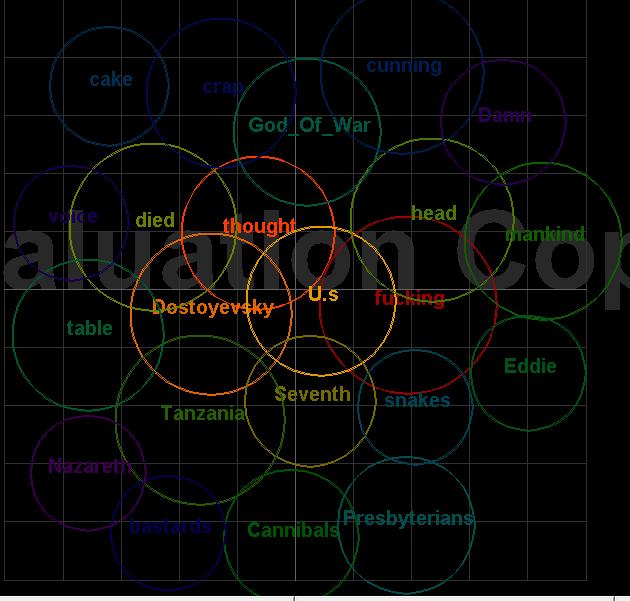
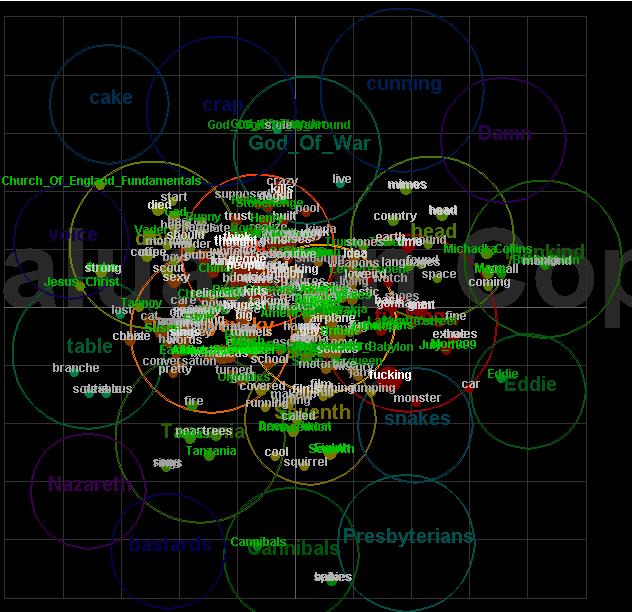 Which is a little clearer if you remove the concepts themselves and just leave the themes (click to enlarge):
And here is some ranking (click to enlarge):
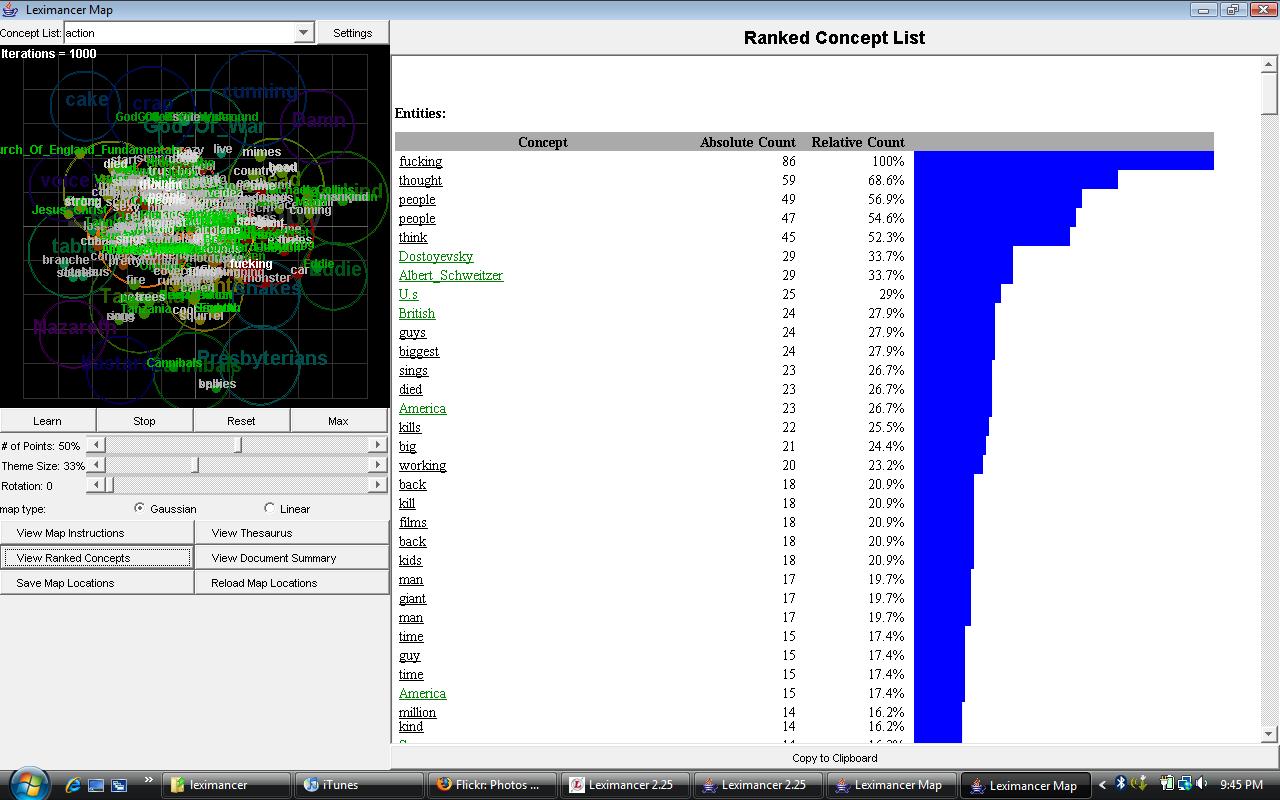
So what can we tell?
The initial sweep on default settings yielded this (click to enlarge):
Massively increasing the terms (or concepts) yielded this (click to enlarge):
Which is a little clearer if you remove the concepts themselves and just leave the themes (click to enlarge):And here is some ranking (click to enlarge):
So what can we tell?
- Eddie has a bit of a foul mouth.
- Eddie has a "thing" about religion.
- And war.
- And cake.
- Eddie is probably British.
- Here was the out-of-the-box pass...
- ...And with more terms...
- ...And with some clarity...
- ...And some ranking.
- Like Eddie, Bill also has a foul mouth and issues with religion & food.
- I really should use this stuff for something more serious.
Thursday, April 17, 2008
aiim findability survey
Following on from their Enterprise 2.0 Survey, Dan & Carl AIIM are doing something similar for Findability. Dan has provided an overview on their approach & requested feedback and also offered an initial list of technology solutions. I like their open approach to both constructing the survey & making the final report available for free (and altho Carl is probably right that the final result shouldn't be a wiki, it should be something more digestible than a single PDF).
One observation I would make about findability tech is that you basically have 3 groups:
One observation I would make about findability tech is that you basically have 3 groups:
- Content creators / providers
- Content users
- Content managers (from both an IT & editorial perspective)
And these 3 groups can have 3 relationships to the tech:
- Don't use
- Consume but don't own / control
- Own / control
Trad search is owned by content managers & consumed by content users. Trad taxonomies tend be owned by content managers (hopefully with some input from the business) & consumed by both content providers & users. Findability tools - esp. social software - tend to have broader spans of ownership/control which makes them simultaneously more power AND harder to manage.
Wednesday, April 16, 2008
podcast - nancy white & ed mitchell - blended facilitation
I had a blast recording this session with Nancy White & Ed Mitchell on "Blended Facilitation". It's a bit on the long side but I am loathe to cut it. We'll probably do another one and Mr Mitchell has requested "more structure".
Download the mp3 now.
Download the mp3 now.
- 00:50 - Ed talks about doing a mix of online & offline facilitation with the Media Sandbox.
- 04:00 - Nancy talks about 4 types of blending: Modalities (sight, sound, touch); Online/Offline; Individuals/Communities; Methods.
- 06:00 - Nancy discusses Seeds of Compassion.
- 09:50 - Matt mentions "extending the event horizon" & multi-modal poetry.
- 13:00 - Online and/or Offline?
- 15:30 - Ed's door intrusion leads to a discussion of Second Life.
- 19:20 - Different strokes (or tools) or different folks - provided there are overlapping experience.
- 22:30 - The thorny question of Generations (Y, X, Boomer) - going into broader diversity issues (e.g. participants from Africa with lo-bandwidth).
- 26:50 - Mindfulness, feedback & signals - the ethics of sharing community data.
- 30:10 - Facilitation + Manipulation = Facipulation.
- 34:00 - The public, the private & ambient exposure. Where are the boundaries?
- 38:50 - We hit the knotty question of identity
- 39:40 - We lay into the culture of expertise.
- 41:00 - I think we've all learnt a valuable lesson here, haven't we?
collaboration tools: centricity
Most social software tools have a focus, a centricity. The focus of that tool will effect your use of it. You can try using Facebook as a wiki but it won't really work - because the focuses of each are different. Here are some suggested focuses. What would you change? What would you add?
[In fact, wouldn't this blog post be better as a wiki page?]
[In fact, wouldn't this blog post be better as a wiki page?]
| Tool | Centricity |
| Wiki | Page |
| Blog | Post |
| Tangler | Forum / Thread |
| Flickr | Image / Account |
| | Ego-based Network |
| Ning | Community |
| YouTube | Clip |
podcast - james dellow - enterprise rss action day
Today I interviewed James Dellow about the Enterprise RSS Day of Action.
Download the podcast here (8Mb, 32:54)
Download the podcast here (8Mb, 32:54)
- 2:00 - Andrew McAfee & SLATES - Enterprise 2.0 is about more than just wikis.
- 3:05 - Grey Areas - when social software isn't "social".
- 5:30 - What is RSS? - Really Simple Syndication
- 9:50 - So what about Enterprise RSS?
- 11:40 - What are the benefits of Enterprise RSS? (the elevator pitch is longer than 30 seconds)
- 14:30 - How will it impact the behaviour of users? It's all about AWARENESS...
- 15:40 - How does it impact internal communications? Measurement & persistence...
- 19:45 - The 10 things that James wants from Enterprise RSS.
- 21:50 - The top 3 challenges to Enterprise RSS: Content / Technologists / Users.
- 23:35 - How to get started with Enterprise RSS.
- 25:50 - Vendors: Attensa & Newsgator.
- 28:20 - Pervasive RSS - Feeds Everywhere.
- 29:35 - Enterprise RSS Action Day.
exploring the webs of citizen journalism
Barry Saunders (thanks Laurel) is doing some very interesting research into citizen journalism & issues on the web. His work interests me on two levels:
- Citizen journalism itself - which simultaneously has been around for a very long time and is also very new in its current visibility.
- The tools he is using to explore this. Issuecrawler and Leximancer look intriguing. Anyone else played with these already?
Tuesday, April 15, 2008
extending the event horizon - collaboration tools
The triggers for this pondering of collaboration tools have been a bunch of events that I am in some way involved with. Many are conferences (or sometimes unconferences). The aim is to "Extend the Event Horizon" (thanks Katie) both before and after the event - should participants want to do so.
Before: Sydney Bar Camp used both a blog - for news releases- and a wiki - for registration. NSW KM Forum also uses a blog for announcements.
During: The Enterprise 2.0 Forum used Tangler as a virtual interaction environment and several people were Twittering like crazy during Bar Camp Sydney. Second Life is becoming the place to do virtual events but I'm not so sure about that.
After: This is up for grabs. A key factor here is the technical savvy of participants. You may just want to stick with an email list. A step up from that might be a Facebook group. I think Facebook makes a pretty rubbish collaborative environment beyond simply pumping out information to interested parties. As Axel Brun (thanks Gav) puts it very well, it's too ego-centric, it mixes up all your relationships in one big pile of social slop & the activities you can engage in are pretty rudimentary. But then a nightclub is not the same environment as an office. Like Axel, I've developed a taste for Ning. If you want your event to be part of something longer-lasting, then I'd go for something Ning-y. But you (& your participants) might not have the appetite for something longer-lasting. In which case, the quick & dirty options (e.g. email) are just fine.
Before: Sydney Bar Camp used both a blog - for news releases- and a wiki - for registration. NSW KM Forum also uses a blog for announcements.
During: The Enterprise 2.0 Forum used Tangler as a virtual interaction environment and several people were Twittering like crazy during Bar Camp Sydney. Second Life is becoming the place to do virtual events but I'm not so sure about that.
After: This is up for grabs. A key factor here is the technical savvy of participants. You may just want to stick with an email list. A step up from that might be a Facebook group. I think Facebook makes a pretty rubbish collaborative environment beyond simply pumping out information to interested parties. As Axel Brun (thanks Gav) puts it very well, it's too ego-centric, it mixes up all your relationships in one big pile of social slop & the activities you can engage in are pretty rudimentary. But then a nightclub is not the same environment as an office. Like Axel, I've developed a taste for Ning. If you want your event to be part of something longer-lasting, then I'd go for something Ning-y. But you (& your participants) might not have the appetite for something longer-lasting. In which case, the quick & dirty options (e.g. email) are just fine.
collaboration tools: stags
I've been thinking about different collaboration tools for various groups recently and I was pondering on some of the different factors you need to consider and I came up with this (click to enlarge):

Let's take each of these in turn:
Size - One thing to consider are the numbers of people who will be collaborating. Three rough groups sizes come to mind:
- Teams (15 approx) - small number of people. Most collaboration in our world that is aimed at doing stuff (as opposed to talking about doing stuff) probably occurs in teams of 5-30 people.
- Tribes (150 approx) - departments, small businesses, communities of interest, Christopher Allen's groups, will have 60-200 active members (plus as unspecified number of blow-ins, lurkers, guests, etc). Note: There may be 300+ people registered as users but the actual number of participants will be far lower. There will probably be less collaborative work and more discussion / show 'n' tell.
- Wide-scale (150+) - Examples here might be IBM's WorldJam.
Assertion: Above 6 people, the size of a group is inversely proportional to its ability to get things done.
Timeframe - The time period over which people will be working together is also important and again I have gone for 3 rough divisions:
- Synchronous (o seconds delay) - I need to work with people now. N.B. There is probably a limit to the number of people I can work with at once without going insane. It is probably less than I think.
- Ephemeral (1 min to 1 week) - It will be over relatively quickly. Longevity & content persistence are minor issues here.
- Project (1 week to 1 year) - For collaboration with a defined start and end.
- On-going - It might be collaboration within an official group (a department) or an unofficial group (a community) but we don't know when it'll stop. Content persistence is important here.
Activities - When people collaboration, they need to do stuff. So this list is a little arbitrary. I'm sure that there's more that could go in there. But for me critical areas are:
- Discussing - Talking about stuff. Ideally in a threaded environment so it's possible to track discussions.
- Planning - Identifying tasks & their dependencies, giving those tasks timeframes & assigning people to those tasks. Project Management 101.
- Creating - Probably co-creating written content to begin with (but also mindmaps & images). Yes I'm talking wikis here.
- Sharing - Sharing documents - be they individual word/excel/ppt files or collaborative wikis/google docs. Also media files - images, audio & video.
- Commenting - marking up documents & adding tags / commentary. BTW I have been having a look at QSR's Nvivo - which allows you to tag sections of audio & video files. This is a product aimed at social science researchers (with a price tag to match) - but there are obvious applications of this in the consumer space.
Geography - I'm not going to say too much about this but basically the more dispersed by space, timezone and culture the collaboration participants are, the more you need to make explicit and the less you can rely on workarounds. Persistence & easy finding of content is critical.
Similarity - So are these people all from the same organisation (with the same culture & infrastructure)? Or do they come from many organisations? This could also be called Security. Do I want to keep our collaboration private or am I happy to have it open to the world?
These are just the things that I've been thinking of. I'm sure that you could come up with more.
window shopping
ABB hits me with a Johari Window reference in the comments. It has something to do with presentation management, ambient exposure and mindfulness. I don't quite know what yet.
There's a pragmatic viewpoint of this in terms of personal data:
There's a third viewpoint that queries who the "self" and "others" are here. Are there not multiple potential groups of "others". And is "I" always the same?
Anyway time for some cogitating...

There's a pragmatic viewpoint of this in terms of personal data:
- Hidden = C:/ drive
- Open = Blog
- Blind = CRM / Gov data (held about you of which you are unaware)
- Unknown = Unknown data
There's a third viewpoint that queries who the "self" and "others" are here. Are there not multiple potential groups of "others". And is "I" always the same?
Anyway time for some cogitating...
a word to the wise
Patrick Lambe gets stuck into Wisdom Management. One sentence sticks in my mind: Wisdom management cannot but focus on the knowledge and ability of privileged individuals.
Some observations:
Some observations:
- James Surowiecki would probably disagree with this.
- There is a demographic driver here. The baby boomer generation is just about to retire. Forty years ago many of them sought enlightenment & nirvana. And now they hit their sixties, they want wisdom. I'm not sure it works that way. Nor am I sure that all of them lack it.
- Decision-making & mindfulness are two closely related things that
most of usI struggle with. - Those pushing wisdom-enhancing courses are probably some of the least-equipped to do so.
Monday, April 14, 2008
incentives schemes and behavioural economics
I am currently reading (& loving) this book. I was reading chapter 4 on social vs market norms last night - excerpt here - and it explains why incentive programmes around knowledge sharing often run out of steam. Alfie Kohn has written at length on this topic but Dan Ariely puts it in a slightly different way.
When people share their experiences, skills or knowledge they either do it in a social context or a market context. If they do it in a market context they will expect to be rewarded appropriately - and if they are highly experienced (and expensive) it will cost you a lot. Conversely, if they do it in a social situation, they do not necessarily expect financial reward (but they will often expect some form of social reciprocation). However once you replace a social context with a market context it becomes very hard to bring social norms back. You are stuck in "**** you, pay me" situation. The interesting thing is that a gift is OK in a social situation provided you do not link it explicitly to money.
The issue with most incentive schemes designed to encourage collaboration is that collaboration is built on social norms that you destroy when you make it all about the money. And most KM programmes do not have enough budget to pay participants for their collaboration at the market rate.
DA goes on to write about the broader implications of social vs market norms for employers, employees and customers but I'll let you read that for yourselves.
When people share their experiences, skills or knowledge they either do it in a social context or a market context. If they do it in a market context they will expect to be rewarded appropriately - and if they are highly experienced (and expensive) it will cost you a lot. Conversely, if they do it in a social situation, they do not necessarily expect financial reward (but they will often expect some form of social reciprocation). However once you replace a social context with a market context it becomes very hard to bring social norms back. You are stuck in "**** you, pay me" situation. The interesting thing is that a gift is OK in a social situation provided you do not link it explicitly to money.
The issue with most incentive schemes designed to encourage collaboration is that collaboration is built on social norms that you destroy when you make it all about the money. And most KM programmes do not have enough budget to pay participants for their collaboration at the market rate.
DA goes on to write about the broader implications of social vs market norms for employers, employees and customers but I'll let you read that for yourselves.
Friday, April 11, 2008
dunbar's number online
This post generated a comment from Patrick. In posts here and here and in this presentation, Christopher Allen discusses the size of functional online communities - and comes to the conclusion that the Dunbar number is a limit rather than a mean. Most online groups will have around 60-80 active members.
Hmmm.
BTW I did some more analysis of the ACT-KM discussion list. See summary.
Hmmm.
BTW I did some more analysis of the ACT-KM discussion list. See summary.
Thursday, April 10, 2008
ambient exposure & persentation management
Leisa writes about ambient exposure and social risk management. The more I think about this, the more I believe that we need social software tools that allow us presentation management*. This would consist of:
*N.B. That has nothing to do with Powerpoint. It could be persona management but that sounds like you are faking stuff. It could be identity management but that's been nabbed by LDAP vendors. Anyway Presentation Management reminds me of Erving Goffman.
- The capability to group our contacts within a particular tool using the names of our choosing and the ability to define access permissions for each group.
- Giving us the choice of whether to inform our contacts which group they are in or not. And what their access permissions are.
- Reminding us who our content is going to in a contextual manner as we create/upload it.
- Allowing us the choice of whether to transfer these different contact across tools (or not) - and thus transferring our personas.
*N.B. That has nothing to do with Powerpoint. It could be persona management but that sounds like you are faking stuff. It could be identity management but that's been nabbed by LDAP vendors. Anyway Presentation Management reminds me of Erving Goffman.
Wednesday, April 09, 2008
chief conversation officer
Last night, Dave Armano posted a Tweet about Chief Bloggers in relation to an interview with Ad Age re this. Sean Craphammer writes "Blogging is not about publishing". And he's right. The parallel here is with Public Relations. Now the sad truth is that most PR people do not spend a lot of time relating to the public. They hang out with journalists. They understand the news cycles for their particular industries and their sets of issues. Some of them might have been journalists once but they don't necessarily write articles. They influence the writing of articles*.
Organisations need Social Media Relations people. And because of the participatory nature of the social media, these people will have to blog. And comment on other blogs. And Twitter. And all that other stuff. They will encourage, advise and look out for bloggers and social media headz in their own organisations. And they will have to believe in what their organisations do (be it curing cancer or causing it) or else they will get found out.
Everyone wants to be Chief Talking Officer. Who wants to be Chief Conversation Officer?
*And wanting to influence people is fine so long as you are open about it.
Organisations need Social Media Relations people. And because of the participatory nature of the social media, these people will have to blog. And comment on other blogs. And Twitter. And all that other stuff. They will encourage, advise and look out for bloggers and social media headz in their own organisations. And they will have to believe in what their organisations do (be it curing cancer or causing it) or else they will get found out.
Everyone wants to be Chief Talking Officer. Who wants to be Chief Conversation Officer?
*And wanting to influence people is fine so long as you are open about it.
mistakes & stories
Two Ning groups that you should all be looking at:
N.B. Ning doesn't seem to be very good at allowing you to merge accounts created with different email addresses. In fact, it's really bad at it.
- The Mistake Bank: The Mistake Bank is a repository for "war stories," or brief narratives of mistakes that people would like to share. Please contribute videos or blog posts recounting your mistakes that you think others could learn from.
- Worldwide Story Work: If you care about story work in organisations please come and join us.
N.B. Ning doesn't seem to be very good at allowing you to merge accounts created with different email addresses. In fact, it's really bad at it.
dear reader
Eric Baumer has done some pretty neat research on blog readers. The latest swag of papers are based a small survey sample (15 people) but here are some edited highlights:
Thanks: Stephanie Allen & Science Daily*
- Most blog readers do not suffer from information overload - like the rest of us, they just ignore stuff when it gets too much.
- Readers as well as writers have expectations of appropriate disclosure.
- Readers feel an expectation to participate through regular reading & comments.
Thanks: Stephanie Allen & Science Daily*
N.B. Science Daily & UCI - it's really helpful when you provide links to the research papers you reference.
global im networks & magic numbers
Following on from yesterday's post on the CMU/Microsoft research, there are two networks in the research: the buddy network and the communications network for that month.
The buddy network has 240 million nodes with 9.1 billion edges. Which equates to 75 contacts per node/person (9,100,000,000 x 2 / 240,000,000). This is an indicator of the size of an individual's weak-tie / acquaintance network.
The communications network has 180 million nodes with 1.3 billion edges. Which equates to 14 contacts per node / person (1,300,000,000 x 2 / 180,000,000). This is an indicator of an individual's strong-tie / tribal network.
How do these results link to the second and third of Dave Snowden's magic numbers?
The buddy network has 240 million nodes with 9.1 billion edges. Which equates to 75 contacts per node/person (9,100,000,000 x 2 / 240,000,000). This is an indicator of the size of an individual's weak-tie / acquaintance network.
The communications network has 180 million nodes with 1.3 billion edges. Which equates to 14 contacts per node / person (1,300,000,000 x 2 / 180,000,000). This is an indicator of an individual's strong-tie / tribal network.
How do these results link to the second and third of Dave Snowden's magic numbers?
Tuesday, April 08, 2008
another six (or seven) degrees
Jure Leskovec (CMU) and Eric Horvitz (Microsoft) have just published this paper analysing 30 billion IM conversations* on Microsoft Messager over one month.
Thanks: Graham
- Staying power & age: Young folk have more conversations but older folk have longer conversations with more messages.
- US, Canada, Spain, Scandanavia & Australasia are heavy per capita users of Messenger.
- Paths within between people in the communications network have a median length of 7 nodes.
Thanks: Graham
hybrid tagging
The Powerhouse Museum* is using a mix of user-tagging & Reuters' Open Calais automated tagging system. Automated tagging seems to be getting better and better at identifying entities (people and things). What it cannot do is provide information on how the document is used by readers - which is where user-generated tags are powerful. One focuses on the stuff inside the document and the other focuses on the context outside the document. Both are necessary going forwards.
Thanks: James Robertson
*I don't know Seb Chan in his PHM guise but I do like his work as one of Sydney's best DJs and event promoters.
Thanks: James Robertson
*I don't know Seb Chan in his PHM guise but I do like his work as one of Sydney's best DJs and event promoters.
open space innovation & consumer research
Jack Leith talks about Open Space Innovation - i.e. getting consumers and corporate (marketing/manufacturing/etc) types to interact and form patterns. I like rhythm to this - first consumers then corporates then consumers then corporates again. A few observations:
- It reminds me a lot of the two-stage emergence bit in archetype production. Complexity requires iteration.
- Is it possible to do part of all of this virtually? Using a mix of discussion, drawing, etc. (I'm thinking blended facilitation here - but more on that in a week or two)
- The contact points between the consumers & corporate types is important - esp. the importance of silence, listening & observation. There's an almost ethnographic quality to it.
I reckon this would be fun to do. Anyone fancy having a go in a relatively safe environment?
Thanks: Johnnie*
*Johnnie's Twittering suggests an absolutely top-notch Phoric in the pipeline.bar camp sydney (5) - sociability
This is a soundfile of my first Bar Camp thang (no recordings for the other two - which is a shame because the squiki one would have been good). I deleted the stoush that I had with some usability nazis and an interesting comment by Laurel. But he with the Sony mp3 recorder gets to write history. Warning: I swear quite a bit.
bar camp sydney (4) - cash from social networks
Want cash from social networks??? Well look, listen & learn to this presentation by Laurel Papworth.
bar camp sydney (3) - good barry
Brett Welch from Good Barry gave us 5 lessons he learnt in the last 5 months as an entrepreneur. Hear the mp3 here. And read the Good Barry Storybook as well.
Check out the presentation slides in all their glory.
bar camp sydney (2) - paymate
Dilip Rao from Paymate gave the first presso I saw. The talk raises all kinds of issues around who does what where when we pay for stuff online. Have a listen to the mp3 here.
Sunday, April 06, 2008
bar camp sydney (1)
Bar Camp Sydney 3 was fab. Many thanks to those who (un)organised it. I recorded a bunch of sessions and will make the mp3s available over the following days if the participants agree.
I did 3 sessions:
I did 3 sessions:
- Sociability Heuristics - a recording of the rant will follow shortly. Laurel had some very interesting comments and has promised to school me on this.
- Peak Email & Squikis - a squiki may be created in the near future.
- Complexity & Social Software - this session went really well. I kept it very simple & most people in the session seemed to intuitively get the complexity stuff.
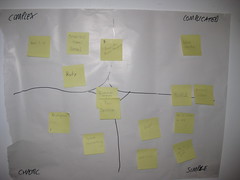
Thursday, April 03, 2008
awareness & squikis - patrick's response to peak email
Patrick Lambe does something very cool with the final section of the Peak Email presentation. I felt it was a bit lacking as well - but couldn't put my finger on what it was. Patrick has cleverly brought in social bookmarking and created the "squiki".
A few years ago Rojo touted itself as a "collaborative RSS system". I signed up for it and used it as a boring (but good) RSS feedreader. I tried inviting a few people but it was a pig to use and the collaborative bit never really got a look in. The squiki may be an idea whose time has come.
I am now in a bit of a bind. If I ever present "Peak Email" then I will have to use Patrick's section. Can I do that in good faith even if I plaster Patrick's name over it? I hope so because I love the idea of collaboratively developing something with others.
A few years ago Rojo touted itself as a "collaborative RSS system". I signed up for it and used it as a boring (but good) RSS feedreader. I tried inviting a few people but it was a pig to use and the collaborative bit never really got a look in. The squiki may be an idea whose time has come.
I am now in a bit of a bind. If I ever present "Peak Email" then I will have to use Patrick's section. Can I do that in good faith even if I plaster Patrick's name over it? I hope so because I love the idea of collaboratively developing something with others.
Wednesday, April 02, 2008
Tuesday, April 01, 2008
peak email presentation
Subscribe to:
Posts (Atom)

 Posts
Posts