Patrick Lambe does something very cool with the final section of the Peak Email presentation. I felt it was a bit lacking as well - but couldn't put my finger on what it was. Patrick has cleverly brought in social bookmarking and created the "squiki".
A few years ago Rojo touted itself as a "collaborative RSS system". I signed up for it and used it as a boring (but good) RSS feedreader. I tried inviting a few people but it was a pig to use and the collaborative bit never really got a look in. The squiki may be an idea whose time has come.
I am now in a bit of a bind. If I ever present "Peak Email" then I will have to use Patrick's section. Can I do that in good faith even if I plaster Patrick's name over it? I hope so because I love the idea of collaboratively developing something with others.
Thursday, April 03, 2008


Wednesday, April 02, 2008
Tuesday, April 01, 2008
peak email presentation
Monday, March 31, 2008
wikis for ray


ready, fire, aiim - enterprise 2.0 report
A detailed discussion by James Dellow on the Enterprise 2.0 report from AIIM. As James notes, there are lots of graphs. The data comes from 441 responses to a web-based survey instrument and about a third of respondents were IT personnel - so at best we have indication of trends rather than anything too reliable. However given the paucity of data available - we have some material from Forrester (most of it not in the public domain) and Melcrum's report on social media & employee engagement.
So let's have a quick canter through:
So let's have a quick canter through:
- Like James, I like the vaguely collaborative nature of Section 1: Defining Enterprise 2.0. We get Andrew McAfee, Dave Weinberger, Patti Anklam & others shooting the sugar about what E2.0 means, maaaan. The debates about the definition are more interesting than the definition itself. And I like how they have pretty much reprinted the emails.
- Section 2 on Tech is a bit blahblahblah - nothing we haven't heard before - and I'm with James in being unconvinced by the 1.0, 1.5, 2.0 split. Figure 2 is pretty much what you'd expect with wikis at the top of the pops (2 years ago blogs would have been at number 2 instead of SNS). Figure 3 is also what you'd expect - the most E2.0 tools are generally the ones with least awareness - blogs being the honourable exception probably due to the hoohah about them since 2004. "Search" scores heavily as a E2.0 tool - but I take that to be i. an example of Google's marketing prowess & ii. a damning indictment of the last decade of attempts at enterprise search solutions. Is search E2.0? I guess it depends how it's done, baby...
- Section 3 looks at the primary business drivers (oo-er). The message here is that E2.0 is primarily about collaboration. Which I don't have a problem with. The IT-centric nature of the survey sample can be seen in Figure 10 - "yes we all know what open source is". Based on a decade of experience, I would disagree that 53% of the respondents fully understand the term "Knowledge Management" but lets not teleport into that world of pain. Figure 12 is interesting in that E2.0 is not seen as well suited to individuals. This is probably because we think of E2.0 as "social" or "collaborative" and completely opposed to individualistic applications. But in fact, E2.0 stuff offers individuals a powerful set of tools for Personal Knowledge Management (PKM). And if they are to succeed, they have to appeal to individuals first AND THEN groups. Work is done by individuals within groups NOT by groups themselves.
- Figure 22 in Section 4 makes a nice complement to Figures 2 & 3. I am intrigued that mashups rank so highly - again this may be due to the IT-centric survey sample. It's like to see those figures split out by the role demographic of respondents (IT vs. everyone else). Figure 28 says that USERS are driving all this. Figure 30 indicates that most uses of E2.0 tools are tactical and Figure 34 will get consultants rubbing their hands in glee while Figure 36 will get them quiet again.
- Section 5 on generational & cultural attitudes is way too prominent but might allow a more nuanced discussion of the "Gen Y love it / Boomers hate it" non-debate. We don't know much about the KM-inclined group except that they are, well, "KM-inclined". Which makes them love E2.0 more.
- Section 6 should be the important one. It's the one with the conclusions. It says a lot of very sensible things about culture and continuums of engagement/collaboration vs. protectionism/control. But it could say a whole lot more. Let's hope that over the coming weeks, both authors will.
And finally, why is this report only available as a single, clunky, dowdy PDF? How Enterprise 2.0 is that?
the long tale - for anecdote
It was a tricky assignment. Damn tricky. Anecdote came back to me regarding the offer. And asked for a poem. About all of them.
The research behind this was kinda cool. I asked all the Anecdoters to keep experience diaries for a week - what they felt, what they saw & heard & smelt & tasted & touched, adding photos where appropriate. All that info is in here somewhere. Although in hindsight I'd probably have run the diaries for a month rather than just a week if possible. People need some time to loosen up.
The Long Tale
Once upon a time,
a long way away,
there were five stories.
It has been said that
there are only seven plots
in our word world
but all I know is that
there were these five stories.
Each story started off as a whisper,
a rumour then a rumour of a rumor.
As each story was told and retold,
it grew and grew and grew.
There are boy stories and girl stories,
grown up stories and baby stories
(and just to be clear on this:
a boy story is not the same
as a story about boys).
Boy stories are loud and blue.
Their ends are loose and untied.
Events happen with little thought.
a blur of testosterone and muddy knees.
Girl stories are more considered,
in the pink not necessarily rose-tinted.
Their details finer, their voices are softer.
They need light and air as much as boys.
Old stories are wrinkled
with layers of circumstance.
They have been passed from mouth to ear to mouth.
Some say that the old stories are the best.
Baby stories are never fully formed.
They sit in bits and grow in fits.
Their meaning hardens with the calcium of time
and you can never tell how they will turn out.
Once upon a time,
there were five stories
and although they have started,
they aren't finished yet.
Listen.
Download the mp3
The research behind this was kinda cool. I asked all the Anecdoters to keep experience diaries for a week - what they felt, what they saw & heard & smelt & tasted & touched, adding photos where appropriate. All that info is in here somewhere. Although in hindsight I'd probably have run the diaries for a month rather than just a week if possible. People need some time to loosen up.
The Long Tale
Once upon a time,
a long way away,
there were five stories.
It has been said that
there are only seven plots
in our word world
but all I know is that
there were these five stories.
Each story started off as a whisper,
a rumour then a rumour of a rumor.
As each story was told and retold,
it grew and grew and grew.
There are boy stories and girl stories,
grown up stories and baby stories
(and just to be clear on this:
a boy story is not the same
as a story about boys).
Boy stories are loud and blue.
Their ends are loose and untied.
Events happen with little thought.
a blur of testosterone and muddy knees.
Girl stories are more considered,
in the pink not necessarily rose-tinted.
Their details finer, their voices are softer.
They need light and air as much as boys.
Old stories are wrinkled
with layers of circumstance.
They have been passed from mouth to ear to mouth.
Some say that the old stories are the best.
Baby stories are never fully formed.
They sit in bits and grow in fits.
Their meaning hardens with the calcium of time
and you can never tell how they will turn out.
Once upon a time,
there were five stories
and although they have started,
they aren't finished yet.
Listen.
Download the mp3
Sunday, March 30, 2008
sociability & design (2): heuristics
Last year I posted on research carried out by Motorola in "sharing practices" and the augmentation of Usability Design by Sociability Design. I have revisited Jakob Nielsen's 10 Usability Heuristics through the social software lens. Some general changes are the replacement of "system" by "relationship", "user" by "participant" and "interaction" by "exchange". Click on the table to enlarge.


the presence paradox - lite communication tools
Lite communications tools such as Twitter & Instant Messaging & SMS txting offer the promise of ambient intimacy or the less confronting option of ambient presence. Little slivers of meaning 'n' grooming flick(er)ing between people.
Leisa Reichelt's ambient intimacy post positions these lite tools as mostly "phatic". I am not convinced that we are very good at correctly recognising "phatic" vs. "semantic" acts of speech. Most of our corporate communications (emails from the CEO, townhall meetings, intranet pages) position themselves as meaningful but are frequently meaningless. Instead they convey another set of messages around status, order & control. They are, in fact, almost purely phatic.
The further you move away from the tools supposedly concerned with meaning into the tools associated with grooming, the more actual meaning you will find. The corporate communications department rarely thinks of IM as a comms channel (thankfully). Let's hope they don't find out.
Leisa Reichelt's ambient intimacy post positions these lite tools as mostly "phatic". I am not convinced that we are very good at correctly recognising "phatic" vs. "semantic" acts of speech. Most of our corporate communications (emails from the CEO, townhall meetings, intranet pages) position themselves as meaningful but are frequently meaningless. Instead they convey another set of messages around status, order & control. They are, in fact, almost purely phatic.
The further you move away from the tools supposedly concerned with meaning into the tools associated with grooming, the more actual meaning you will find. The corporate communications department rarely thinks of IM as a comms channel (thankfully). Let's hope they don't find out.
depth perception
When I was doing The Phoric with Rob & Johnnie, it struck me that things are not always as they seem with human behaviour. The example in the podcast was was about meetings. Many meetings I have been in have had an agenda. Then at the end of the agenda there is AOB - "Any Other Business". Now we tell each other that the real content of the meeting is in the body of the agenda. That is the semantic, meaningful part of the event. Then in the AOB section, there is general chit-chat and socialising and what-not, pretty much all phatic stuff.
This is fine in theory but in practice it works out differently. The agenda consists of worthy but dull topics - Why is the fridge out of yoghurt? Who will take the minutes of the next meeting? Then in the AOB section, all the really important stuff gets asked - What is the new CFO like? What will be the outcome of the restructure? The agenda items are not unimportant (i.e. not completely phatic) but they serve a crucial non-semantic, social function. With unfamiliar people, we observe how they respond and behave during the structured items - Are they responsive, aggressive, loud, knowledgeable, ignorant? Then when we get to the AOB, we have some insight that allows us to manage our interactions with them.
In short, the stuff that often appears to be concrete is actually social and the stuff that often appears to be social is actually concrete.
This is fine in theory but in practice it works out differently. The agenda consists of worthy but dull topics - Why is the fridge out of yoghurt? Who will take the minutes of the next meeting? Then in the AOB section, all the really important stuff gets asked - What is the new CFO like? What will be the outcome of the restructure? The agenda items are not unimportant (i.e. not completely phatic) but they serve a crucial non-semantic, social function. With unfamiliar people, we observe how they respond and behave during the structured items - Are they responsive, aggressive, loud, knowledgeable, ignorant? Then when we get to the AOB, we have some insight that allows us to manage our interactions with them.
In short, the stuff that often appears to be concrete is actually social and the stuff that often appears to be social is actually concrete.
innovative household - masters of our domayne*?
Just before Easter, I crashed was kindly invited to the Innovative Household launch. You can download the whole magazine here. I haven't had time to dig into my copy in detail but it looks pretty browsable. I arrived a bit late (& frazzled) so I only caught Graeme Philipson & Immo Buschmann (you can download their presentations from the launch page).
Now free is good but the whole event seemed a bit of mishmash. We were surrounded by the domestica of Domayne. We had a few Audi cars parked here and there. We had some research on consumer attitudes to networked appliances. We heard (or rather we barely heard due to iffy sound) how innovative Audi were.
Ralph & Ian & Annalie were there so there were some good things - and Graeme was quite droll - but there was something missing. It didn't seem very, well, innovative. Just as knowledge management practitioners can be terrible at sharing knowledge, are those trumpeting innovation liable to clothe a potentially radical message in retro duds? Anyway, Grant Crossley is doing some interesting stuff so I am looking forward to future events (assuming I get invited to any).
*Yes, that is a Seinfeld reference.
Now free is good but the whole event seemed a bit of mishmash. We were surrounded by the domestica of Domayne. We had a few Audi cars parked here and there. We had some research on consumer attitudes to networked appliances. We heard (or rather we barely heard due to iffy sound) how innovative Audi were.
Ralph & Ian & Annalie were there so there were some good things - and Graeme was quite droll - but there was something missing. It didn't seem very, well, innovative. Just as knowledge management practitioners can be terrible at sharing knowledge, are those trumpeting innovation liable to clothe a potentially radical message in retro duds? Anyway, Grant Crossley is doing some interesting stuff so I am looking forward to future events (assuming I get invited to any).
*Yes, that is a Seinfeld reference.


Thursday, March 27, 2008
enterprise collaborative bookmarking
Here are the fruits of my recent research on Collaborative Bookmarking inside the Enterprise:
Follow this link if slideshare is knackered (you can download the presentation if you want).
Feel free to comment on this - it's a first version: I am still waiting on Connectbeam & IBM to get back to me with some more case studies. And if you know of any others then drop me a line please.
Follow this link if slideshare is knackered (you can download the presentation if you want).
Feel free to comment on this - it's a first version: I am still waiting on Connectbeam & IBM to get back to me with some more case studies. And if you know of any others then drop me a line please.
why don't people get it?
Along with 275 of my closest friends in the world*, I will be contributing to Drew's & Gav's sequel to The Age Of Conversation - Why Don't People get It?
All 275 contributors are selecting a section of the book to contribute to even as we speak. I want to contribute to the section on... oh - that would be telling.
*That is a lie - and not the last one I will tell relating to this project.
All 275 contributors are selecting a section of the book to contribute to even as we speak. I want to contribute to the section on... oh - that would be telling.
*That is a lie - and not the last one I will tell relating to this project.
are you interesting?
So we have the second coming of Interesting South to Sydney. Get your red hot speaker application form here. It will be double the fun, double the danger, double the excitement.
Do it! Do it now!!!
Do it! Do it now!!!
Tuesday, March 25, 2008
be kind rewind - the analogue acolyte messages the digital
Saw Be Kind Rewind last night. It's sweet and just right side of corny. Director Michel Gondry was one of the stars of last week's Phoric session. MG is an analogue obsessive in a digital world. The star of BKR is magnetic videotape rather than the ubiquitous DVD but despite this it's really all about the digital world of user generated content found in YouTube, Flickr, etc.
***Spoilers***
If you want to understand the real nature of human creativity at play on the interweb then watch this movie:
***Spoilers***
If you want to understand the real nature of human creativity at play on the interweb then watch this movie:
- It's not about the coolest technology [Mike & Jerry use video fercrissakes].
- It is about involving people [Mike & Jerry invite the renters to star in the videos].
- Copyright enforcement can be just plain nasty [the steamroller, people].
- Creativity is driven by necessity [Mike & Jerry don't dream this up just because they think that it's cool - they frickin' have to stop the shop being knocked down].
- Creativity begins with plagarism [The Fats Waller movie comes after they have learnt their craft through rip-offs].
- Great stories have their own truth & power [Fats Waller did not come from Passaic].
Most of all MG finds the creative, the magical, the alchemical in everyday life and its detritus.
Can you?
Sunday, March 23, 2008
urban fragments - for kim (1)
Kim offered me 3 photographs of urban fragments. I gave her 3 fragments back. Here is her post about the first.
listen carefully through your lens
the city’s concrete parapraxes
its slips of a rusty tongue
its sly evasions when put to the question
you can’t get a straight answer out of the city
you read its map statement again
combing over the misremembered debris
until you find a path through the rubble
a lead in the case
some lead from the windows
are you hungry?
in need of entertainment?
then follow the corroded path
up through the air vents
past the fire escape and insulation
into the tainted daylight
the city won’t budge
The other 2 fragments can be found here and here.
 Their audio kin are here, here & here.
listen carefully through your lens
the city’s concrete parapraxes
its slips of a rusty tongue
its sly evasions when put to the question
you can’t get a straight answer out of the city
you read its map statement again
combing over the misremembered debris
until you find a path through the rubble
a lead in the case
some lead from the windows
are you hungry?
in need of entertainment?
then follow the corroded path
up through the air vents
past the fire escape and insulation
into the tainted daylight
the city won’t budge
The other 2 fragments can be found here and here.
Their audio kin are here, here & here.
Wednesday, March 19, 2008
information architects
I was in Woolloomooloo last night with a bunch of Information Architects (after the Innovative Household thingo which I will talk about shortly). Eric Scheid was there running things, as was Greg Dwyer. Steve Baty claims to have worked on 1500 web projects over the last 10 years - which equates to approximately one every 2.5 days - so expect him to get a couple in over Easter. Lindsay Evans & Dean Hargreaves put up with some ranting and responded with some offerings of their own.
Dean's PhD around collaborative development reminded me of the PLM/CPC stuff from my days as a Supply Chain Knowledge Manager at PwC but that's another story...
Dean's PhD around collaborative development reminded me of the PLM/CPC stuff from my days as a Supply Chain Knowledge Manager at PwC but that's another story...
touch podcast
Johnnie, Patrick & Mark join forces for a podcast on touch. Lovely stuff - esp. the Dad's Army references.
Monday, March 17, 2008
phoric 6: alchemy
Rob & Johnnie let me do a phoric session with them. Watch the videos and listen to the podcast here. It was great fun. Among other things, we talk about:
- Improv and making offers
- Risk
- Alchemy
- Skinny white English guys
- Iceland magicians
- Viral simplicity
- Phatic contradictions
Friday, March 14, 2008
america
I have decided to go to the United States of America in May. I plan to be in Washington for this and this and then it's fair game. So far, I plan to see Nancy in Seattle, Vincent & Bruce in San Fran, Jenny & Rashid in NYC, Stan in Michigan, Jack in either Chicago or Boston.
Do you want to meet? Is there someone else you think I should meet? Or attend? Or just gawk at?
Detours into Mexico & Canada cannot be ruled out at this stage.
N.B. EwF believes absolutely in whim and kismet.
Do you want to meet? Is there someone else you think I should meet? Or attend? Or just gawk at?
Detours into Mexico & Canada cannot be ruled out at this stage.
N.B. EwF believes absolutely in whim and kismet.
Thursday, March 13, 2008
australian km? deceptive pragmatism
I was shooting the breeze having a very serious business meeting with Laurie Lock Lee yesterday and I was reminded of this post I wrote a few years back. Laurie has been applying some VNA stuff to a specific set of business issues in a neat way. In many ways it reminds me of Shawn's approach to the Cynefin / Cognitive Edge stuff.
- There is distinctly pragmatic approach to both Laurie & Shawn's work.
- This may mean simplifying the source material and adapting it to local needs.
- There is a willingness to mix approaches from different sources where appropriate.
In many ways with chimes with Thomas Barlow's book on the history of innovation in Australia. As a nation, we are great at taking other people's stuff and making it work. You want a 2020 vision, then go for this. The Chinese are brilliant at ripping off other nation's brands (and creating their own unique forms of innovation in the process). We need to return to our past as the China of Ideas & Tools.
I doubt Australian KM will ever produce someone with the mercurial brilliance of a Dave Snowden or the visionary fervour of a Verna Allee. We are more likely to produce writer/practitioners with the clarity of Tom Davenport or the considered erudition of a Larry Prusak (although arguably Singapore has got that last one already).
N.B. I have probably offended everyone mentioned in this post but I'm writing this with a huge amount of respect & gratitude to all concerned. And if you don't like what I've said about you, well, tough.
Tuesday, March 11, 2008
information architecture in the public sector conference
The 3rd Annual Information Architecture in the Public Sector Conference 2008 will be held on 23 & 24 June in Canberra and then I will be running a workshop on the Friday afternoon on "Architecting Anarchy".
Beg the money from your employer or steal it from an old lady or sell crack or something. Just come.
Beg the money from your employer or steal it from an old lady or sell crack or something. Just come.
bar camp sydney - april 5/6
Bar Camp Sydney will be on the weekend of April 5 & 6. Assuming I am not struck down by the flu again, EwF will be there in full on rant-machine mode. I'm probably going to be road-testing some of the stuff discussed here. There will be activities. And scones. And did I mention the ranting?
In the meantime I will be "persuading" Chris Khalil to present something on his application of value networks to social software inside the enterprise. Come on Chris, don't make me reach for the vodka again...
In the meantime I will be "persuading" Chris Khalil to present something on his application of value networks to social software inside the enterprise. Come on Chris, don't make me reach for the vodka again...
Tuesday, March 04, 2008
enlightened self-interest
Check out this presentation from the RIAA if you get the opportunity. Definitely worth a go.
london
The city is blind but it will not slow down.
I lived in London for 4 years. It seems like a lifetime ago and I don't regret leaving. Lauren's experience is more immediate. She has her own triggers associated with that environment. But I see this and I remember what I loved about London.
London is an accelerator. Its immigrant communities from all over the world provide the raw energy. The bad weather and overcrowding intensify this until some form of fusion occurs (both in the senses of the productive and the devastating). I didn't grow there so I too was a blow-in. An extra. Part of the mutation.
More than any other modern city, London has a soundscape. You hear the city before you see it.
The city is blind but that just sharpens its sense of sound. It detects you as you move through it. An audioghost. A sonic hallucination.
Maybe I only existed when it deluded me into existence as a lost voice.
life as musical
Nancy White asks the question: Is a fully lived life a musical? Probably, but without me doing any singing. I make occasional references to music on this blog (which probably baffle 90% of my readers as the references are very specific and localised). If I can work it out with Johnnie and Rob, there may be an episode of The Phoric about this.
If there is one area of the world where I am part of the dominant elite, it is language. I can do stuff. With words. Like. And yet I crave experiences that exceed and overwhelm the resources of language. Physical stuff like hanging from a trapeze. Or listening to music. Music hotwires our emotional machinery, joyrides around our dreams. As an atheist (tho brung up a believer, baby), it is my last connection to the divine.
Many musicians talk about music as salvation. I don't want to be saved for eternity - I just want to be here and not here in the now. And music grants that paradoxical wish. Thank you.
If there is one area of the world where I am part of the dominant elite, it is language. I can do stuff. With words. Like. And yet I crave experiences that exceed and overwhelm the resources of language. Physical stuff like hanging from a trapeze. Or listening to music. Music hotwires our emotional machinery, joyrides around our dreams. As an atheist (tho brung up a believer, baby), it is my last connection to the divine.
Many musicians talk about music as salvation. I don't want to be saved for eternity - I just want to be here and not here in the now. And music grants that paradoxical wish. Thank you.
draw me a picture
I'm at the CSTC breakfast kindly put together by Ralph Kerle and AMP's Catalyst for Magic (who does not blog but should). The posed and lovely Linda Naiman is in town. About half-way in, there's a lot of talking go on and my minute attention span is attenuating so I ask her to draw what she does. She bats it back to me and gets two us to do a drawing conversation exercise with her guiding us. I am a terrible drawer but I really enjoyed it. Especially the comet.
Check out Linda's site, there's heaps of good stuff there.
Check out Linda's site, there's heaps of good stuff there.
even less touching
A while ago, Patrick wrote about touching. Being an anglo-saxon heterosexual male (I am a member of the dominant elite, go me), who you can touch is pretty circumscribed. You can't touch other men without being a "poofta". You can't touch a woman you are not involved with as that could be misinterpreted. In our culture (tho not others), touching is too tightly related to sex. And yet touch is about so much more than sex. Years ago, I was on a beach on a tiny island in Indonesia. And this old guy with huge hands is giving massages on the beach. And so I have a massage. And it's all innocuous. And I've been travelling for ages and I haven't been touched in months. And it's too much. I have to ask him to stop because I'm in tears.
A couple things happened tonight that triggered that reflection. The bad: a woman cracking a homo gag when I'm working with another guy in circus classes. The good: a Melbourne and a Brisbane poet (both male) having a hug and then bagging Sydney poets for keeping their (physical) distance.
I am one of the dominant elite. Fear me.
But don't come too close or else I might cry.
A couple things happened tonight that triggered that reflection. The bad: a woman cracking a homo gag when I'm working with another guy in circus classes. The good: a Melbourne and a Brisbane poet (both male) having a hug and then bagging Sydney poets for keeping their (physical) distance.
I am one of the dominant elite. Fear me.
But don't come too close or else I might cry.
Monday, March 03, 2008
blogging and you don't know it
I was talking to a couple of people about RSS and blogs today and suddenly we all realised that if you RSS enable different parts of your site, even if you don't have a site blog, the material will still appear blog-like in an RSS feedreader.
And then later on, Russ Weakley came into discuss the planned changes to the Australian Museum website - which involve tagging (both author & user generated) and reader comments.
Mix the two together (RSS + Tags + User Generated Content coupled with Organisational Content) and blogs disappear - instead everything is a blog (but not as we know it, Jim).
One possible future is that the majority of websites become hyperblogs such as this and the majority of intranets become next-gen wikis.
Go figure.
And then later on, Russ Weakley came into discuss the planned changes to the Australian Museum website - which involve tagging (both author & user generated) and reader comments.
Mix the two together (RSS + Tags + User Generated Content coupled with Organisational Content) and blogs disappear - instead everything is a blog (but not as we know it, Jim).
One possible future is that the majority of websites become hyperblogs such as this and the majority of intranets become next-gen wikis.
Go figure.
Sunday, March 02, 2008
meauring organisational health
The following was in answer to a question posted to the AFN email list. Several people liked it so I thought I share it more widely.
"I'm a bit obsessed with measurement at the moment so here's my 2 cents. Depending on what you mean by "health & wellness" (physical, mental, emotional, social), you have a whole range of options.
They probably fall into four buckets:
- Existing operational HR data (as noted by Belinda) - staff retention, sick days,
- Direct surveys aimed at aggregating individual experiences (as noted by Belinda, Hans & Cory) such as staff satisfaction & the human synergistics stuff.
- Direct surveys aimed mapping connections between individuals (social network analysis) - see here for an example: http://www.robcross.org/pdf/roundtable/energy_and_innovation.pdf
- Indirect surveys using narrative (as noted by Mary Alice). These can either be done using F2F workshops or online software. This can yield both qualitative & quantitative insights.
A fifth area might be some kind of ethnographic research (i.e. getting stuck in there and having a look around) - but this yields qualitative rather than quantitative insights.
You probably want some combination of the above depending on the organisation's:
- Budget
- Culture
- Previous experiences with these approaches."
"I'm a bit obsessed with measurement at the moment so here's my 2 cents. Depending on what you mean by "health & wellness" (physical, mental, emotional, social), you have a whole range of options.
They probably fall into four buckets:
- Existing operational HR data (as noted by Belinda) - staff retention, sick days,
- Direct surveys aimed at aggregating individual experiences (as noted by Belinda, Hans & Cory) such as staff satisfaction & the human synergistics stuff.
- Direct surveys aimed mapping connections between individuals (social network analysis) - see here for an example: http://www.robcross.org/pdf/roundtable/energy_and_innovation.pdf
- Indirect surveys using narrative (as noted by Mary Alice). These can either be done using F2F workshops or online software. This can yield both qualitative & quantitative insights.
A fifth area might be some kind of ethnographic research (i.e. getting stuck in there and having a look around) - but this yields qualitative rather than quantitative insights.
You probably want some combination of the above depending on the organisation's:
- Budget
- Culture
- Previous experiences with these approaches."
teens & the elderly getting fresh: innovation & social software
In the late 90s, the joke in KM circles was that KM in business was like teenage sex - lots of people talking about doing it, far fewer people actually doing it. The use of social software inside the firewall (or Enterprise 2.0) is probably the reverse - lots of it going on but very few people willing to talk about it in public - like sex among the elderly in fact.
Which brings me to the topic of innovation. I rocked up to the Innofuture Sydney gig on Thursday. There was a panel featuring people from here, here, here and here. There were some interesting comments from the panel and people on the floor but it felt like a bit of a talkfest (I contributed to this talkfest by getting in a few rants from the floor where I could). There was some debate over "what is innovation?" which I find tediously like the question "what is knowledge?"
On the one hand, they are both very, very important questions. On the other, the answers that are provided are often trite at best or opaque at worst*. Where and when they are asked is of critical importance. Knowledge and innovation are such diverse entities the local context of discussion really defines the answer that will help you. Hence the discussion needs the be anchored in the concrete and those participating in the conversation need a sufficient common context for the discussion to be meaningful.
*Please do not mention Popper's 3 worlds. They do not help. Really. They don't.
Which brings me to the topic of innovation. I rocked up to the Innofuture Sydney gig on Thursday. There was a panel featuring people from here, here, here and here. There were some interesting comments from the panel and people on the floor but it felt like a bit of a talkfest (I contributed to this talkfest by getting in a few rants from the floor where I could). There was some debate over "what is innovation?" which I find tediously like the question "what is knowledge?"
On the one hand, they are both very, very important questions. On the other, the answers that are provided are often trite at best or opaque at worst*. Where and when they are asked is of critical importance. Knowledge and innovation are such diverse entities the local context of discussion really defines the answer that will help you. Hence the discussion needs the be anchored in the concrete and those participating in the conversation need a sufficient common context for the discussion to be meaningful.
*Please do not mention Popper's 3 worlds. They do not help. Really. They don't.
Saturday, March 01, 2008
edge of life
Cairo Walker hits us with another painting.
Like CW, I have a fascination with viruses* and pathogens in general. I studied a bit of pathology at Uni. When I lived in Calcutta, I became painfully aware that we not only live in ecologies but that our bodies themselves are ecologies (bacterial dysentery will do that to you). The human body contains 10 times as many bacterial prokaryotic cells as human eukaryotic cells.
Viruses are reproductive machines that don't have the full equipment to reproduce without hijacking other organisms. They swarm through the environment. They mutate, recreate themselves in a constant state of becoming. The AIDS virus has killed (and changed the lives of) people close to me. But on one level it is beautiful. Don't you think? A little strand of nucleic acid surrounded by proteins. Not that dissimilar to us.
*I think the term "viral" is hideously misused but that's a rant for another time.

Like CW, I have a fascination with viruses* and pathogens in general. I studied a bit of pathology at Uni. When I lived in Calcutta, I became painfully aware that we not only live in ecologies but that our bodies themselves are ecologies (bacterial dysentery will do that to you). The human body contains 10 times as many bacterial prokaryotic cells as human eukaryotic cells.
Viruses are reproductive machines that don't have the full equipment to reproduce without hijacking other organisms. They swarm through the environment. They mutate, recreate themselves in a constant state of becoming. The AIDS virus has killed (and changed the lives of) people close to me. But on one level it is beautiful. Don't you think? A little strand of nucleic acid surrounded by proteins. Not that dissimilar to us.

*I think the term "viral" is hideously misused but that's a rant for another time.
kiva poetry auction update
Remember this? So far we have 2 bids:
- Andrew Mitchell weighed in with AU$100.
- Lesser Kudu upped the ante to $150 for "hope". Not bad for someone with hooves (do they cause problems with the keyboard LK?) and funky stripes.
Come on - you can band together to get the cash remember? For the cost of a good meal for 4 people, those same 4 people can:
- Contribute to the well-being of many human beings.
- Influence the behaviour of one specific human being (for better or humorous).
What could be better? Post your bid now.

Friday, February 29, 2008
luis suarez goes cold turkey
Luis Suarez has given up email. Well, not quite - he's taking a harm minimisation / gradual reduction approach. Luis has now crossed the peak email threshold. I'm sure it's nice and sunny there. I hope the rest of us can join him soon.
Meanwhile just one more hit, just one...
Meanwhile just one more hit, just one...
should ewf sell out to the man?
So I get this email from polimedia.us (despite their domain name being registered in Miami, their website seems oddly, er, Romanian). And it says:
We have reviewed your blog on behalf of one of our clients that would be interested in placing advertising with you.
Oooohhhhh, noice. Apparently they are acting on behalf of doingfine.org (tagline: "We're Doing Just Fine").
We'd like either a 150x150 button, 160x600 skyscraper or 468x60 full banner (or footer). Alternatively, we may be interested in text-only advertising.
Uh huh, uh huh. SHOW ME THE MONEY!!!
This would be a weekly, monthly or yearly arrangement. In either case we will require a one time, one day (24 hours) free placement in order to test the quality and quantity of traffic your website can actually provide.
So no money straight away? And I have to give you free advertising?
We prefer using PayPal but may be able to accommodate alternative payment methods.
We have a deal breaker! I send this response:
I would like the money in a brown paper envelope* rather than paypal.
They counter-offer:
That'd be a little hard to do.
Sorry guys, no free advertising for you. Oh, hang on...
*It's a tax thing.
We have reviewed your blog on behalf of one of our clients that would be interested in placing advertising with you.
Oooohhhhh, noice. Apparently they are acting on behalf of doingfine.org (tagline: "We're Doing Just Fine").
We'd like either a 150x150 button, 160x600 skyscraper or 468x60 full banner (or footer). Alternatively, we may be interested in text-only advertising.
Uh huh, uh huh. SHOW ME THE MONEY!!!
This would be a weekly, monthly or yearly arrangement. In either case we will require a one time, one day (24 hours) free placement in order to test the quality and quantity of traffic your website can actually provide.
So no money straight away? And I have to give you free advertising?
We prefer using PayPal but may be able to accommodate alternative payment methods.
We have a deal breaker! I send this response:
I would like the money in a brown paper envelope* rather than paypal.
They counter-offer:
That'd be a little hard to do.
Sorry guys, no free advertising for you. Oh, hang on...
*It's a tax thing.
sydney opera house & the economics of scarcity
So here's the good news: Sydney Opera House is putting on Night Words. They have some of Sydney's best spoken word talent*. At the Opera house. With music. And other stuff. Book now!!!
And now for the less good news: I have heard on the grapevine that there is some weird "you can't perform several weeks either side of the event in Sydney" restriction on performers. Apparently this is quite common in the arts world. Because the audience for this stuff is small and we must guard our audience share at all costs. The preciousss is ourses.
Which if it's true is stuffed. Sure, you don't want someone trying to recreate a similar event the next week with the same line-up. But you do want these charismatic, talented people promoting your show all around town in a million smaller venues to new audiences. That's right: new people.
If you run your business on a scarcity model, don't be surprised if your market is well, scarce. Lots of parts of the arts seem to be run on exactly that scarcity model. And then there is a whole heap of whinging that the general public aren't interested or engaged**.
Now this may all be a load of rubbish. Can someone reassure me that the Opera House isn't doing something moronic?
*My favourite is probably Tom Keily - not only because he is a brilliant, passionate performer but also because he was an economist at the RBA in a former life.
**I am a crass populist and I love it.
N.B. There are lots of things that avoid the scarcity model: I was really impressed by the opening night of the Sydney Festival - so much cool stuff for free! The poetry / spoken word scene in Sydney does a lot of cross-promotion - largely due to Roberta, Danny & Jack.
And now for the less good news: I have heard on the grapevine that there is some weird "you can't perform several weeks either side of the event in Sydney" restriction on performers. Apparently this is quite common in the arts world. Because the audience for this stuff is small and we must guard our audience share at all costs. The preciousss is ourses.
Which if it's true is stuffed. Sure, you don't want someone trying to recreate a similar event the next week with the same line-up. But you do want these charismatic, talented people promoting your show all around town in a million smaller venues to new audiences. That's right: new people.
If you run your business on a scarcity model, don't be surprised if your market is well, scarce. Lots of parts of the arts seem to be run on exactly that scarcity model. And then there is a whole heap of whinging that the general public aren't interested or engaged**.
Now this may all be a load of rubbish. Can someone reassure me that the Opera House isn't doing something moronic?
*My favourite is probably Tom Keily - not only because he is a brilliant, passionate performer but also because he was an economist at the RBA in a former life.
**I am a crass populist and I love it.
N.B. There are lots of things that avoid the scarcity model: I was really impressed by the opening night of the Sydney Festival - so much cool stuff for free! The poetry / spoken word scene in Sydney does a lot of cross-promotion - largely due to Roberta, Danny & Jack.
dogear raid - throw a football in a greenhouse
It's been a slow night here at EwF towers. IBM runs a testbed for its social software called Lotus Greenhouse. I have been evaluating a number of IBM products for various reasons, including IBM's version of del.icio.us called dogear. Seeing that most of the tags were for "Lotus" and "Connections" (Dogear is part of the Lotus Connections suite), I decided to have a bit of fun (N.B. the following very much depends on a non-standard definition of fun). Here is the "before" picture (click to enlarge):

And here is the "after". Pay particular attention to the "active tags" thingo on the left-hand side of the screen (click to enlarge):


And here is the "after". Pay particular attention to the "active tags" thingo on the left-hand side of the screen (click to enlarge):

I quite like dubstep. I really don't care about football that much. But I do like the idea of mildly confusing people. Feel free to get yourself a Greenhouse ID and start randomly tagging things. I want IBM to be unwitting providers of the premier dubstep/football portal site on the whole of the interweb. Who's with me?
[FULL DISCLOSURE: I used to work for IBM but I have no financial interest in them. I advocate the flagrant coup d'tag of any social bookmarking site, not just IBM's. But please, let's keep it clean. Think of the children.]
Thursday, February 28, 2008
kiva poetry auction
Inspired by Johnnie's gift, I am instituting a Kiva poetry auction. Here is the skinny:
- You can bid for a special poem. What makes it different to an ordinary one? I will video a performance and put it on YouTube. You decide the topic of the poem. And you get to decide any "special" requirements for the video performance*.
- You then get to choose the Kiva entrepreneur (or entrepreneurs) we give the money to. I will feature regular updates from them on my blog - and if you are a blogger you will do the same.
- I will add AU$100 of my own.
- The closing date is midnight March 31st.
- The bidding starts at AU$100.
- Bids are made in the comments box of this blog post.
- Given the cooperative nature of Kiva, consortiums of bidders are allowed.
*I will not go nude. I will do not anything illegal or health-threatening. But apart from that, it's all fair game.
johnnie's response - kiva chain
Meet Johnnie. He wanted a poem about action points. Johnnie's has decided on what his response will be - a Kiva gift certificate. Excellent choice, Mr Moore.
Meet Kiva. "Kiva lets you connect with and loan money to unique entrepreneurs in the developing world. By choosing a loan on Kiva, you can "sponsor a business" and help the world's working poor make great strides towards economic independence. Throughout the course of the loan (usually 6-12 months), you can receive email journal updates from the entrepreneur you've sponsored. As loans are repaid, you get your loan money back."
Meet Lay Sok. A budding construction magnet from Cambodia, he is the first recipient of EwF's largesse. Why did I choose Lay Sok?My due diligence team scrutinised his business plan and accounts for weeks. I like Cambodia and like the idea of him building stuff - in part because it links to Annette's poem (though I am sure things will end better for him).

In loaning someone else's money to Lay Sok, I join Paul from Illinois, Ville from Helsinki and Frode from the other side of Sydney harbour.
Kiva Rocks!!!
Meet Kiva. "Kiva lets you connect with and loan money to unique entrepreneurs in the developing world. By choosing a loan on Kiva, you can "sponsor a business" and help the world's working poor make great strides towards economic independence. Throughout the course of the loan (usually 6-12 months), you can receive email journal updates from the entrepreneur you've sponsored. As loans are repaid, you get your loan money back."
Meet Lay Sok. A budding construction magnet from Cambodia, he is the first recipient of EwF's largesse. Why did I choose Lay Sok?
In loaning someone else's money to Lay Sok, I join Paul from Illinois, Ville from Helsinki and Frode from the other side of Sydney harbour.
Kiva Rocks!!!
Tuesday, February 26, 2008
sticky fingers
Just finished Sticky Knowledge by Gabriel Szulanski. It's a brief book written in a somewhat academic style but GS's point is both simple and powerful.
We often wonder why we can't get the one team/division/subsidiary that does something really, really good to show the other team/division/subsidiary how to do. There is a tendency to think that this main barrier is recipient motivation - "they just don't want to improve" - and that this barrier can be surmounted by tweaking incentives.
GS's research indicates that the main barrier in his examples was actually the absorptive capacity of the recipients - i.e. the people that need to learn don't know enough to take the new stuff on board. The knowledge jump is too great for them. The second barrier was causal ambiguity - i.e. we didn't understand what made the original good thing tick well enough to transport it lock stock & barrel.
So if we are going to learn from each other (generalisations ahoy):
- A little and often is better than all at once.
- We must be cautious of overconfidence in our preferred solution.
- Bribery may not help.
sns around the world
Le Monde have produced this very useful map of social networking site up-take around the world.
Courtesy of Greg.

Courtesy of Greg.
gisajob
Come the end of May, my current employment contract will be ending - and I can't see it being renewed in its current form. So if you want to work with me in some capacity (employer, client) then drop me a line. You know what kind of stuff I am into. Come on, let's make it happen...
australians & social media
Laurel notice this research from Nielsen (& a brief search also reveals this recent data about Australasian SNS usage). At last, data, sweet data! What can we tell:
- Kiwis are more into this stuff than Aussies (esp. in the "friend finding" area).
- The most popular kind of shared media are photos.
- Lots of people like reading blogs and wikis.
- Quite a few people update blogs (about 15%). Now the survey refers to "online consumers" as the sample population. ABS data indicates that 61% of the 11.3 million online Australians purchased something. Which might indicate* there are approximately 200,000 bloggers in the Sydney area. I feel much less special now. Do you believe that figure?
*Sydney population x (% who purchase online x % who blog x Aussies online / Total Aussie pop)
i wear a bowler hat and drink tea
Curtis Conley discusses individualist vs communitarian approaches to KM. This kind of cross-cultural analysis is based on the work of Geert Hofstede and Fons Trompenaars & Charles Hampden-Turner. The more I am exposed to these tools, the more they remind me of MBTI and HBD approaches in personality typing - a useful place to start but a terrible place to finish.
Basically your behaviour is rated using a survey instrument. I remember taking a survey based on Hofstede's work and coming out looking pretty English. The cross-cultural stuff then underlies a lot corporate training in multinationals where as the personality stuff is often used in the service of teambuilding. If facilitated with a lightness of touch and a respect for people's experiences this can lead to a useful discussion on difference and diversity.
The problem occurs when you take this stuff too seriously. At the personality level, knowing my MBTI score will not allow you to predict my future behaviour. At the cross-cultural level, a lot of diversity training tends to get mired in stereotypes: we English don't express ourselves, Americans are loud, Japanese people are submissive. Now most stereotypes have an element of truth in them but they do not have predictive power. There are quiet Americans and loud Japanese people.
I think we are still at the stage where the acknowledgement of difference has use but I suspect these tools will lose whatever power they have over time. I hope we will outgrow them.
Basically your behaviour is rated using a survey instrument. I remember taking a survey based on Hofstede's work and coming out looking pretty English. The cross-cultural stuff then underlies a lot corporate training in multinationals where as the personality stuff is often used in the service of teambuilding. If facilitated with a lightness of touch and a respect for people's experiences this can lead to a useful discussion on difference and diversity.
The problem occurs when you take this stuff too seriously. At the personality level, knowing my MBTI score will not allow you to predict my future behaviour. At the cross-cultural level, a lot of diversity training tends to get mired in stereotypes: we English don't express ourselves, Americans are loud, Japanese people are submissive. Now most stereotypes have an element of truth in them but they do not have predictive power. There are quiet Americans and loud Japanese people.
I think we are still at the stage where the acknowledgement of difference has use but I suspect these tools will lose whatever power they have over time. I hope we will outgrow them.
Monday, February 25, 2008
the absurd
Johnnie recommended I pick up Management of the Absurd by Richard Farson. As usual he is right. Most management writers fancy themselves as system builders (pocket Kants if you will). Farson is a writer more in the tradition of Nietzsche. He is less interested in the six things you need to do tomorrow to become an effective manager and more concerned with provoking you into thought and self-reflection. Some taster headings:
- Effective managers are not in control.
- Individuals are indestructible but organisations are very fragile.
- We think we want change or creativity but we really don't.
Farson is a purveyor of paradox - that disconcerting situation where a thing and its reverse can both be true. An ambiguity that is unresolvable (and ambiguity is what managers most fear). You cannot eliminate paradox, only embrace it.
whose innovation is it anyway?
So I was talking to a dude at one of Australia's major banks. And he was enthusing about P2P lending (Kiva, Zopa, Prosper). And I said something along the lines of "You know that Grameen bank has been doing microfinance in Bangladesh for over 30 years?" He hadn't. Whilst P2P lending and microfinance are not identical, there are significant similarities.
I had a brief Skype conversation this evening with Sriram Reddy from Infoxchange and Engineers Without Borders. Some of the issues he is working on with farmers in India sound very similar to initiatives I have heard about in rural Australia.
For decades we have assumed that technology transfer in international development basically flows from the Developed World to the Developing World. That assumption is increasingly untenable.
I had a brief Skype conversation this evening with Sriram Reddy from Infoxchange and Engineers Without Borders. Some of the issues he is working on with farmers in India sound very similar to initiatives I have heard about in rural Australia.
For decades we have assumed that technology transfer in international development basically flows from the Developed World to the Developing World. That assumption is increasingly untenable.
there there - for lou
You may remember the offer. Lou is someone who took up the offer and the first person without a web presence to do so. She had jotted down some thoughts and we talked about them over a fantastic lunch she cooked yesterday. She is also a talented photographer. The thoughts aren't getting reprinted here but we are getting some of the quotes she provided.
"my life has been a tapestry of rich and royal hue, an everlasting vision of the ever-changing view” – Carole King
“I’m sensitive and I’d like to stay that way” - Jewel
“The deeper that sorrow carves into your being, the more joy you can contain.” - Kahlil Gibrahn
“most people live lives of quiet desperation” Thoreau
“we are only as sick as the secrets we keep” Sue Atchley Ebaugh
“pain is inevitable. Suffering is optional” Kathleen Casey Theisen
“we are all so much together but we are all dying of loneliness” Dr Albert Schweitzer
“the greatest gift we can give one another is rapt attention to one another’s existence” Sue Atchley Ebaugh
And now without further ado...
There There
For 35 years,
I have worn you.
I have grown you,
stretched and
moisturised and
bronzed you.
I have tended you,
my beautiful boundary.
I have fed you
with the caresses of others.
They have traced the veins
that lie just under you.
They have run their fingers
through the hairs
that break your surface.
I can't remember when
I realised that you were
holding me back.
Maybe when the butterfly
landed on us in that meadow.
Or perhaps the sun's nagging,
gossamer impact over decades.
I have been cushioned, comforted, cordoned.
I want to feel the world unguarded by you.
Every touch overwhelming,
a glorious agony of contact.
I start pulling you
behind my left ear.
You let go of me with some reluctance.
I unwind you like a veil,
like bandages over a healed wound.
A breeze dabs my muscles
and feels like a tornado.
I know now that the sun
is a vast nuclear furnace.
The others hold me,
even though it stings.
The others hold me,
and let me whisper
my frayed, flayed hopes
into their ears.
Download the mp3.
"my life has been a tapestry of rich and royal hue, an everlasting vision of the ever-changing view” – Carole King
“I’m sensitive and I’d like to stay that way” - Jewel
“The deeper that sorrow carves into your being, the more joy you can contain.” - Kahlil Gibrahn
“most people live lives of quiet desperation” Thoreau
“we are only as sick as the secrets we keep” Sue Atchley Ebaugh
“pain is inevitable. Suffering is optional” Kathleen Casey Theisen
“we are all so much together but we are all dying of loneliness” Dr Albert Schweitzer
“the greatest gift we can give one another is rapt attention to one another’s existence” Sue Atchley Ebaugh
And now without further ado...
There There
For 35 years,
I have worn you.
I have grown you,
stretched and
moisturised and
bronzed you.
I have tended you,
my beautiful boundary.
I have fed you
with the caresses of others.
They have traced the veins
that lie just under you.
They have run their fingers
through the hairs
that break your surface.
I can't remember when
I realised that you were
holding me back.
Maybe when the butterfly
landed on us in that meadow.
Or perhaps the sun's nagging,
gossamer impact over decades.
I have been cushioned, comforted, cordoned.
I want to feel the world unguarded by you.
Every touch overwhelming,
a glorious agony of contact.
I start pulling you
behind my left ear.
You let go of me with some reluctance.
I unwind you like a veil,
like bandages over a healed wound.
A breeze dabs my muscles
and feels like a tornado.
I know now that the sun
is a vast nuclear furnace.
The others hold me,
even though it stings.
The others hold me,
and let me whisper
my frayed, flayed hopes
into their ears.
Download the mp3.
Sunday, February 24, 2008
life-based learning - should my circus skills course be funded by my employer?
Currently I spend my Tuesdays playing with silks, juggling balls and the trapeze. I am officially the world's worst juggler (I struggle to juggle one ball, let alone three) whereas I am surprisingly relaxed on the trapeze (possibly down to my poorly developed sense of self-preservation). My employer would probably fork out tens of thousands of dollars for an MBA but wouldn't hand over 200 bucks for this course - which I would argue has lots of workplace applications.
Reflecting on life-based learning, I'm not sure if I want my employer to see me as a whole person. I want to stay hidden, thank you very much. At the same time, it would be nice if the various employers I have had would acknowledge that my life outside work has been beneficial to them. The acting course I did a few years back had a major impact on my approach to facilitating & presenting.
There has been a shift to talking about user-centred learning (UCL) and personalised learning environments (PLE). Whilst a welcome shift from just force-feeding people courses, a lot of the discussion around UCL/PLE avoids the thorny topic of control. User-centred is not the same as user-owned.I suspect there is often a co-dependent relationship between employees and their managers within many organisations:
"We don't want to give control over your learning because we don't trust you. In fact we see training as primarily a tool for us to shape your behaviour to our vision."
"I don't want you to give me control over my own learning. Then I wouldn't be able to blame you for my lack of development and growth."
I don't think life-based learning is the answer to personal and organisational development but I am interested in perspectives that broaden the debate.
What do you think?
Reflecting on life-based learning, I'm not sure if I want my employer to see me as a whole person. I want to stay hidden, thank you very much. At the same time, it would be nice if the various employers I have had would acknowledge that my life outside work has been beneficial to them. The acting course I did a few years back had a major impact on my approach to facilitating & presenting.
There has been a shift to talking about user-centred learning (UCL) and personalised learning environments (PLE). Whilst a welcome shift from just force-feeding people courses, a lot of the discussion around UCL/PLE avoids the thorny topic of control. User-centred is not the same as user-owned.I suspect there is often a co-dependent relationship between employees and their managers within many organisations:
"We don't want to give control over your learning because we don't trust you. In fact we see training as primarily a tool for us to shape your behaviour to our vision."
"I don't want you to give me control over my own learning. Then I wouldn't be able to blame you for my lack of development and growth."
I don't think life-based learning is the answer to personal and organisational development but I am interested in perspectives that broaden the debate.
What do you think?
thought for the day
If you haven't annoyed anyone then you are not trying hard enough*.
*If you've annoyed everyone then you're probably trying a bit too hard.
*If you've annoyed everyone then you're probably trying a bit too hard.
Friday, February 22, 2008
my life as a fake
So I'm having a coffee with Brad. And we start talking about roles & preferences & stuff. As you may have gathered, I am a big-picture, wave-my-arms-about kinda guy. And yet I have worked with people who are even bigger-picture, more-wavy-of-arm than myself. In this situation I find myself playing the role of "detail dude". I get my Gantt chart on. I might even trot out my serial killer face. I am shifting role. Now Laurel is talking about acting. And this is relevant. Because when you act, you don't pretend to be someone else. That will fool no one. If you are being a villain, a lover, a leader then you find the bit of you that is evil/loving/charismatic. Because it's there. It may be minute and undernourished but it's there. And you amplify it. I find it most fun to play something completely different to my normal character. You want to stretch yourself.
And going back to the "role at work" thing, that's what a good manager will do for you: "Yes you are great at playing the project manager, system tester, strategic thinker but how abouts you try a different role for a bit?" Now a good manager will also know that you can't be playing a role all the time. You don't give a details person a highly ambiguous brief. Just asking for trouble. But you do want to stretch people because they are a bit like muscles. They only grow if you stretch them.
*There is no reason for using this snippet from Underworld except that I love it. Unless you want to find one - in which case knock yourself out.
Wednesday, February 20, 2008
collaboration station
Dr Dan points me to this Forrester op ed by Ray Wang. Some comments:
- Figure 3 offers "Implement an enterprise collaboration strategy" (a priority for 49%) and "Adopt Web 2.0 Technologies" (a priority for 24%) as separate priorities. The major pay-off for social software (inside the enterprise at least) is enhanced collaboration - as the E2EF repeated again and again. Hell, even Tom Davenport as come round to the idea that social software is the new KM. So why are we breaking these out as spearate things?
- Possibly because as figure 5 indicates. 77% of them already have some form of collaboration software. In fact, they probably have multiple types of collaboration software that they cannot fit together. Hence the desire to implement a collaboration strategy.
- Figure 6 indicates what surveys (many of them from Forrester) have shown repeatedly*, familiar tech like surveys & discussion threads are most popular with wikis next on the list. Evil, terrible social networking tools are much less popular. RSS & tagging have the biggest "uh, wuh?" factor.
The pitch for social software within the enterprise for IT guys (rather than people in the business) is as collaboration glue. Want a way of joining these myriad collaboration tools? Well social software is it. Think of it as middleware for carbon-based lifeforms...
*Is this a genuine trend or are the same people being asked again and again?
conspiracy theories
A mate of mine is well into conspiracy theories. The one he aired last night stated that the CIA were well aware of 9/11 but deliberately let it happen to provide a rationale for the invasions of Afganistan and Iraq.
I am actually not a big fan of conspiracy theories. Now occasionally they are right (my friend pointed to the Gulf of Tonkin incident as evidence that the US had prior form in this area). But challenging someone's belief in a conspiracy theory is like challenging their religious or spiritual beliefs. It is a no-win situation. So from now on, I will just nod: "CIA, hmmm, Bilderberg, hmmm" - just as I nod when people start talking to me about Jesus or crystals.
These faith-based beliefs are a form of sensemaking. The world is a chaotic place and if there is a god or some other mystic power or shadowy group ultimately in charge then that's more comforting than the alternative. That no one is in charge.
Most large organisations are also rife with conspiracy theories. Takeovers, layoffs, wars and rumours wars. And sometimes these conspiracy theories are right. Most corporate communications guides advice the robust rebuttal of false rumours and the shining shield of truth. The thing is: we never wholly trust our leaders and nor should we. There will be circumstances where (for the best of reasons as well as the worst) they will withhold information from us. So we all live in the perpetual half-light of organisational uncertainty.
We should listen to the rumours and conspiracy theories but we should decide how we listen to them and how we take them - as fact, as myth, as desire or fear or as all four at once.
I am actually not a big fan of conspiracy theories. Now occasionally they are right (my friend pointed to the Gulf of Tonkin incident as evidence that the US had prior form in this area). But challenging someone's belief in a conspiracy theory is like challenging their religious or spiritual beliefs. It is a no-win situation. So from now on, I will just nod: "CIA, hmmm, Bilderberg, hmmm" - just as I nod when people start talking to me about Jesus or crystals.
These faith-based beliefs are a form of sensemaking. The world is a chaotic place and if there is a god or some other mystic power or shadowy group ultimately in charge then that's more comforting than the alternative. That no one is in charge.
Most large organisations are also rife with conspiracy theories. Takeovers, layoffs, wars and rumours wars. And sometimes these conspiracy theories are right. Most corporate communications guides advice the robust rebuttal of false rumours and the shining shield of truth. The thing is: we never wholly trust our leaders and nor should we. There will be circumstances where (for the best of reasons as well as the worst) they will withhold information from us. So we all live in the perpetual half-light of organisational uncertainty.
We should listen to the rumours and conspiracy theories but we should decide how we listen to them and how we take them - as fact, as myth, as desire or fear or as all four at once.
Tuesday, February 19, 2008
km researcher wiki
Every so often the actKM mailing list will get hit with a survey request - often from students or staff in academia. Sometimes the surveys are OK. Sometimes they are awful.
It's as though they don't know what other researchers are doing. Or how best to ask us practitioners (and others) about our experiences.
After a full & frank exchange of views with Graham Durant-Law*, I have set up a little experimental wiki. At the moment it has two components:
If something like this already exists then please tell me about it. Otherwise make what is there better (because it is just a start).
*Graham has been trained to kill people with his bare hands but fortunately he is Canberra and I am in Sydney.
It's as though they don't know what other researchers are doing. Or how best to ask us practitioners (and others) about our experiences.
After a full & frank exchange of views with Graham Durant-Law*, I have set up a little experimental wiki. At the moment it has two components:
- A draft FAQ for would-be KM researchers wanting to engage with actKM.
- A list of surveys that have graced actKM in the last 2 years.
If something like this already exists then please tell me about it. Otherwise make what is there better (because it is just a start).
*Graham has been trained to kill people with his bare hands but fortunately he is Canberra and I am in Sydney.
cynefin model & enterprise 2.0 governance
I am running a workshop later this year on social software inside the enterprise with a bunch of information architects. I am toying with using the Cynefin framework as part of a discussion on goverance issues. I would briefly explain the framework with a story for each (15 mins), get them to do a butterfly stamping exercise with a bunch of IA / social software terms (e.g. Requirements Gathering, ERP, Blogs, Ontolgies, Social Bookmarking, etc) for 15 mins and then debrief for another 15. I want to explore with them the idea that social software often plays in the complex space and therefore requires a different approach to governance than, say, ERP systems.
Reckon it will work or is it hopelessly ambitious?

Reckon it will work or is it hopelessly ambitious?

melbourne cluster fest
This post is all about name dropping - because I got to catch up with a lot of cool people in Melbourne. You probably know them already but lets wheel them out here.
I met (& ranted at/with) him, him, him, him, her, him & him.
She took me to the this where we saw someone from here, someone from there & him whilst the two of us argued about chair design. There is a major social software play around development being made as we speak. It's just that no one knows about it yet.
I saw him interview him here.
He took me here to see them (and I picked up a poem commission in the process). I also got beaten at Wii by his kids.
He was as sharp as ever and she was a shot in the arm.
The ever delightful & stylish Anne was my host whilst we talked about here, them, her, him, this, that and the other.
I met (& ranted at/with) him, him, him, him, her, him & him.
She took me to the this where we saw someone from here, someone from there & him whilst the two of us argued about chair design. There is a major social software play around development being made as we speak. It's just that no one knows about it yet.
I saw him interview him here.
He took me here to see them (and I picked up a poem commission in the process). I also got beaten at Wii by his kids.
He was as sharp as ever and she was a shot in the arm.
The ever delightful & stylish Anne was my host whilst we talked about here, them, her, him, this, that and the other.
2020 hindsight
So there's been a lot of noise from Stephen & Laurel & others about the Australia 2020 Summit. Frankly they are welcome to it. Because these things are about timing.
Australia is not in a place to ask any questions about 2020 let alone answer them. The 2007 election was fought on a common platform by both parties: "We will stuff things up less than the other guys". We are still doing rather nicely from the commodities boom. Australia will only be able to define its future when it can work out what it should be. And it will only be able to do that when it faces an existential crisis brought on by declining commodity revenues.
Let me tell you what I think Australia's future should be. Australia is at the edge (or arse-end) of the world. Frankly no one cares about us. Which is good. It gives us a freedom. An opportunity to innovate & experiment should we choose to do so. If we take our position as an edge culture seriously, if we own our outcast nature rather than reject it then the future is ours to invent. We need to cast of the last vestiges of our anglo conservatism and recognise that none of us can go back to a 50s semi-rural world. And our future will be different to our present.
The best the 2020 Summit can do is float some tenative suggestions around that future - upturn a conceptual apple cart or two - but its immediate impact will be minimal. The rest of us will be biding our time...
Australia is not in a place to ask any questions about 2020 let alone answer them. The 2007 election was fought on a common platform by both parties: "We will stuff things up less than the other guys". We are still doing rather nicely from the commodities boom. Australia will only be able to define its future when it can work out what it should be. And it will only be able to do that when it faces an existential crisis brought on by declining commodity revenues.
Let me tell you what I think Australia's future should be. Australia is at the edge (or arse-end) of the world. Frankly no one cares about us. Which is good. It gives us a freedom. An opportunity to innovate & experiment should we choose to do so. If we take our position as an edge culture seriously, if we own our outcast nature rather than reject it then the future is ours to invent. We need to cast of the last vestiges of our anglo conservatism and recognise that none of us can go back to a 50s semi-rural world. And our future will be different to our present.
The best the 2020 Summit can do is float some tenative suggestions around that future - upturn a conceptual apple cart or two - but its immediate impact will be minimal. The rest of us will be biding our time...
Monday, February 18, 2008
ties & uses
In Andrew McAfee's Enterprise 2.0 presentation, he talks about the circle of ties that we have - something like this (N.B. This is all second-hand as I wasn't there): [click on image for big version]


Moving from strong ties (family, close friends) to weak ties (acquaintances, that chick from line dancing) to potential ties (a stranger being a friend you haven't met yet) to no ties. Andrew then positioned different technologies as being relevant to different tie situations - e.g. enterprise wikis work well with strong ties. Now my interpretation of this is that different forms of social software such as blogs, wikis, etc, work differently (and in some cases not at all) depending on context. The kinds of relationships that users have with each other are a critical part of that context. These are, after all, first and foremost relationship technologies. So my version of Andrew's circles ends up looking like this: [click on image for big version]
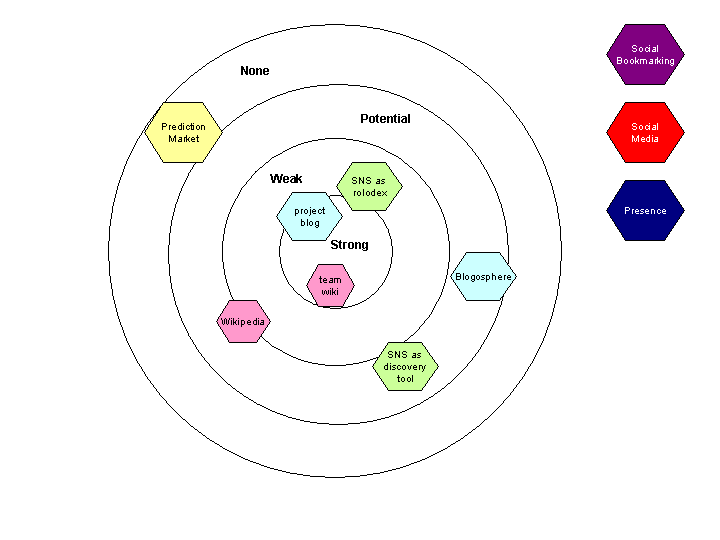
I have left a few tools - bookmarking, media (which includes Flickr, YouTube & podcasts) and Presence (Twitter, IM, SMS) to one side because I think they go all over the place - but where they go defines how they are used and what they mean.
So event attendees - have I got this right or wrong?
stabilisers
Luke was at the Enterprise 2.0 thang this morning and I caught up with him afterwards.
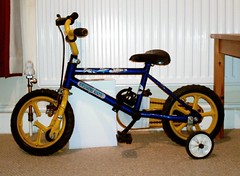
We talked about the governance / structure issues for social software activities inside the firewall. You want a little structure (policies, templates, limited usage) to begin with. Kinda like the stablisers (AKA training wheels)on this kid's bike. And then at some point you might want to take the structures away (or at least reduce them), because they are actually slowing you down. Now the first thing that happens when you take the stabilisers away is that the kid falls off the bike. And when this happens we learn our lesson and put an even bigger set of stabilisers on the bike and NEVER TAKE THEM OFF AGAIN. Don't we?
Well, we don't. We make sure the first time we take the stabilisers off, our kid is biking across nice, soft grass with nothing dangerous nearby. And we watch them fall off. And if each time we try this, the kid gets more stable then we breathe a sigh of relief. A few kids should never learn to cycle properly but they are in the minority.
Now my concern is that as we implement E2.0 tech and reduce the governance (coz we'll have to), a few incidents will occur and we'll swing back into clamp-down mode. This would be a bad thing. Plan for mistakes to be made. And make sure that the grass is nice and soft.
no touching
Patrick writes about touch. There is a hierarchy of senses in organisations. Sight is number one. Then hearing. Then smell and taste. And finally touch. The further we get from written language (semantic, numeric or diagrammatic) the less trustworthy the senses become.
Touch is the only sense that does not occur at a distance. Touch implies intent - when it's accidental we jump. An intent of contact and intimacy. It is less open to obfuscation than the other senses - "I didn't mean to see/hear that" won't cut it with touch. Which is one reason I think we tend to avoid it within organisations - we often need a get-out clause in our communications.
As Coleman Yee indicates in the post comments, touch can be all about power and abuse - "you have no choice but to accept my physical contact". We want our touches to be accepted by others, so touch can be about risk - the risk of being brushed aside, of our actions being interpreted as inappropriate or just plain wrong.
There's a gender issue here too. Touch between heterosexual men is tightly circumscribed. I'm not a big fan of group hugs.
Patrick, I think touch may be too close for us to handle. Certainly too unpredictable for our rigid change management methodologies and measurement systems.
Touch is the only sense that does not occur at a distance. Touch implies intent - when it's accidental we jump. An intent of contact and intimacy. It is less open to obfuscation than the other senses - "I didn't mean to see/hear that" won't cut it with touch. Which is one reason I think we tend to avoid it within organisations - we often need a get-out clause in our communications.
As Coleman Yee indicates in the post comments, touch can be all about power and abuse - "you have no choice but to accept my physical contact". We want our touches to be accepted by others, so touch can be about risk - the risk of being brushed aside, of our actions being interpreted as inappropriate or just plain wrong.
There's a gender issue here too. Touch between heterosexual men is tightly circumscribed. I'm not a big fan of group hugs.
Patrick, I think touch may be too close for us to handle. Certainly too unpredictable for our rigid change management methodologies and measurement systems.
Wednesday, February 13, 2008
social network analysis fun & games (2)
Krackhardt's Graph Theoretical Dimensions of Hierarchy; Density; E-I index; Cliques; N-cliques; N-clans; K-plexes; K-cores; F-groups; Lambda sets and bridges; Automorphic equivalence; Optimization by Tabu search; Two-mode SVD analysis...
The list goes on. SNA has its own arcane set of techniques and an equally arcane language to decribe them. Other forms of data mining have their own obscure vocabularies (CHAID, CART, k-Nearest-Neighbour) and they have been heavily used in the CRM world. As we have tended to think of customers as isolated actors, this kinda made sense - but if that assumption was once correct (and I doubt it was) then it is decreasingly true.
So can we use N-clans & E-I indexes to make more money? I mean sure we want to engage with customers, improve service, yadda yadda yadda but can they earn us cold, hard cash?
Tuesday, February 12, 2008
social network analysis fun & games (1)
Currently playing with various SNA tools:
- NetDraw - download it for free and have a play. I've pretty much got my head round the VNA data format and it generates cute pictures such as this:
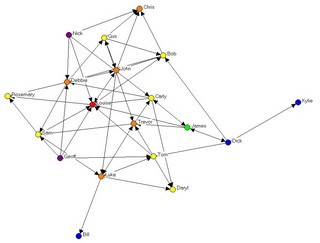
- Maje offers nifty 3D visualisations of social networks like this*:

- And now I am wrestling with UCInet. Whereas NetDraw gives you lots of pretty pictures, UCInet is all about social network ANALYSIS. The screen shots from UCInet would involve lots of numbers formatted in ASCII text. Not so much fun, oh no. Get your harcore SNA jollies here.
*My only beef with Maje is that whilst 3D visualisations look cool, they are pretty much useless from an analytics perspective.
Monday, February 11, 2008
identity mapping
Kim points to Michael Zimmer who points to Fred Cavazza who has created this:

Which is all good. Except that something in the design irks me. We have boxes and clean lines and no overlaps. It needs to be a bit more like Thomas Vander Wal's stack.
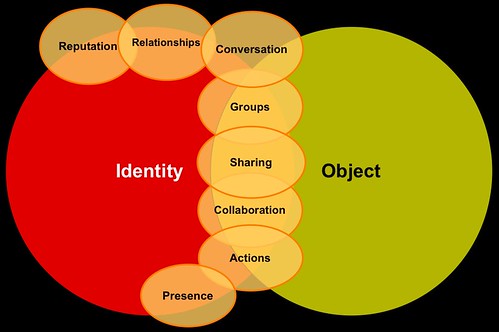
The elements of identity are not distinct and I may engage in more than one activity at one time. To extent can we keep these actions separate and would we want to anyway?
training management systems vs learning management systems
One familiar discussion/rant I get into with ABB concerns the difference between training management and learning management.
Training management operates at the level of courses (classroom or virtual), learners being another cog in the mechanism (along with content, budgets, schedules, performance agreements, etc). But whilst courses might train, they don't learn.
Learning management by its very nature works at the level of individual. Only I learn. But I do not learn in a vacuum. I learn with a context of others. My actual learning management system is a mix of blogs, wikis, RSS, books, coffee conversations, tags, networks, newspapers, magazine, drunken exchanges at bus stops, epiphanies whilst watching trash TV. I can (I have to) share some of it with you. But it eludes, evades, overwhelms a trad LMS. It is more like being washed away in the rip of a lifestream.
There is something inherently, annoyingly messy about learning. We need ways of making sense of it but any attempt to control it is doomed to fail.
This presentation by Stephen Downes says a lot of this (and much more) in a much prettier way.
Training management operates at the level of courses (classroom or virtual), learners being another cog in the mechanism (along with content, budgets, schedules, performance agreements, etc). But whilst courses might train, they don't learn.
Learning management by its very nature works at the level of individual. Only I learn. But I do not learn in a vacuum. I learn with a context of others. My actual learning management system is a mix of blogs, wikis, RSS, books, coffee conversations, tags, networks, newspapers, magazine, drunken exchanges at bus stops, epiphanies whilst watching trash TV. I can (I have to) share some of it with you. But it eludes, evades, overwhelms a trad LMS. It is more like being washed away in the rip of a lifestream.
There is something inherently, annoyingly messy about learning. We need ways of making sense of it but any attempt to control it is doomed to fail.
This presentation by Stephen Downes says a lot of this (and much more) in a much prettier way.
saddles for the horsemen
Starting here and ending here, Patrick Lambe talks his way out of an apocalyse (perhaps). This is PL at his best - erudite, thoughtful, practical, compassionate. I want to touch on Patrick's last post about struggle and the role of the consultant.
Struggle within an organisation to reach a goal (which may not have been the goal you started out for) is a wearing business. It takes its toll physically and mentally. And you cannot do it alone. Any kind of organisational change requires support from others - including outsiders. What help can we give each other, gentle readers?
What help and encouragement do you need from me, right here, right now?
It doesn’t rest on us alone, but on all those involved in the struggle, and those whom we encourage along the way.
Struggle within an organisation to reach a goal (which may not have been the goal you started out for) is a wearing business. It takes its toll physically and mentally. And you cannot do it alone. Any kind of organisational change requires support from others - including outsiders. What help can we give each other, gentle readers?
What help and encouragement do you need from me, right here, right now?
second life (2): get rid of the game designers
I suspect that most of the developers that work at Second Life have a background in games. Which is problem because SL is currently too gamer. In game design, you can't make things too easy otherwise you lose the players. There is an optimal level of difficulty and it is not zero. Except that for SL it should be zero - if it wants to attract non-gamers (i.e. me).
I am tired of bumping into walls. I am tired of not knowing how to get off the freakin' beginners' island. Stop making me play a game you *****. STOP IT!!!
I am tired of bumping into walls. I am tired of not knowing how to get off the freakin' beginners' island. Stop making me play a game you *****. STOP IT!!!
second life (1): learning in context
So I was having a coffee with the ever-engaging Anne Bartlett-Bragg and we were talking about Second Life. Neither of us are fans (bah humbug) but ABB outlined an interesting experience she had whilst teaching a bunch tradespeople to be trainers. She tried her damnest to pitch the Web 2.0 stuff (blogs, wikis, tagging, etc) and got a big yawn. So she showed them SL and they loved it. What they used it for was quite specific.
The motor mechanics and hairdressers didn't want SL to teach their apprentices how to strip down an engine or apply highlights. You can only do that with real hair or a real engine. Instead it would allow them to teach customer interaction skills with real people in an environment with visual cues. Because the people are real (enough).
The motor mechanics and hairdressers didn't want SL to teach their apprentices how to strip down an engine or apply highlights. You can only do that with real hair or a real engine. Instead it would allow them to teach customer interaction skills with real people in an environment with visual cues. Because the people are real (enough).
Sunday, February 10, 2008
melbourne
I will be in Melbourne from early on Friday 15 Feb (yes, this Friday) until the evening of Monday 18 Feb (yes, next Monday).
Drop me a line if you want to meet up - esp. if we have never met before.
Drop me a line if you want to meet up - esp. if we have never met before.
money's too tight to mention
Laurel hits something that's been the topic of several conversations of late - how an economic slowdown will impact the use of social software by people.
Hell yeah!
Maybe it's just me, but I believe the time to innovate is when the going gets tough.
Hell yeah!
The Phoric
Rob Patterson & Johnnie Moore hit us with The 'Phoric. Check it out.
For all you etymologists out there, the end of euphoria and metaphor comes from the Greek word pherein which means to bear or carry. Rob & Johnnie are using stuff we all know (i.e. movies) to do some of the work of carrying their ideas.
Fancy carrying this somewhere yourselves?
For all you etymologists out there, the end of euphoria and metaphor comes from the Greek word pherein which means to bear or carry. Rob & Johnnie are using stuff we all know (i.e. movies) to do some of the work of carrying their ideas.
Fancy carrying this somewhere yourselves?
watts redux (2): influentials
Watts has also critiqued the influentials or two-step model (not to be confused with this). The mass media model posits an atomistic world where TV/newspapers/etc reach individuals (kinda like the Protestant view of Christianity, with the Marketer as God). The influencer model inserts a layer of intermediaries (like Catholicism with its Priesthood) who are especially influential. All the marketer has to do is reach the influencers and they then spread the message to everyone else.
Reading the paper available via the link above (and not pretending to understand it all), a few things stick out:
- In the models that Watts & Dodds build, influencers do have a role - but that role is dwarfed by the influence of the wider environment.
- Having a bunch of people who are susceptible to your message is more important than influencers (does this mean that followers are more important than leaders?).
- Rather than trying to reach influencers, how do you go about trying to first understand the environment of your audiences?
- It implies that you need multiple ways of intervening in this environment, rather than just dropping a line to some influential people.
watts redux (1): virals
Duncan Watts is getting a boost courtesy of this Fast Company article. For those of you after meatier stuff, the much of the original research mentioned can be found here. Now for some reflections...
Viral marketing campaigns mostly fail - i.e. they don't end up generating the huge amounts of buzz. Which is exactly what you would expect in a complex environment - the success of the viral campaign is at the mercy of its environment.
Watts, Peretti & Frumin discuss their concept of Big Seed marketing which basically adds some viral/sociable characteristics to a mass-marketing campaign. I'd like to take a different tack.
Going back to the viral metaphor, one reason that viruses can be so difficult to control is that they mutate and reproduce with unbelievable speed. They are in a constant state of "beta" (one for the nerds there). Most viral marketing campaigns are very unviral in this respect. The agency crafts a brilliant viral artifact and expects people to pass it on.
You don't want invest in creating a single, sterile virus - because the odds are that it will fail. Instead you want to create a virus-generating engine (which, when you think about it, is all a real virus is), something that will create lots of social objects connected to your product/brand. Most of these objects will remain immobile, a tiny fraction will spread.
Ten years ago, that would have been impossible. Thanks to the world of user-generated media, that is no longer the case. People are creating social objects by the truckload every day. A few points:
Viral marketing campaigns mostly fail - i.e. they don't end up generating the huge amounts of buzz. Which is exactly what you would expect in a complex environment - the success of the viral campaign is at the mercy of its environment.
Watts, Peretti & Frumin discuss their concept of Big Seed marketing which basically adds some viral/sociable characteristics to a mass-marketing campaign. I'd like to take a different tack.
Going back to the viral metaphor, one reason that viruses can be so difficult to control is that they mutate and reproduce with unbelievable speed. They are in a constant state of "beta" (one for the nerds there). Most viral marketing campaigns are very unviral in this respect. The agency crafts a brilliant viral artifact and expects people to pass it on.
You don't want invest in creating a single, sterile virus - because the odds are that it will fail. Instead you want to create a virus-generating engine (which, when you think about it, is all a real virus is), something that will create lots of social objects connected to your product/brand. Most of these objects will remain immobile, a tiny fraction will spread.
Ten years ago, that would have been impossible. Thanks to the world of user-generated media, that is no longer the case. People are creating social objects by the truckload every day. A few points:
- Viruses are by their very nature uncontrollable. Epidemics do not spread under the command of a master virus with its base in an extinct volcano somewhere.
- As Watts & co point out, viral marketing and mass marketing are not antithetical. You probably need some way of combining the two.
- How do you measure the effectiveness of virals. Again the Watts & co paper has some interesting measures. But you need a way of quickly sensing your environment to see which objects are spreading and which are not.
Some organisations are already doing this. Who are they?
Friday, February 08, 2008
measurement in complex systems
Further to the previous post, why do we measure? Operationally the main reason we need information to make decisions (indeed to find out if we need to make a decision in the first place). Quantitative information is needed to work out how much of something we need to do.
Now in ordered systems, that's straight-forward. My car is 2 litres low on oil. So I add 2 litres of oil. Job done.
The issue is that many systems are not ordered and these complex systems have 2 annoying properties:
Now in ordered systems, that's straight-forward. My car is 2 litres low on oil. So I add 2 litres of oil. Job done.
The issue is that many systems are not ordered and these complex systems have 2 annoying properties:
- Input-output may not be linear. A small change to the system may have a big (even catastrophic) effect.
- By measuring the system we may actually change its state - e.g. sending out an employee engagement survey may actually raise or lower employee engagement.
So these 2 properties require us to:
- Measure the system more regularly when we make changes so we can understand whether our impact is greater or smaller than expected. We need to sense it.
- Use plenty of indirect measures that are less likely to be disturbed by our intervention.
Now I believe that the social media ecosystem is more often a complex environment than it is a simple one. So we need measurement systems that fulfil the 2 criteria above.
A little
Often
And off to one side.
Let me go off and find some examples of what these might be. One example might be the monitoring of tag clouds.
Thursday, February 07, 2008
how long is a piece of string? (and who does it join?)
So the recent posts by Gav & Katie have mingled in my brain with the SNA work I have been doing.
Trad market research is based demographics. Although it lumps people together in groups (by age, location, wealth, gender, race, etc), it tells us little about how they interact with each other.
As Gav well knows, audience 2.0 isn't really an audience. An audience sits in the dark, only joined to each other by what they observe. This audience is noisy, they jump out of their seats. They interrupt the play. The critical thing about social media is that it's, well, social. What you have is more like a football terrace or a dance hall than a theatre/cinema/TV audience.
In SNA, you have two sets of measures:
Trad market research is based demographics. Although it lumps people together in groups (by age, location, wealth, gender, race, etc), it tells us little about how they interact with each other.
As Gav well knows, audience 2.0 isn't really an audience. An audience sits in the dark, only joined to each other by what they observe. This audience is noisy, they jump out of their seats. They interrupt the play. The critical thing about social media is that it's, well, social. What you have is more like a football terrace or a dance hall than a theatre/cinema/TV audience.
In SNA, you have two sets of measures:
- Attributes of nodes - i.e. characteristics of entities or demographics if we're talking about people (which we may not be).
- Attributes of links between nodes. Now a link between nodes is simply an interaction between them. We might have edited the same wiki page, we might communication in some fashion once a week about tennis, we might be having sex every night.
As a network analyst, you are often concerned with the interplay between node & link data - e.g. do 20-something males talk to more people more frequently on the topic of, say, organisational change. Or aftershave.
Link data is normally collected in 2 ways:
- Surveys of network participants - with all the problems of surveys (e.g. deliberate lying, wishful thinking, inaccurate recall).
- Automated collection of data (e.g. email usage patterns). In absolute terms, these are more reliable but give you no access to subjective evaluations of interactions - e.g. "that email was useful for me".
If we are going to understand the social media environment we need a solid understanding of 2. as well 1. There are several impediments to this:
- Collecting link data has traditionally been a lot harder than demographic data.
- Link data that is easy to collect is often difficult to interpret ("was that email exchange positive or negative?").
- Network-based metrics are poorly understood by marketers (in fact, by everyone).
- SNAs have tended to break down when you get more than 200+ participants - which in the consumer space is piddling. There are ways round this however.
Understanding social media and herd behaviour requires us to revolutionize our measurement techniques. Are we ready for that?
cooking the books
I like analysing data*. And I also like to cook*. It only hit me recently that these two passions may be linked.
*I like it but I don't always do it well.
- Both of them require an attention to detail balanced with a focus on outcome.
- Both (to an extent) involve losing yourself in another world.
- And with both, either things work or they don't. There are steps to be taken if they don't work out but ultimately you have to bin it.
- Both do not require managing or persuading other people to do stuff (once you have your ingredients).
- And both are best when the results are presented to other for appreciative consumption.
*I like it but I don't always do it well.
Wednesday, February 06, 2008
i am spam
I accidently cc:ed myself into an email I sent and it ended up in my spam folder.
Is YahooMail trying to tell me something?
Is YahooMail trying to tell me something?
Sunday, February 03, 2008
submarine scheme
On Friday afternoon I get a call from Chris M:
"What are you doing at 7:30 tomorrow morning?"
"Normally I am in bed."
"How do you fancy a tour of an active sub?"
"Sure."
So I find myself getting a tour of HMAS Rankin. Submarines are cramped. Very cramped. Definitely not for the claustrophobic. The submariners I met were some of the most laid-back, calm people I have encountered. You are stuck with other people in a confined space for up to 3 months so it helps if you aren't a jerk.
Could you cope with being in a submarine with your colleagues for 3 months at a stretch?
"What are you doing at 7:30 tomorrow morning?"
"Normally I am in bed."
"How do you fancy a tour of an active sub?"
"Sure."
So I find myself getting a tour of HMAS Rankin. Submarines are cramped. Very cramped. Definitely not for the claustrophobic. The submariners I met were some of the most laid-back, calm people I have encountered. You are stuck with other people in a confined space for up to 3 months so it helps if you aren't a jerk.
Could you cope with being in a submarine with your colleagues for 3 months at a stretch?
Subscribe to:
Posts (Atom)

 Posts
Posts

